Mercedes-Benz CLK-Klasse Сoupé 1997
Presented at the Detroit auto show in January 1997, the Mercedes-Benz CLK Coupé introduced the first generation of the CLK family, internally identified as the C 208. This four-seat coupé used the new four-headlamp face associated with the contemporary E-Class W 210, while much of its underlying architecture came from the smaller C-Class. Its role was to combine Mercedes-Benz touring comfort with a more distinctive and sporting two-door shape than a conventional saloon. The launch range included the CLK 200, CLK 230 Kompressor and CLK 320, with V8-powered versions joining the line later. Built at Bremen, the C 208 remained in production until 2002 and became one of the most successful Mercedes coupés of its period.
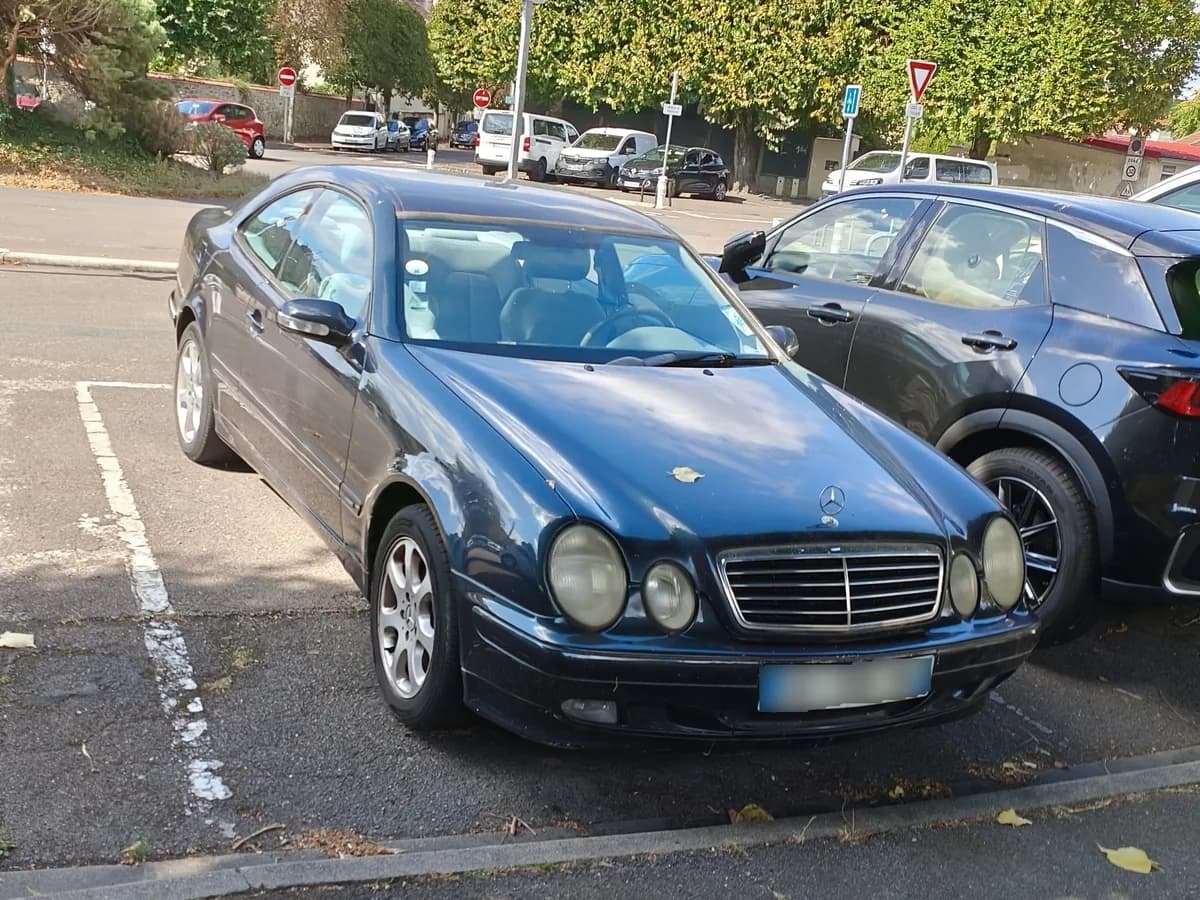
Curious about this car?
Explore CLK-Klasse, then try your own photo.
No account needed for the result · Publish only if you choose
History
The CLK story began before the production car. In March 1993, Mercedes-Benz showed a four-seat coupé study at the Geneva motor show to introduce the public to several new design ideas, including the four-headlamp front end and a smooth, rounded body. The production car unveiled in Detroit in January 1997 followed that concept remarkably closely, an unusual degree of continuity for the period. Mercedes-Benz positioned it within a broader expansion of its model range that also included the SLK roadster, the A-Class and the forthcoming M-Class.
Under the skin, the CLK C 208 shared its platform and several major components with the C-Class, but its body, interior and calibration gave it a separate character. It indirectly replaced the previous E-Class coupés derived from the 124 series rather than simply becoming a two-door E-Class. Early equipment lines were called Sport and Elegance. The A 208 convertible joined the family in 1998, while the coupé continued to develop until the C 209 generation replaced it.
Latest scans
Photos added by the community for this page.
Anecdotes
The production CLK was preceded by a concept shown in Geneva in 1993. Mercedes-Benz described it as the company’s first show car, created to preview new styling themes to the public. The connection between the concept and the 1997 coupé was unusually close, especially in the front-end treatment and the overall shape of the body.
Production
Production of the 208-series CLK Coupé took place at Bremen. Mercedes-Benz reports that 233,367 examples were built over roughly five years, through May 2002. This figure applies to the 208-series coupé and does not combine it with the separately produced CLK convertibles. The manufacturer also identifies the CLK 320 as the most numerous version, with 68,778 units produced. These figures place the C 208 among the commercial successes of Mercedes-Benz’s product expansion during the 1990s. The cited source does not provide a complete breakdown by production year, market or engine, so more detailed totals should be treated cautiously.
Press reception
Contemporary reactions were broadly positive, although they recognized the compromise built into the car’s mission. In a November 1997 road test, Ward’s Auto described the CLK as another success for a Mercedes-Benz undergoing a major renewal, despite a coupé market that was not especially strong. British motoring coverage likewise emphasized its comfort, perceived quality and polished road manners, while noting that its C-Class underpinnings could make it feel less sporting than some rivals. In retrospect, the C 208 is chiefly remembered for making the Mercedes coupé concept more accessible and for combining luxury presentation, compact architecture and a broad choice of engines.
Evolution
The C 208 range expanded soon after its launch. The initial line-up combined the four-cylinder CLK 200, the supercharged CLK 230 Kompressor and the six-cylinder CLK 320. Mercedes-Benz later added the CLK 430 with a V8 engine, followed by the CLK 55 AMG, which became the most powerful member of the series. Mid-cycle changes focused on engines, equipment and presentation while preserving the original body design. The convertible introduced in 1998 belonged to the same technical family but carried the A 208 designation. The coupé version remained in production until 2002, when the second-generation C 209 took its place.
Variants
References
- Coupé-Premiere im Januar 1997: Mercedes-Benz CLK der Baureihe 208Mercedes-Benz Österreich / Mercedes-Benz Classic
Supports the January 1997 Detroit debut, the 1993 coupé study, the C-Class technical basis, Sport and Elegance lines, engine range, production total, Bremen assembly and CLK 320 production figure.
- Mercedes-Benz CLK model series 208: coupé premiere in January 1997Mercedes-Benz Classic archive document
Supports the model series debut at the North American International Auto Show in Detroit and identifies period archive images of the CLK 200, CLK 230 Kompressor, CLK 320, CLK 430 and CLK 55 AMG.
- Mercedes CLK (W208) C208, A208: technical dataAuto Motor und Sport
Supports the listed engine displacements and power outputs for the C 208 range, including CLK 200, CLK 230 Kompressor, CLK 320, CLK 430 and CLK 55 AMG.
- ‘Entry-Level’ CLK is Still a MercedesWard’s Auto
Supports contemporary press reaction to the 1997 CLK and its reception as a successful new Mercedes model.
- Mercedes-Benz CLK-Class (1997–2002) used car reviewRAC Drive
Supports the model’s positioning between compact and executive Mercedes ranges, its C-Class platform basis, and period observations about comfort and road manners.
- https://www.automobile-catalog.com/make/mercedes-benz/208_clk_class/c-208_clk_coupe/1997.htmlautomobile-catalog.com
Source found by OpenAI web search for this vehicle page.
- https://australiancar.reviews/review-mercedes-benz-c208-clk-coupe-1997-02/australiancar.reviews
Source found by OpenAI web search for this vehicle page.
- https://mb-france.mercedes-benz-clubs.com/wp-content/uploads/sites/21/2020/05/E-Klasse-Cabriolet-Coupe.pdfmb-france.mercedes-benz-clubs.com
Source found by OpenAI web search for this vehicle page.