McLaren F1 GTR 1995
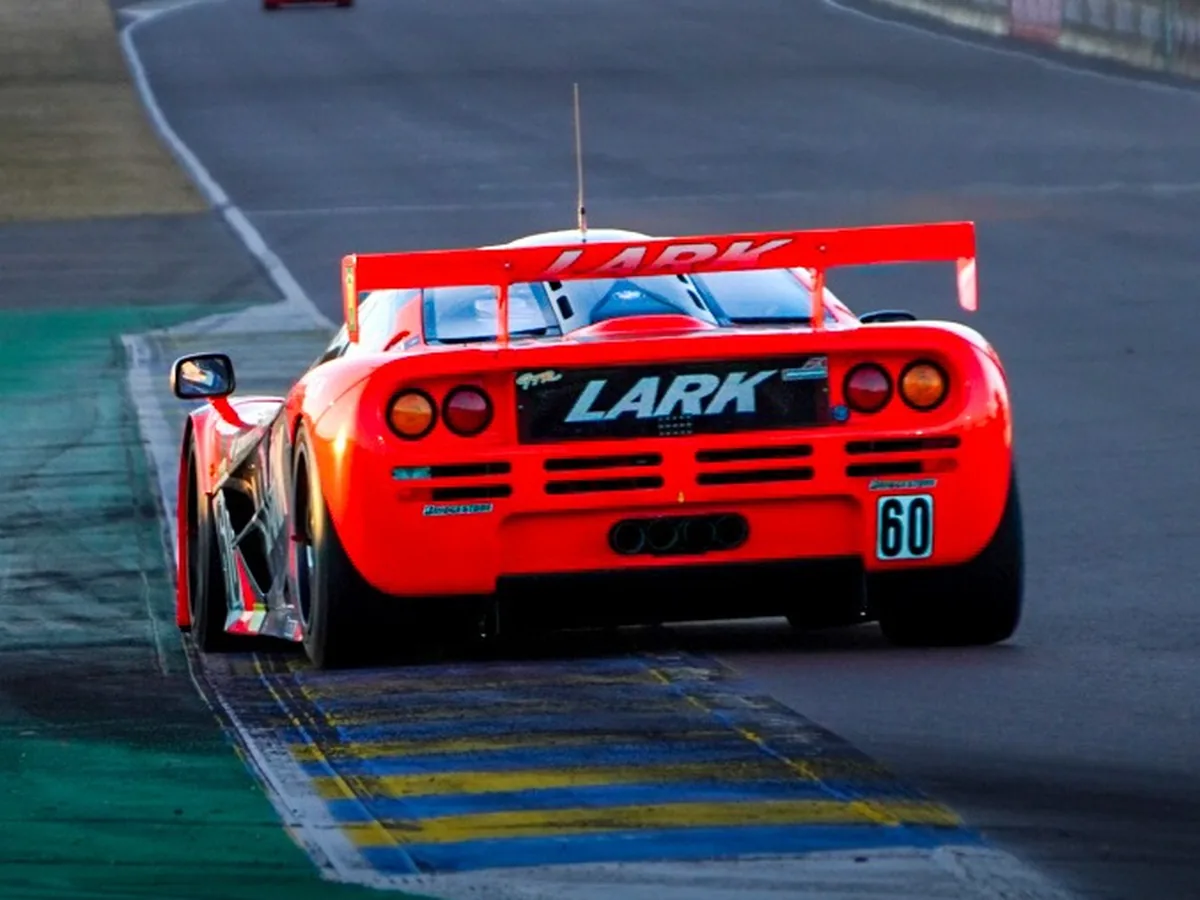
The 1995 McLaren F1 GTR is a racing derivative of the road-going F1, developed for international grand touring competition and entered notably in the BPR Global GT Series. Its creation followed requests from customers who wanted to race Gordon Murray’s supercar. Although the car remained closely related to the production F1, it received a steel roll cage, revised suspension, quicker steering, competition brakes and dedicated aerodynamic equipment. The regulations also required an engine air restrictor, so the race car produced slightly less power than the unrestricted road model. Its debut season became one of the defining stories of modern endurance racing: in June 1995, an F1 GTR won the 24 Hours of Le Mans on McLaren’s first appearance in the event.
History
The F1 GTR emerged from customer demand rather than from a competition program planned when the McLaren F1 was launched. Racing driver Ray Bellm and F1 owner Thomas Bscher were among those who encouraged McLaren to enter the BPR Global GT Series, an endurance championship for grand touring cars. Once Ron Dennis approved the idea, Gordon Murray’s team had only a short period in which to convert the road car for the 1995 season.
The changes remained deliberately close to the original design. The F1 GTR retained its carbon-fibre structure, central driving position and naturally aspirated BMW engine, but much of the road car’s comfort equipment was removed. A steel roll cage, revised suspension, quicker steering, competition brakes and additional aerodynamic components were introduced for circuit use. McLaren also arranged endurance testing to expose weaknesses before the major races.
Seven F1 GTRs started the 1995 24 Hours of Le Mans. The Kokusai Kaihatsu Racing entry, driven by Yannick Dalmas, J.J. Lehto and Masanori Sekiya, won in exceptionally wet conditions. Four other McLarens finished among the first five, providing an unusually strong result for a new racing model and validating the decision to base the car so closely on the production F1.
Latest scans
Photos added by the community for this page.
Anecdotes
The 1995 Le Mans victory carried several historical distinctions. McLaren won the race on its first appearance, while the F1 GTR won the event during its first year of production. The result also marked the first Le Mans victory for a Finnish driver, J.J. Lehto, and for a Japanese driver, Masanori Sekiya. McLaren’s heritage account records exceptionally difficult conditions, with rain falling for roughly sixteen hours of the 24-hour race.
Production
Production of the 1995 F1 GTR was limited and focused entirely on competition use. Specialist historical sources generally identify nine chassis built to the 1995 specification. Chassis 01R was initially used by McLaren for development before being entered at Le Mans by Kokusai Kaihatsu Racing, where it achieved the overall victory. The remaining cars were supplied to customer teams competing in grand touring championships and endurance races.
This figure refers to chassis built in 1995 specification and should not be confused with the total number of F1 GTRs produced across all model years. McLaren subsequently developed 1996 and 1997 versions, and some earlier cars were later upgraded. The importance of the first series therefore comes from both its limited production and its position as the original F1 GTR configuration.
Press reception
The 1995 F1 GTR’s reception was shaped primarily by its results rather than by an established racing reputation. Specialist publications and McLaren’s heritage archives emphasize the significance of its Le Mans victory on debut, together with four additional McLarens finishing among the first five. The achievement was particularly notable because the F1 GTR remained closely related to a road car and had to operate with power restricted by the regulations.
Its consistency in the 1995 Global GT championship was also widely recognized. McLaren records that the model secured the title through reliable points-scoring, even though the championship-winning car won only two races. The combination of speed, endurance reliability and technical similarity to the production F1 helped make the first GTR one of the most influential grand touring racing cars of its era.
Evolution
Variants
References
- F1 GTRMcLaren Racing Heritage
Supports the car’s development, race configuration, power restriction, 1995 Le Mans result, wet-weather conditions and Global GT championship context.
- McLaren Trophies: Le Mans, 1995McLaren Racing Heritage
Supports McLaren’s first Le Mans victory and the strong finishing record of the F1 GTR entries.
- The McLaren F1 GTR at Le Mans: Key dates 1995-199824 Hours of Le Mans
Supports the 1995 Le Mans result and the number of F1 GTRs finishing near the front.
- McLaren F1 GTRUltimatecarpage.com
Supports the distinction between the 1995-1996 specification and the model’s competition identity.
- McLaren F1 GTRWikipedia
Used cautiously for the commonly cited production count of nine 1995-specification chassis and the broader specification history; cross-checked against specialist chassis references.
- https://www.motorsportmagazine.com/special-article/twice-around-the-clock/92/the-story-of-how-the-mclaren-f1-conquered-le-mans-in-1995/motorsportmagazine.com
Source found by OpenAI web search for this vehicle page.
- https://en.wikipedia.org/wiki/McLaren_F1en.wikipedia.org
Source found by OpenAI web search for this vehicle page.
- https://www.motorsportmagazine.com/articles/100-years-of-le-mans/a-le-mans-fairytale-1995-victory-for-mclaren-f1-that-was-never-designed-to-race/motorsportmagazine.com
Source found by OpenAI web search for this vehicle page.