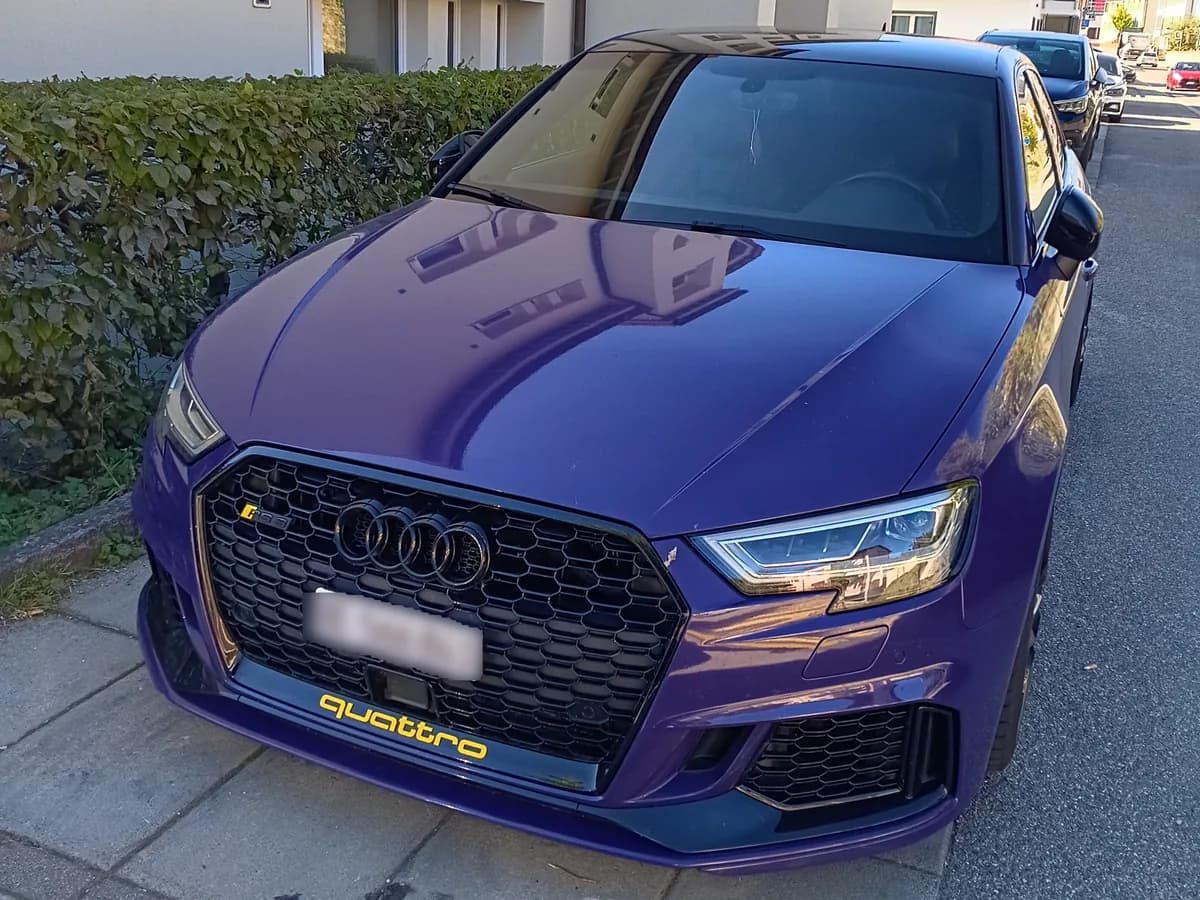
Audi RS3 Sedan 2024
Updated in 2024, the Audi RS3 Sedan retains its 294 kW (400 PS), 500 Nm 2.5-litre turbocharged five-cylinder engine. Quattro all-wheel drive, the rear-axle torque splitter and a seven-speed S tronic transmission support a chassis retuned for greater cornering precision.

Curious about this car?
Explore RS3, then try your own photo.
No account needed for the result · Publish only if you choose
History
The modern Audi RS3 is derived from the A3 family and serves as the entry point to the Audi Sport range. The current generation introduced an active rear-axle torque splitter in 2021. The 2024 update refines the styling, chassis control systems and tyres while retaining the same maximum output.
Latest scans
Photos added by the community for this page.
Editorial photos
Manufacturer press photos, relayed by ScanRacer until the community shoots this car.
Technical data
Official Audi technical data for the RS3 Sedan, matched precisely to this version and model year.
Compare powertrains
Pick a powertrain: the detailed sheet below follows your selection.
| Criterion | ||
|---|---|---|
| Power | 294 kW | 294 kW |
| Torque | 500 Nm | 500 Nm |
| 0-100 km/h | 3.8 s | 3.8 s |
| Top speed | 250 km/h | 290 km/h |
| Consumption | 9.3–8.9 l/100 km | 9.4–9.1 l/100 km |
| CO₂ | 210–201 g/km | 213–207 g/km |
| Unladen weight | 1,565 kg | 1,565 kg |
| Drivetrain | All-wheel | All-wheel |
| Boot | 321 l | 321 l |
Showing: main
Performance
- System output
- 294 kW
- System torque
- 500 Nm
- 0-100 km/h
- 3.8 s
- Top speed
- 250 km/h
Combustion engine
- Layout
- Inline 5-cylinder engine
- Displacement
- 2,480 cm³
- Bore × stroke
- 82.5 × 92.8 mm
- Compression ratio
- 10
- Engine output
- 294 kW
- Engine torque
- 500 Nm
- Emission standard
- Euro 6e-bis
- Fuel
- Gasoline
Consumption and emissions
- WLTP consumption
- 9.3–8.9 l/100 km
- CO₂ emissions
- 210–201 g/km
- CO₂ class
- G
Drivetrain
- Transmission
- 7-speed S tronic
- Drive type
- All-wheel drive
- Rear differential
- Torque splitter
Chassis and brakes
- Front suspension
- McPherson struts, front, adjustable coilover suspension
- Rear suspension
- 4-link rear axle, adjustable coilover
- Steering
- Electromechanical progressive steering with speed-dependent power assistance
- Steering ratio
- 14.5
- Turning circle
- 12 m
- Brake discs front / rear
- 380 / 310 mm
- Wheels
- Cast aluminum flow forming 9 J x 19 | Cast aluminum 8 J x 19
- Tyres
- 265/30 ZR 19 | 245/35 ZR 19
Dimensions and volumes
- Length
- 4,533 mm
- Width (excl. mirrors)
- 1,851 mm
- Width (incl. mirrors)
- 1,984 mm
- Height
- 1,393–1,418 mm
- Wheelbase
- 2,629 mm
- Track front / rear
- 1592 / 1524 mm
- Boot
- 321 l
- Doors / seats
- 4 / 5
- Drag coefficient Cd
- 0.32
- Body structure
- Unitary steel
Weights and loads
- Unladen weight
- 1,565 kg
- Unladen weight with driver
- 1,640 kg
- Gross weight limit
- 2,055 kg
- Axle load front / rear
- 1105 / 1055 kg
- Roof load
- 75 kg
- Fuel tank
- 55 l
Source: Audi
Anecdotes
The five-cylinder uses a 1-2-4-5-3 firing order that contributes to the RS3’s distinctive soundtrack.
Production
Figures correspond to the Audi Germany programme, using technical data sheets dated March and July 2026.
Press reception
Audi validated the chassis update with a 7:33.123 compact-class lap record on the Nordschleife in 2024.
Evolution

Variants

References
- Audi RS3 SedanAudi
Official model presentation, images and technical data
- A feast for the senses: upgrade for the Audi RS 3Audi MediaCenter
Official 2024 product update press release