
Sport Spider
Unveiled at the 1995 Geneva Motor Show, the Renault Sport Spider is a two-seat, mid-engined roadster built around a deliberately simple idea: remove anything not essential to driving. Its aluminium chassis, open body and stripped-out cockpit make it closer in spirit to a road-legal competition car than to a conventional convertible. The road version uses a 1,998 cc four-cylinder petrol engine producing 150 hp, while assembly took place at the Alpine factory in Dieppe. The Spider also holds a special place in Renault history as the first road-going model to carry the Renault Sport name. In the ScanRacer catalogue, the model is represented by a single Base version associated with the 1995 model year.
Variants by year
1995
Model summary
Data from the ScanRacer library, organized to compare versions quickly.
Model introduction
Unveiled at the 1995 Geneva Motor Show, the Renault Sport Spider is a two-seat, mid-engined roadster built around a deliberately simple idea: remove anything not essential to driving. Its aluminium chassis, open body and stripped-out cockpit make it closer in spirit to a road-legal competition car than to a conventional convertible. The road version uses a 1,998 cc four-cylinder petrol engine producing 150 hp, while assembly took place at the Alpine factory in Dieppe. The Spider also holds a special place in Renault history as the first road-going model to carry the Renault Sport name. In the ScanRacer catalogue, the model is represented by a single Base version associated with the 1995 model year.
History
The Sport Spider project emerged in the early 1990s, when Renault was looking to reinforce its sporting image. The Laguna concept shown in 1990 had already explored the idea of a mid-engined roadster and was the first car to display the Renault Sport badge. A Spider prototype was subsequently developed at the Alpine factory in Dieppe before the production model made its public debut at the 1995 Geneva Motor Show. The design focused on low weight and direct driver involvement. The Spider used an aluminium structure, a transversely mounted four-cylinder engine positioned behind the occupants and a composite body. Equipment was intentionally limited: power steering, ABS, conventional heating and several comfort features were outside the car’s core brief. Early examples used an aeroscreen, while a full windscreen version was also offered and became the more common configuration according to Renault. The project also had a clear motorsport connection through the Renault Sport Spider Trophy, a one-make series based on a dedicated competition version. Production of both road cars and race cars remained limited. Renault gives a total of 1,726 vehicles built between 1995 and 1999, including Trophy cars. The Sport Spider therefore introduced a Renault Sport road-car identity that was later carried forward by the Clio and Mégane performance models.
Generations
The Renault Sport Spider is not officially divided into several generations. It represents a single production series built at Dieppe from 1995 to 1999. This distinction matters when comparing cars: the main differences between examples concern body configuration, equipment and intended use rather than a complete generational redesign. The most important road-car distinction is the type of wind protection. One configuration uses an aeroscreen and preserves the most uncompromising appearance, closely connected to the car’s competition origins. Another uses a full windscreen, making the Spider more practical on public roads and becoming the more widely produced configuration. Renault states that the windscreen version adds approximately 35 kg. Both configurations retain the same basic layout, with a rear-mid engine, rear-wheel drive, aluminium chassis and a 1,998 cc four-cylinder petrol engine producing 150 hp. The Trophy version sits alongside the road cars as a competition derivative rather than a separate generation. It can be identified by features including its roll cage and its uprated 180 hp engine. The ScanRacer entry covered here lists only a Base version for 1995. It is therefore more accurate to describe the model as one short production series with body and competition variants than as a multi-generation range.
Key differences
The most visible difference between Sport Spiders is the type of wind protection. Aeroscreen cars have a more open profile and a presentation closer to a racing machine. Full-windscreen cars are easier to use on public roads and are described by Renault as the more widely produced configuration. This change does not alter the fundamental mechanical layout. Road cars must also be separated from the Spider Trophy competition cars. Trophy examples can feature a more substantial roll cage and an engine producing 180 hp. They should not be treated as a higher road-going trim level of the Base model. The available evidence does not support multiple generations, year-by-year engine changes or a major body redesign. For reliable identification, the presence or absence of a full windscreen, the safety equipment and the car’s intended use are more useful clues than the 1995 date alone.
Photo recognition
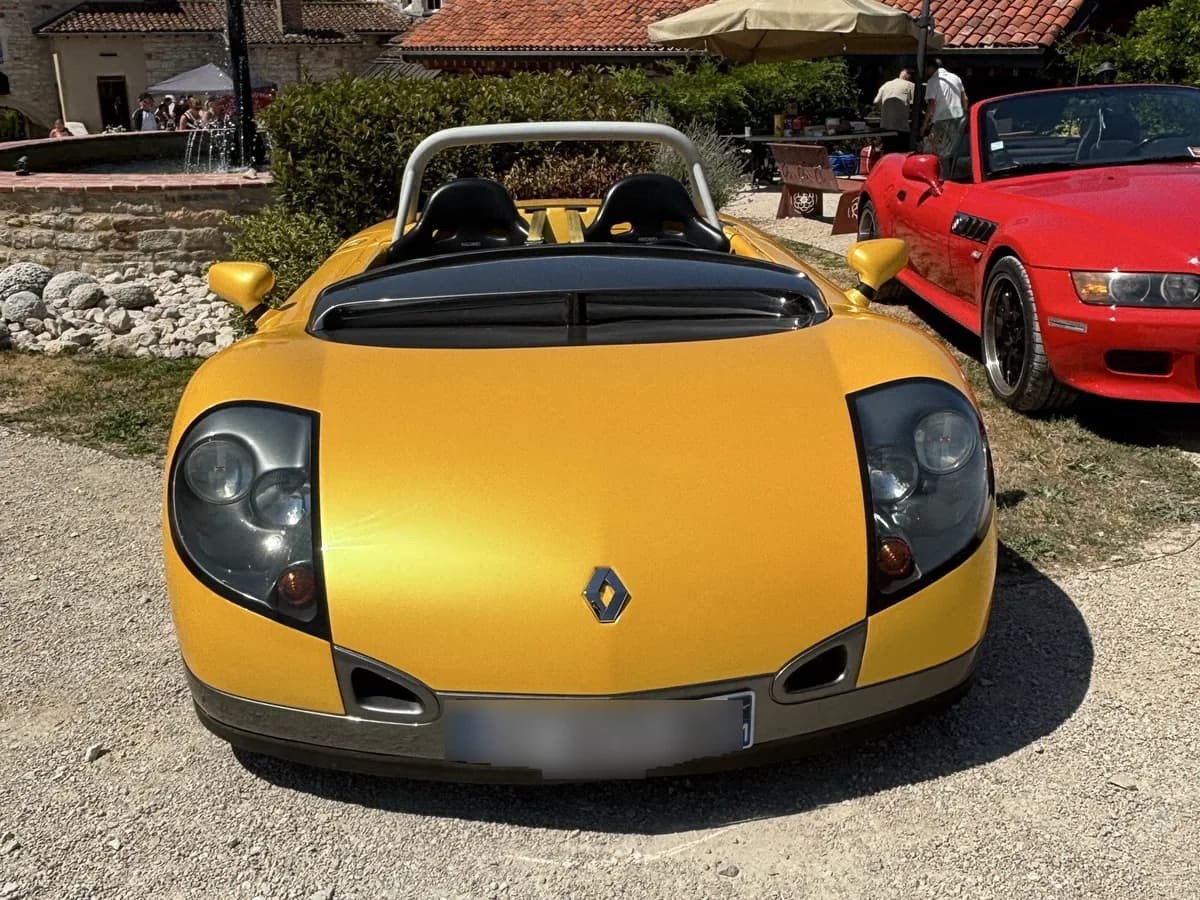
The Sport Spider is immediately recognizable by its very low profile, two-seat cabin and vertically opening doors. Its body is deliberately sparse, with visually separate front and rear fenders and a roll bar behind the occupants. Aeroscreen cars have only a small wind deflector in front of the driver and passenger, while full-windscreen cars use a complete glass screen with a wiper. The engine sits in a rear-mid position, helping create the short nose and forward-set cabin. Wheels, paint colours and trim details may vary and are not sufficient on their own to establish a version. Track-prepared cars also require caution, especially when the roll cage, seats or aerodynamic parts no longer match the original road configuration. A Renault Sport badge, an open body without a fixed roof and the absence of conventional comfort equipment are useful clues. Final identification should nevertheless be checked against the vehicle’s documentation and chassis number, particularly when distinguishing a road car from a Trophy competition example.
Important versions
The Base road version is the primary reference for the 1995 model year in the ScanRacer catalogue. It uses the 2.0-litre four-cylinder engine producing 150 hp and drives the rear wheels. Depending on specification, it may be fitted with an aeroscreen or a full windscreen; this body distinction does not represent a separate generation. The Trophy is the most important derivative to know outside the road-car range. Developed for a one-make racing series, it received dedicated competition equipment, a roll cage and an engine rated at 180 hp. Renault states that 90 Trophy cars were produced. It should be treated as a racing derivative of the Spider rather than as a conventional optional trim of the Base model.
The name “Sport Spider” follows Renault naming, with its rules and its exceptions. Decode a Renault name
References
- Renault Sport SpiderThe Originals Renault Museum
- 25 Jahre Renault Sport SpiderRenault Austria Press
- https://www.auto-data.net/en/renault-sport-spider-generation-2157auto-data.net
- https://www.reddit.com/r/sportsandclassiccars/comments/1shrbn4/the_renault_sport_spider_was_conceived_as_a/reddit.com
- https://www.reddit.com/r/WeirdWheels/comments/1u4qsm1/renault_sport_spider_track_special_that_brought/reddit.com
- https://www.reddit.com/r/regularcarreviews/comments/1u5ndc6/renault_sport_spider_the_official_car_of/reddit.com
Technical specifications
Structured data available for versions linked to this model.
| Version | Power | Torque | Top speed | Drivetrain | Fuel |
|---|---|---|---|---|---|
| Base | 110 KW @ 6000 RPM 150 HP @ 6000 RPM 148 BHP @ 6000 RPM | 137 lb-ft @ 4500 RPM 186 Nm @ 4500 RPM | 133.6 mph (215 km/h) | Rear Wheel Drive / 5-Speed manual | Gasoline |
Frequently asked questions
- What years was the Renault Sport Spider produced?
- ScanRacer's referenced versions cover 1995.
- How many Renault Sport Spider examples are documented on ScanRacer?
- 4 published scans from 4 members, with the latest photo added in August 2026.
- What is the power output of the Renault Sport Spider?
- The sourced technical data lists 110 KW @ 6000 RPM 150 HP @ 6000 RPM 148 BHP @ 6000 RPM.