
Rafale
The Renault Rafale is a D-segment coupe-SUV introduced in 2023 as the brand’s new high-end model. Measuring 4.71 metres in length, it uses the Alliance’s modular CMF-CD platform and shares core architecture with the Renault Austral and Espace, while receiving its own bodywork and design language. Its fastback profile combines a long bonnet, pronounced rear shoulders and a sloping roofline. The Rafale was launched with a 200 hp E-Tech full-hybrid petrol powertrain and a multimode automatic transmission. A 300 hp E-Tech 4x4 plug-in hybrid subsequently broadened the range. The name refers to the Caudron-Renault C.460, a 1930s racing aircraft. Renault selected it to connect the vehicle with ideas of aerodynamics, speed and technical innovation, rather than to continue an earlier passenger-car model line.
Variants by year
2023
Model summary
Data from the ScanRacer library, organized to compare versions quickly.
Model introduction
The Renault Rafale is a D-segment coupe-SUV introduced in 2023 as the brand’s new high-end model. Measuring 4.71 metres in length, it uses the Alliance’s modular CMF-CD platform and shares core architecture with the Renault Austral and Espace, while receiving its own bodywork and design language. Its fastback profile combines a long bonnet, pronounced rear shoulders and a sloping roofline. The Rafale was launched with a 200 hp E-Tech full-hybrid petrol powertrain and a multimode automatic transmission. A 300 hp E-Tech 4x4 plug-in hybrid subsequently broadened the range. The name refers to the Caudron-Renault C.460, a 1930s racing aircraft. Renault selected it to connect the vehicle with ideas of aerodynamics, speed and technical innovation, rather than to continue an earlier passenger-car model line.
History
Renault unveiled the Rafale on 18 June 2023 at the Paris Air Show, an appropriate setting for a model whose name is tied to the company’s aviation heritage. The name had been announced several weeks earlier, in May 2023. It was new as a Renault passenger-car name, but not new to the company’s industrial history. After Louis Renault acquired Caudron in 1933, the Caudron C.460 was renamed Rafale in 1934. Designed by Marcel Riffard, the single-seat racing aircraft was known for its advanced aerodynamics and achieved several records, including a women’s speed record with aviator Hélène Boucher. The modern vehicle supports Renault’s move into the upper part of the D segment. It uses the CMF-CD platform also associated with the Austral and Espace, but combines that architecture with unique body panels, chassis tuning and wider rear track. The original product plan called for market arrival in spring 2024 with a 200 hp E-Tech full-hybrid system. Renault later introduced a 300 hp E-Tech 4x4 plug-in hybrid, adding an electric motor to the rear axle. The Rafale is therefore a recent model family, not a name with several established automotive generations.
Generations
The Renault Rafale currently has only one clearly established automotive generation. The first generation was presented in 2023 and marked the model’s arrival in the Renault range. It is not a replacement for an earlier Renault road car called Rafale: the name was revived from aviation heritage and applied to an entirely new production body style. This generation uses the latest version of the CMF-CD platform. It shares its basic architecture and 2.74-metre wheelbase with the Austral and Espace, but it has unique bodywork, a 4.71-metre overall length and model-specific chassis tuning. Renault also developed the car around a multi-link rear axle and, depending on specification, its 4Control Advanced rear-wheel-steering system. The first generation has evolved mainly through powertrain and equipment changes rather than through a new generation. Its initial technical specification centred on the 200 hp E-Tech full-hybrid system. The later 300 hp E-Tech 4x4 plug-in hybrid is an expanded version of the same model family, not a second generation. Unless Renault announces a major structural redesign, the most accurate description remains first-generation Rafale with successive powertrain and trim developments.
Key differences
The main difference between Rafale versions is the powertrain. The 200 hp E-Tech full hybrid is not plug-in: its relatively small battery is replenished through energy recovery and the hybrid system itself. It combines a 1.2-litre three-cylinder petrol engine with a multimode automatic transmission. This configuration is intended to deliver low-fuel daily driving without requiring external charging. The 300 hp E-Tech 4x4 is a more powerful, plug-in development. Its 22 kWh battery supports a substantially longer electric-driving capability, while an additional electric motor drives the rear axle. It therefore adds all-wheel drive as well as higher system output. Equipment, wheel sizes, suspension calibration and interior presentation may also change with trim level and market. Commercial names should not be compared in isolation because Renault’s specifications and trim structures can differ by country and model year.
Photo recognition
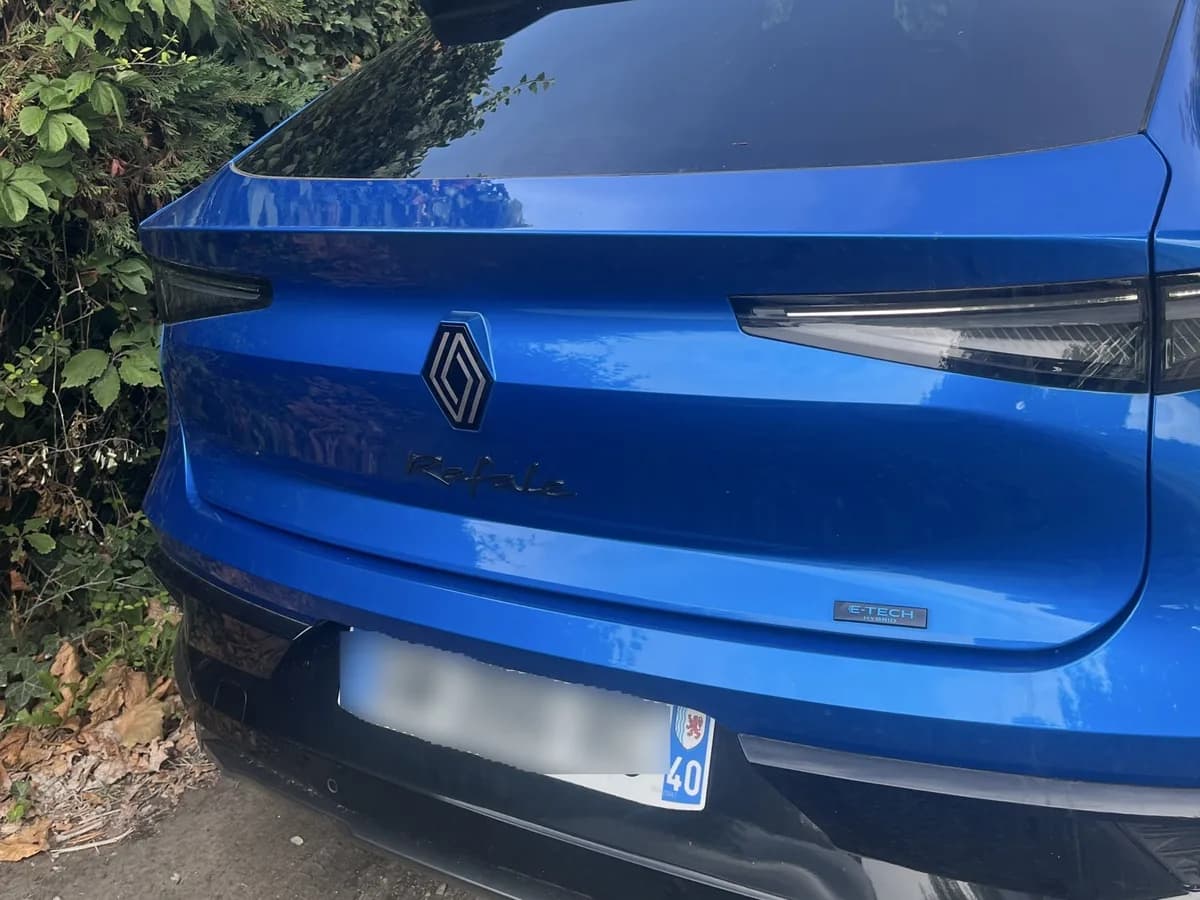
The Rafale is easiest to identify by its coupe-SUV profile. The roof tapers toward the rear, while the vehicle retains SUV ride height and family-car proportions. A long, fairly horizontal bonnet leads into rear haunches that sit prominently above the wheels. The front grille uses a black three-dimensional pattern made from small diamond shapes around the Renault badge; its appearance changes noticeably with viewing angle. The front and rear lighting signatures use geometric forms associated with Renault’s newer design language. The sharply angled rear glass and absence of a rear wiper are useful visual clues. Its considerable length, stretched wheelbase and large wheels help separate the Rafale from the smaller Austral. Inside, the openR cockpit uses two screens arranged in an L-shaped layout, while Google-integrated functions and, on selected specifications, the Solarbay opacifying panoramic roof provide further clues. E-Tech, 4x4 and trim badges can then help identify the powertrain and equipment level, although exact details depend on market and model year.
Important versions
The key launch version is the Renault Rafale E-Tech full hybrid with 200 hp. It combines a 1.2-litre three-cylinder petrol engine, two electric motors and a multimode automatic transmission. Its main distinction is self-charging hybrid operation, designed for everyday use without a plug-in routine. The most significant expansion is the 300 hp E-Tech 4x4. This plug-in hybrid adds a rear electric motor, all-wheel drive and a 22 kWh battery. Higher specifications may also include dedicated chassis and equipment features developed with Alpine engineering input. Trim names and standard equipment are not identical in every market, so version identification should always be tied to a country and model year.
The name “Rafale” follows Renault naming, with its rules and its exceptions. Decode a Renault name
References
- Rafale: a time-honoured name for the Renault brand’s new flagship coupe SUVRenault Global Media
- Rafale, a breath of fresh air in Renault’s upmarket rangeRenault Global Media
- All-new Renault Rafale: Conquering New Horizons press kitRenault Press
- Renault Rafale E-Tech full hybrid and hyper hybrid specificationsRenault UK
- Renault Rafale: flagship coupe-SUV priced from £38,195Autocar
- https://media.renault.com/the-brand-brings-the-legendary-1934-renault-caudron-rafale-c460-back-to-the-skies/?lang=engmedia.renault.com
- https://media.renault.com/la-marque-fait-revoler-le-mythique-avion-renault-caudron-rafale-c460-de-1934/?lang=framedia.renault.com
- https://www.largus.fr/actualite-automobile/le-renault-rafale-explique-par-gilles-vidal-directeur-du-design-30028638.htmllargus.fr
Frequently asked questions
- What years was the Renault Rafale produced?
- ScanRacer's referenced versions cover 2023.
- How many Renault Rafale examples are documented on ScanRacer?
- 5 published scans from 5 members, with the latest photo added in August 2026.