
8
Presented to the press in June 1962, the Renault 8 was a compact four-door saloon with a rear-mounted engine and rear-wheel drive. Its angular styling marked a clear visual change from the rounded Dauphine, while a new 956 cc four-cylinder engine and four-wheel disc brakes gave the car a notably modern specification for its class. The R1130 designation identifies the early Renault 8 that established the model family before later, more powerful and better-equipped derivatives appeared. The 1962 entry covered here corresponds to the Base configuration listed in the ScanRacer catalogue. It should not be confused with the Renault 8 Major or Renault 8 Gordini, introduced later and distinguished by different engines, equipment, styling details and sporting intent.
Variants by year
1962
Model summary
Data from the ScanRacer library, organized to compare versions quickly.
Model introduction
Presented to the press in June 1962, the Renault 8 was a compact four-door saloon with a rear-mounted engine and rear-wheel drive. Its angular styling marked a clear visual change from the rounded Dauphine, while a new 956 cc four-cylinder engine and four-wheel disc brakes gave the car a notably modern specification for its class. The R1130 designation identifies the early Renault 8 that established the model family before later, more powerful and better-equipped derivatives appeared. The 1962 entry covered here corresponds to the Base configuration listed in the ScanRacer catalogue. It should not be confused with the Renault 8 Major or Renault 8 Gordini, introduced later and distinguished by different engines, equipment, styling details and sporting intent.
History
The Renault 8 emerged during a period of renewal for Renault’s compact car range. Presented in June 1962 as the R1130, it gradually took over the role previously occupied by the Dauphine, although the two models overlapped during a transition period. The new saloon retained a rear-mounted engine and rear-wheel-drive layout, but introduced a more formal three-box body with straighter, more geometric lines. The styling is commonly associated with Philippe Charbonneaux and Gaston Juchet, reflecting Renault’s effort to give its small family car a more modern appearance. The early model’s most notable technical feature was its 956 cc Cléon-Fonte four-cylinder engine combined with four-wheel disc brakes. That specification gave the Renault 8 a distinctive position among compact family cars of the period. Its mechanical foundation also made it suitable for more ambitious derivatives. The Renault 8 Major, introduced in February 1964, used the enlarged 1,108 cc engine. That same year, the Renault 8 Gordini turned the compact saloon into a highly recognizable performance model, with engine and chassis modifications aimed at faster road driving and competition use. Those sporting derivatives played a major role in shaping the Renault 8’s long-term reputation.
Generations
The Renault 8 is not best understood as a sequence of formally distinct generations in the modern sense. Its development is more accurately described through changes in versions, engines and equipment during the model’s career. The 1962 launch model, identified as the R1130, represents the first phase. It combines the angular saloon body with the 956 cc engine and the four-wheel disc-brake system that became one of the early car’s defining technical features. A second stage arrived with the Renault 8 Major, introduced in 1964. It used the 1,108 cc engine and offered a more upscale specification. The Renault 8 Gordini belonged to the same model family, but represented a much more extensive transformation, with a tuned engine, revised chassis settings and a strong competition-oriented identity. Later Gordini development brought further mechanical changes and visible body revisions, including a four-headlamp front treatment on subsequent versions. For identification purposes, it is therefore more precise to refer to phases and derivatives rather than generations. This avoids treating the 1962 Base saloon, the 1,108 cc Major and the various Gordini models as if they were equivalent versions. Their engines, equipment, appearance and intended use were different, even though they shared the Renault 8 name and basic family architecture.
Key differences
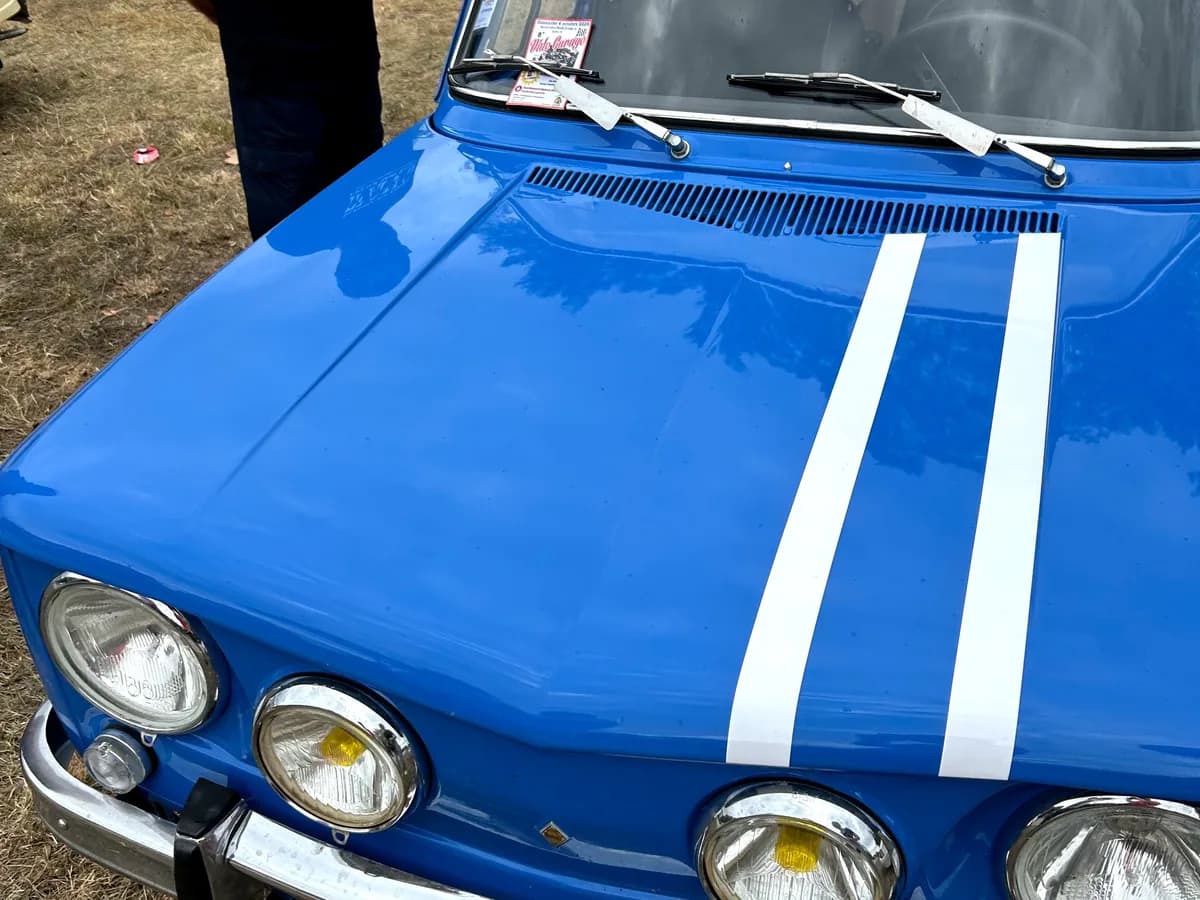
The 1962 Renault 8 Base is defined first by its launch specification: a rear-mounted 956 cc engine, compact family-saloon body and relatively straightforward equipment. The Renault 8 Major, introduced in 1964, used a 1,108 cc engine and a more upscale specification, so it should not be treated as merely a trim level of the original Base model. The Gordini was a more substantial transformation, with a tuned engine, revised suspension settings and a distinctly sporting presentation. The most useful visual differences involve the front end, wheels, badges, exterior stripes and interior equipment. Early Gordini cars are especially associated with blue paint and twin white stripes, while later examples adopted a four-headlamp front treatment. These clues should be checked against period documentation rather than used in isolation. Restorations, replacement parts and owner modifications can alter body details and make an ordinary Renault 8 appear closer to a higher-performance derivative than it originally was.
Photo recognition
A Renault 8 can generally be identified by its compact three-box body, four doors, relatively straight-sided design and rear-mounted engine. The front end has a narrow grille and round headlamps, while the hood crease and squared-off passenger compartment help distinguish it from the earlier Dauphine. Four-wheel disc brakes are an important technical clue, although confirming them may require mechanical inspection or period documentation. For a car described as a 1962 Base model, look for restrained equipment rather than added Gordini features such as white stripes, sporting badges, special wheels or the later four-headlamp front end. Badges and trim should not be treated as conclusive because they are easily changed. A reliable identification combines the body details with the manufacturer plate, Renault type code, mechanical numbers, year-specific brochures and restoration history. Export cars may also differ in lighting, trim or equipment from French-market examples, so market origin should be considered before drawing a firm conclusion.
Important versions
The 1962 Renault 8 Base was the launch version, combining the compact rear-engined saloon body with the 956 cc engine. The Renault 8 Major, introduced in February 1964, broadened the range with a 1,108 cc engine and more comfort-oriented equipment. The Renault 8 Gordini, unveiled at the Paris Motor Show in October 1964, became the family’s major performance derivative. It combined engine tuning, chassis changes and a strong competition presence. Renault 8 S, TS and licensed-production cars belong to different market or range contexts and should not automatically be identified as the French-market 1962 Base model.
The name “8” follows Renault naming, with its rules and its exceptions. Decode a Renault name
References
- Renault 8 Gordini – Renault Classic heritage dossierRenault Classic / Renault Group
- Renault 8 GordiniThe Originals Renault Museum
- Renault 8 (1962). De Gordini à Dacia, la berline aux multiples visagesL’Argus
- Renault 8 – 1962 brochures and catalogue archiveArchives Catalogues Automobiles
- https://mijnautofoldercollectie.jouwweb.nl/car-brochures/renault/8mijnautofoldercollectie.jouwweb.nl
- https://www.brochure-catalogue-voiture-neuve.fr/brochures/renault/8/renault-8-1962brochure-catalogue-voiture-neuve.fr
Frequently asked questions
- What years was the Renault 8 produced?
- ScanRacer's referenced versions cover 1962.
- How many Renault 8 examples are documented on ScanRacer?
- 6 published scans from 6 members, with the latest photo added in September 2026.