
17
Introduced at the Paris Motor Show in October 1971, the Renault 17 was a four-seat front-wheel-drive coupé based on the Renault 12 platform. It shared its basic structure with the Renault 15 but adopted a more dramatic appearance, including twin headlamps, a heavy rear pillar and rear side glass concealed behind louvres. Renault also offered an open-bodied version, giving the range an unusual alternative to the conventional coupé. For the 1972 model year, the ScanRacer catalogue identifies the Coupé and Convertible variants. The R17 combined mass-production mechanicals with a distinctly sporting presentation, including a longitudinal four-cylinder engine and an early dashboard arranged around four deeply hooded instruments. Production continued until 1979, with total output remaining below 100,000 cars. (theoriginals.renault.com)
Variants by year
1972
 RR
RRModel summary
Data from the ScanRacer library, organized to compare versions quickly.
Model introduction
Introduced at the Paris Motor Show in October 1971, the Renault 17 was a four-seat front-wheel-drive coupé based on the Renault 12 platform. It shared its basic structure with the Renault 15 but adopted a more dramatic appearance, including twin headlamps, a heavy rear pillar and rear side glass concealed behind louvres. Renault also offered an open-bodied version, giving the range an unusual alternative to the conventional coupé. For the 1972 model year, the ScanRacer catalogue identifies the Coupé and Convertible variants. The R17 combined mass-production mechanicals with a distinctly sporting presentation, including a longitudinal four-cylinder engine and an early dashboard arranged around four deeply hooded instruments. Production continued until 1979, with total output remaining below 100,000 cars. (theoriginals.renault.com)
History
The Renault 17 formed part of Renault’s early-1970s move into more expressive coupés. The company wanted a personal-looking car without abandoning the practical and economical engineering of its mainstream range. The R17 and R15 were unveiled together in 1971, both derived from the Renault 12. That relationship explains their front-wheel-drive layout, longitudinal engine installation and useful rear hatch, a combination that gave the coupés a practical character unusual for the period. The R17 was positioned as the sportier member of the pair. It featured twin round headlamps, a more assertive side profile and a substantial rear pillar containing a small louvred side window. The absence of a visible centre pillar and the fully retractable rear side windows contributed to a hardtop-coupé appearance. Renault also offered a convertible-style version, providing a distinctive alternative while retaining the four-seat concept. Mechanical and visual changes were introduced during the model’s career. TS and Gordini versions formed the performance-oriented part of the range, with Renault listing the Gordini’s 1,605 cc engine at 108 hp. In competition, a Renault 17 TS was homologated in Group 2 and achieved a notable international result when Jean-Luc Thérier won the 1974 Press on Regardless Rally. Production ended in 1979, with Renault sources giving a total of roughly 92,000 to 95,000 cars depending on the stated production count. (theoriginals.renault.com)
Generations
The Renault 17 is not best understood as a series of completely separate modern-style generations. A more accurate description is a two-phase design history. The first phase covers the cars introduced in 1971 and built during the early part of the production run, including the 1972 model year represented in the ScanRacer data. These cars have twin round headlamps, a heavily hooded dashboard and early-style front seats. Their original angular bodywork includes the thick rear pillar and louvred side treatment that became central to the R17’s identity. A significant update arrived for the 1976-1979 period. Renault revised the front-end treatment and refreshed the cabin, including more distinctive front seats that were later associated with the restyled cars. Equipment and trim details could vary by specification, model year and export market, so a single feature should not be treated as definitive proof of a particular version. The ScanRacer context supplied for this model contains two 1972 entries: Coupé and Convertible. Both therefore belong to the early, pre-restyling phase of the Renault 17 rather than the revised cars introduced from 1976 onward. The distinction is useful when comparing photographs, dashboards and exterior trim, but exact identification should still rely on several matching details and, where possible, original documentation. (theoriginals.renault.com)
Key differences
The clearest difference between the two 1972 variants is the body style. The Coupé has a fixed roof and a continuous roofline leading into the thick rear pillar. The Convertible uses the same general R17 concept but replaces the fixed upper structure with an opening roof arrangement, changing both the side profile and the cabin atmosphere. Both versions nevertheless retain the model’s basic engineering: four seats, front-wheel drive, a longitudinal four-cylinder engine and a rear hatch. The Convertible should therefore not be described as a completely separate mechanical model without documentation specific to the relevant market or trim. Equipment, engine specification, transmission and interior details may vary according to year, finish and destination country. For the two 1972 entries represented here, body configuration is the most dependable first distinction; secondary details should be checked against period brochures or vehicle identification records. (theoriginals.renault.com)
Photo recognition
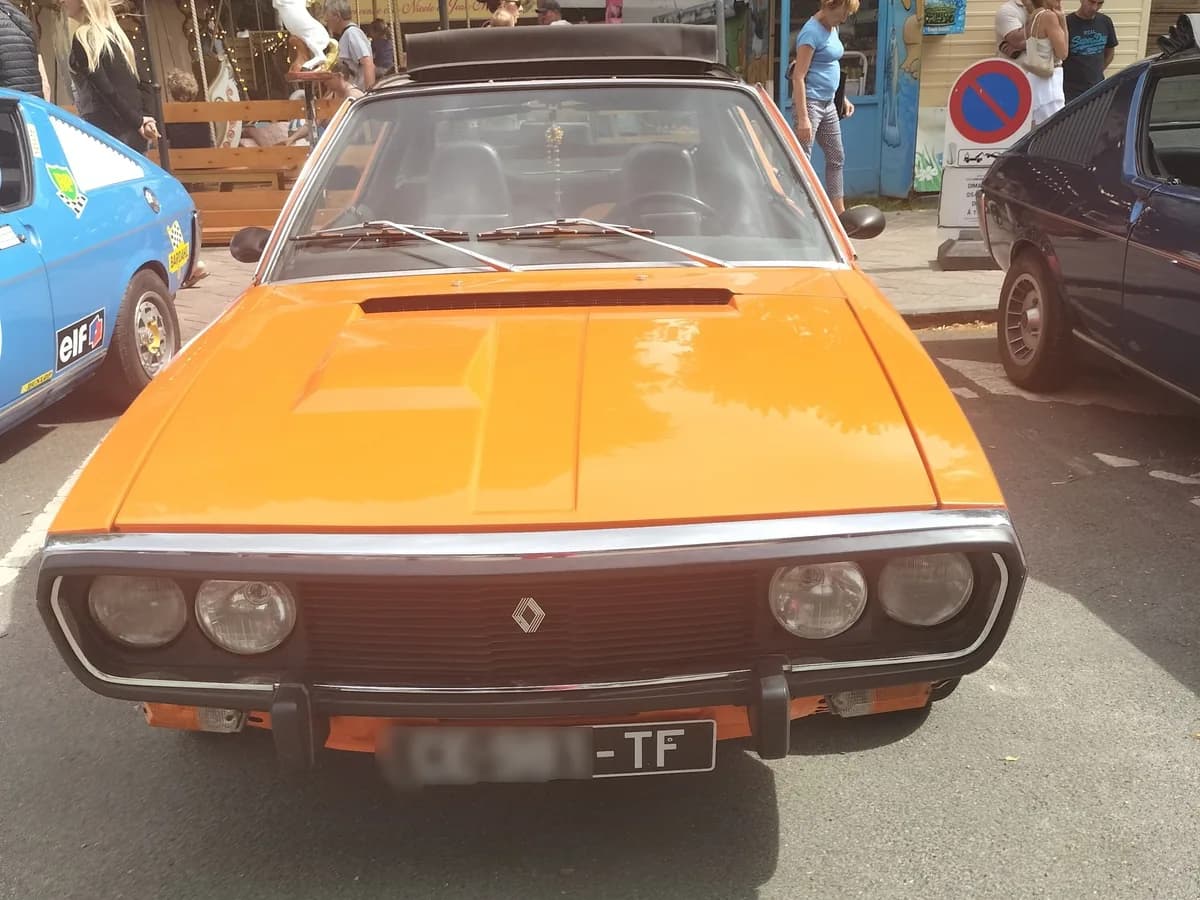
An early Renault 17 can first be identified by its twin round headlamps on each side, wraparound bumper treatment and fastback coupé profile. The most distinctive exterior feature is the broad rear pillar combined with a small side window covered by louvres. The lack of an obvious centre pillar and the retractable rear side glass give the car a hardtop-like appearance. The interior offers another useful clue. Early R17s use a distinctive dashboard with four instruments set beneath deep individual hoods. This detail can help separate a 1972 car from the restyled models introduced from 1976, although replacement dashboards and trim parts are possible on surviving vehicles. To distinguish the Coupé from the Convertible, inspect the roof structure and its operating hardware rather than relying on paint, wheels or seat design. Equipment could vary between markets, and restored cars may combine parts from different years. A reliable identification should therefore compare the body configuration with the model year, vehicle plates and period documentation. (theoriginals.renault.com)
Important versions
The Renault 17 range included TL, TS and Gordini versions, with equipment and performance changing according to model year and market. The R17 TS has particular historical importance because it was homologated by the FIA in Group 2 in 1974. The Gordini is the performance-oriented version most often sought by collectors, and Renault’s heritage material gives it a 1,605 cc four-cylinder engine rated at 108 hp. The Convertible is significant as a distinctive body style, while the Coupé represents the closed-roof shape most commonly associated with the R17 name. In the supplied 1972 ScanRacer context, the available variants are the Coupé and Convertible. (theoriginals.renault.com)
The name “17” follows Renault naming, with its rules and its exceptions. Decode a Renault name
References
- R17 TLThe Originals Renault Museum
- R17 electric restomod x Ora Ïto: the iconic Renault 17 becomes a stylish restomodRenault Global Media
- 50 Jahre Renault 15 und 17Renault Deutschland Presse-Service
- Renault 17 TS Historic HomologationFIA Historic Database
- https://www.brochure-catalogue-voiture-neuve.fr/brochures/renault/17/brochure-catalogue-voiture-neuve.fr
- https://media.renault.com/r17-electric-restomod-x-ora-ito-le-restomod-elegant-de-lemblematique-renault-17-par-ora-ito/?lang=engmedia.renault.com
Technical specifications
Structured data available for versions linked to this model.
| Version | Power | Torque | Top speed | Drivetrain | Fuel |
|---|---|---|---|---|---|
| — | 90 hp | — | — | Front-wheel drive / 4-speed manual | — |
Frequently asked questions
- What years was the Renault 17 produced?
- ScanRacer's referenced versions cover 1972.
- How many Renault 17 examples are documented on ScanRacer?
- 2 published scans from 1 member, with the latest photo added in July 2026.
- What is the power output of the Renault 17?
- The sourced technical data lists 90 hp.