Power
478.1 KW @ 6000 RPM 650 HP @ 6000 RPM 641 BHP @ 6000 RPM
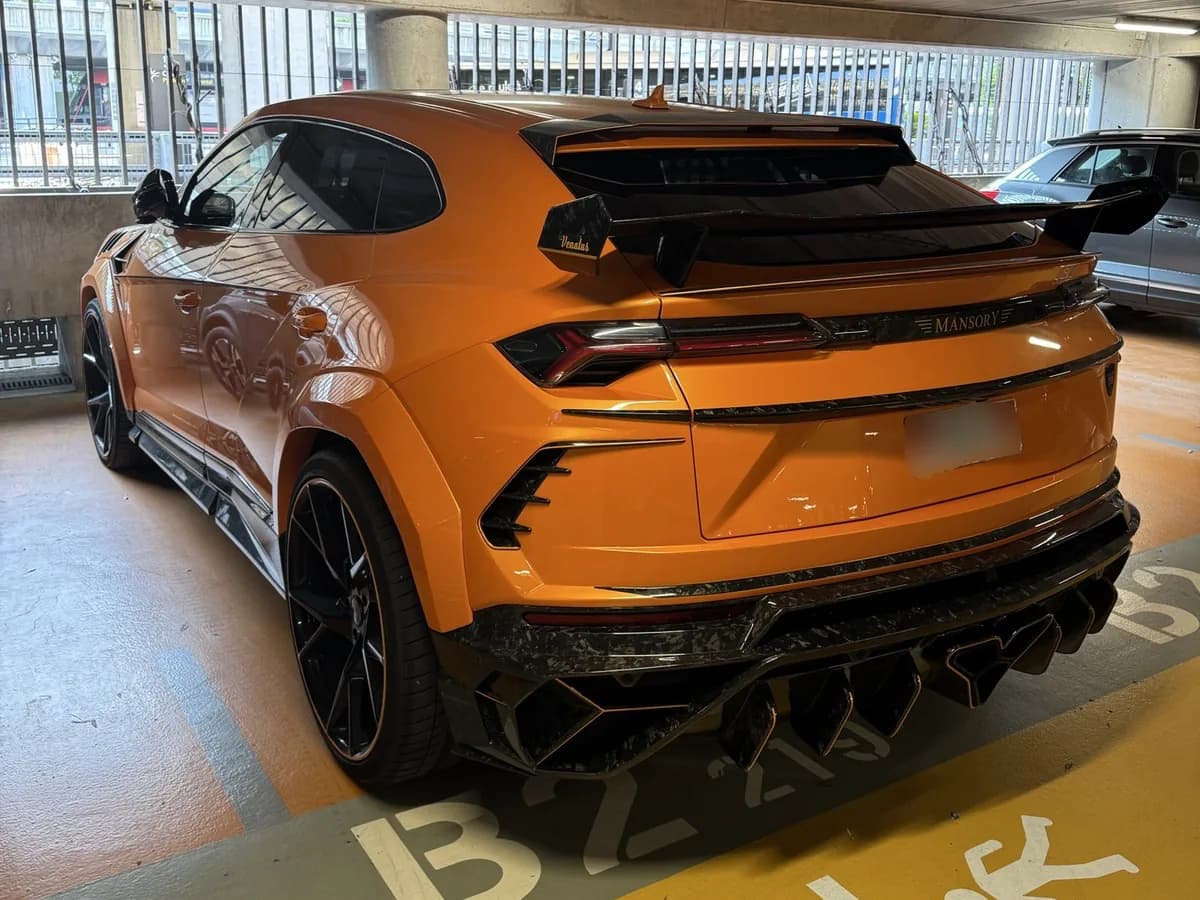
Presented in 2017 and introduced to customers in 2018, the Lamborghini Urus is a five-door SUV developed to combine sports-car performance with greater everyday versatility. The first-generation model uses a 4.0-liter twin-turbocharged V8 producing 650 CV, an eight-speed automatic transmission, and permanent all-wheel drive. Lamborghini claimed a 0-to-100-km/h time of 3.6 seconds and a top speed of 305 km/h. The Urus became the company’s third product line, extending Lamborghini’s reach beyond traditional two-door supercars. Its practical format did not erase the brand’s visual identity: the bodywork incorporated familiar Y-shaped and hexagonal design cues, while the chassis and control systems were engineered to support road, track, and selected off-road driving modes. (lamborghini.com)

The Urus name first appeared on a concept shown at the 2012 Beijing Auto Show, but the production vehicle took shape as a more complete interpretation of Lamborghini’s SUV ambitions. The definitive model was unveiled in December 2017 at Sant’Agata Bolognese, followed by international presentations during the first months of 2018. European market introduction began in spring 2018, while other markets, including China, received the vehicle progressively during the year. The Urus became Lamborghini’s third product line alongside the Aventador and Huracán. Its arrival required a major production ramp-up at Sant’Agata Bolognese, including expanded facilities and a dedicated assembly line. Lamborghini positioned the model as a Super Sport Utility Vehicle: a practical, multi-seat vehicle with luggage capacity, but also with acceleration and top-speed figures more commonly associated with high-performance cars. During 2018, the Urus played a major role in increasing Lamborghini’s production and customer deliveries. (lamborghini.com)
Photos added by the community for this page.
Source: autoevolution
The name Urus refers to the aurochs, a large wild cattle species, fitting Lamborghini’s long-standing bull-related naming tradition. The model’s 2018 dynamic launch took place at the Vallelunga circuit near Rome, a venue later used again for the international debut of the Urus Performante in 2022. Lamborghini also emphasized the vehicle’s ability to move between road driving, desert terrain, racetrack use, and snowy surfaces through its ANIMA driving modes. (lamborghini.com)
Urus production began alongside a major transformation of Lamborghini’s Sant’Agata Bolognese facility. The company expanded the site to accommodate its third product line and established dedicated manufacturing operations for the SUV. Audi’s 2018 annual report states that Lamborghini built 6,571 vehicles at Sant’Agata during the year, identifying the Urus production ramp-up as the main contributor to the increase. That figure covers all Lamborghini models built at the facility, not the Urus alone, so it should not be presented as an exact Urus production total. The available evidence confirms the importance of the model to the factory’s 2018 expansion, but not a definitive model-specific unit count in the cited report. (lamborghini.com)
Early specialist road tests generally emphasized the contrast between the Urus’s size and practicality and its sports-car-like responses. MotorTrend praised the vehicle’s cornering ability, strong braking performance, and effective traction from the all-wheel-drive system. Testers also noted how easily the Urus could shift from daily transportation to fast circuit driving, a combination that became central to its identity. Reviews remained conscious of the high price, substantial mass, and extensive list of costly options, all of which limited its accessibility. Overall, the initial reception recognized the technical success of Lamborghini’s approach while making clear that the Urus delivered a different experience from a traditional two-seat supercar. (motortrend.com)
For the 2018 model year, the Urus represents Lamborghini’s initial production configuration, using the 650-CV twin-turbo V8 and permanent all-wheel drive. Launch documentation primarily describes the Urus as a single model rather than presenting a detailed trim structure like that used by mainstream manufacturers. The label “Base” can therefore be treated as a reference designation for the original configuration, but it should not be used to assign specific equipment that is not confirmed by period documentation. More clearly named derivatives appeared later: Performante for a stronger performance focus, S for a refined and versatile interpretation, and SE for plug-in hybrid technology. Those later versions are distinct developments and should not be confused with the original 2018 specification. (preview.thenewsmarket.com)
Supports the 2018 presentation, the 650 CV twin-turbo V8, the SSUV positioning, and the production-facility expansion.
Supports the eight-speed automatic transmission, permanent four-wheel drive, seven ANIMA modes, and 2018 performance claims.
Supports the launch timing, 4.0-liter V8 specifications, 650 hp output, and performance figures.
Supports Lamborghini’s 2018 production total, the Urus production ramp-up, and the model’s contribution to deliveries.
Supports contemporary press observations about handling, braking, all-wheel drive, options, and everyday versatility.
Supports the later Urus S derivative and its 666 CV output.
Supports the later Performante derivative and its performance-focused development.
Supports the 2024 Urus SE evolution and its 800 CV plug-in hybrid powertrain.