Power
350 CV at 7,000 rpm
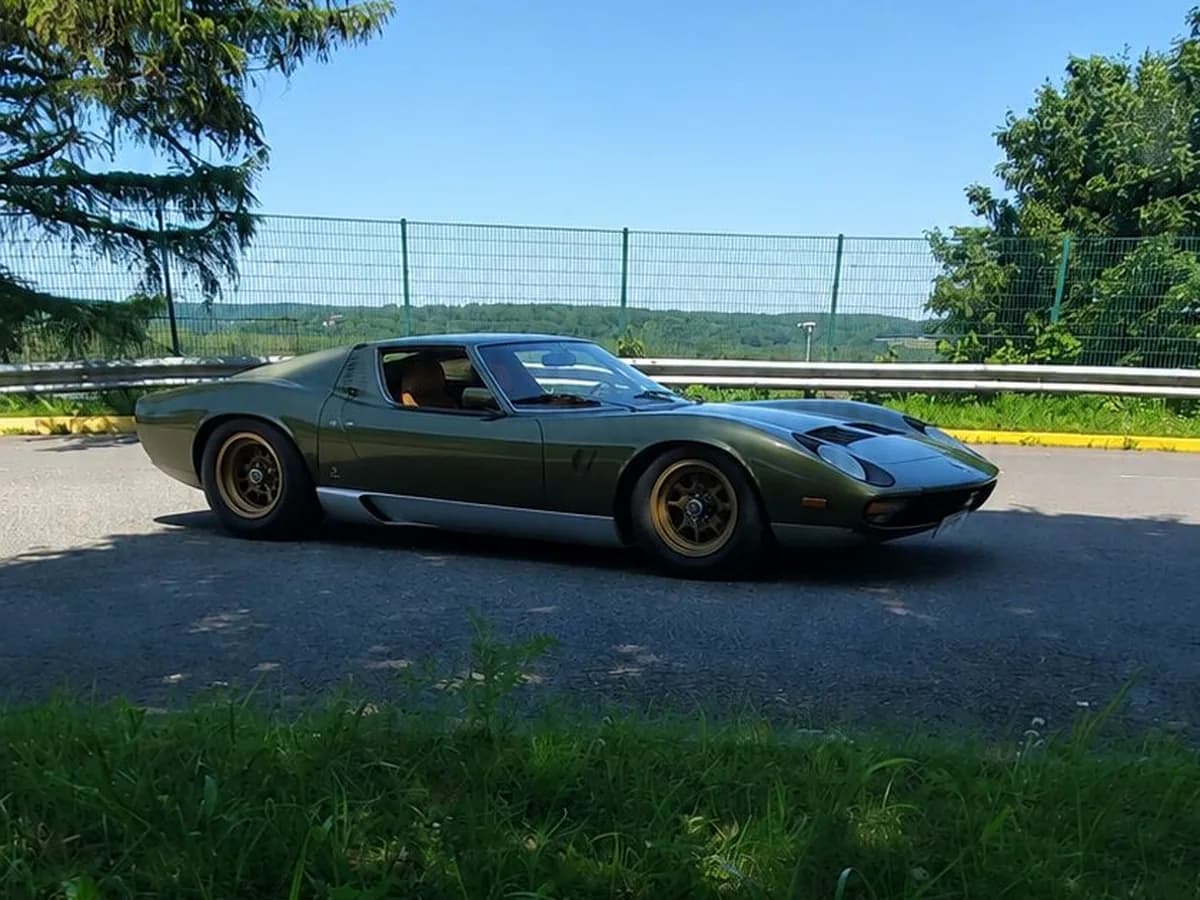
Presented at the Geneva Motor Show in March 1966, the Lamborghini Miura P400 introduced a production road car with a transversely mounted V12 positioned behind the passenger compartment. Designed by Marcello Gandini for Bertone, it combined an exceptionally low body with distinctive headlight “eyelashes” and engineering influenced by racing practice. Its 3.9-liter engine produced 350 CV at 7,000 rpm and drove the rear wheels through a five-speed manual transmission. The Miura quickly became one of the defining cars of its era, helping establish the modern idea of the supercar: a road-going machine built around an exotic mid-engine layout, dramatic styling, and performance that had previously been associated mainly with competition vehicles.
Curious about this car?
Explore Miura, then try your own photo.
No account needed for the result · Publish only if you choose
The Miura originated with a rolling chassis project developed in the mid-1960s by Gian Paolo Dallara, Paolo Stanzani, and Bob Wallace. The P400 chassis was shown at the Turin Motor Show in 1965 before Carrozzeria Bertone clothed it in a body designed by Marcello Gandini. The complete car appeared at Geneva in March 1966 as the Miura P400; the letter “P” referred to the rear engine position, while “400” indicated an approximately four-liter displacement. Lamborghini chose a transverse layout for the V12 to keep the wheelbase compact, integrating the engine and gearbox into a tightly packaged unit. The arrangement created engineering challenges but gave the Miura its unmistakable mechanical character. Early orders exceeded the expectations of Ferruccio Lamborghini and Nuccio Bertone. Production began in 1966, and the original P400 remained the foundation of the range until the arrival of the more powerful and better-equipped P400 S.
Photos added by the community for this page.
Source: Automobili Lamborghini
The Miura’s bare chassis was shown in Turin in 1965, one year before the finished car appeared at Geneva. The design also attracted the attention of New York’s Museum of Modern Art, which included the car in an automotive exhibition during the 1960s. A Miura later featured in the opening sequence of the British film “The Italian Job,” released in 1969, reinforcing its public image as one of the era’s most dramatic road cars.
Lamborghini states that 265 P400 Miuras were produced between 1966 and 1968. The P400 S followed with 338 cars built from 1969 to 1971, while the SV reached 150 examples between 1971 and 1973. Historical totals can differ depending on how transitional cars and special versions are counted, but the P400’s production remained very limited by mass-production standards. Its small output, complex mechanical layout, and Bertone bodywork helped make the early Miura an especially significant collector car. The 1966 P400 is particularly important because it represents the original production specification from which the later S and SV versions evolved.
The Miura received an exceptional response when it was shown at Geneva in 1966. Lamborghini records that orders arrived quickly, surprising both Ferruccio Lamborghini and Nuccio Bertone. The Petersen Automotive Museum describes the car as one of the earliest road-going mid-engine automobiles to achieve genuine supercar status, while Gandini’s design is widely regarded as a landmark in automotive styling. The press response was not based on speed alone. The transverse V12 layout, extremely low proportions, and Bertone bodywork gave the P400 a technical and visual unity that was unusual for a production road car at the time.
Supports the 1966 Geneva debut, P400 naming, transverse V12 layout, 350 CV output, design details, model evolution, and Lamborghini's production figures.
Supports the P400 technical specifications, including the 3.9-liter V12, 350 hp, five-speed manual transmission, and historical positioning.
Supports the Miura's mid-engine significance, Bertone bodywork, chassis development, and role in the emergence of the supercar.
Supports the 1965-1968 development period, the 1966 Turin presentation, the car's cultural impact, and its inclusion in the MoMA context.
Supports the inclusion of the 1966 Lamborghini P400 Miura in a MoMA automotive exhibition.
Source found by OpenAI web search for this vehicle page.
Source found by OpenAI web search for this vehicle page.
Source found by OpenAI web search for this vehicle page.