
Miura
Presented at the Geneva Motor Show in March 1966, the Lamborghini Miura was Lamborghini’s first production car with a mid-mounted engine. Its 4.0-liter V12 was installed transversely behind the cockpit, allowing a short wheelbase while giving the car an exceptionally low profile. Designed by Marcello Gandini for Carrozzeria Bertone, the Miura combined a competition-inspired layout with a two-seat grand touring body. Lamborghini’s historical material lists the initial P400 at 350 CV and gives the model a 280 km/h top speed. Its arrival helped establish the word “supercar” in automotive journalism. For the 1966 model year, the ScanRacer reference corresponds to the first-series Miura, before the later P400 S and P400 SV developments. The car’s importance rests on both its engineering layout and the influence of its design.
What about the car you photographed?
Upload a photo to get a suggested make, model and likely year.
No account needed for the result · Publish only if you choose
Variants by year
Make: Lamborghini · Model: Miura
1 / 1 versions shown
1966
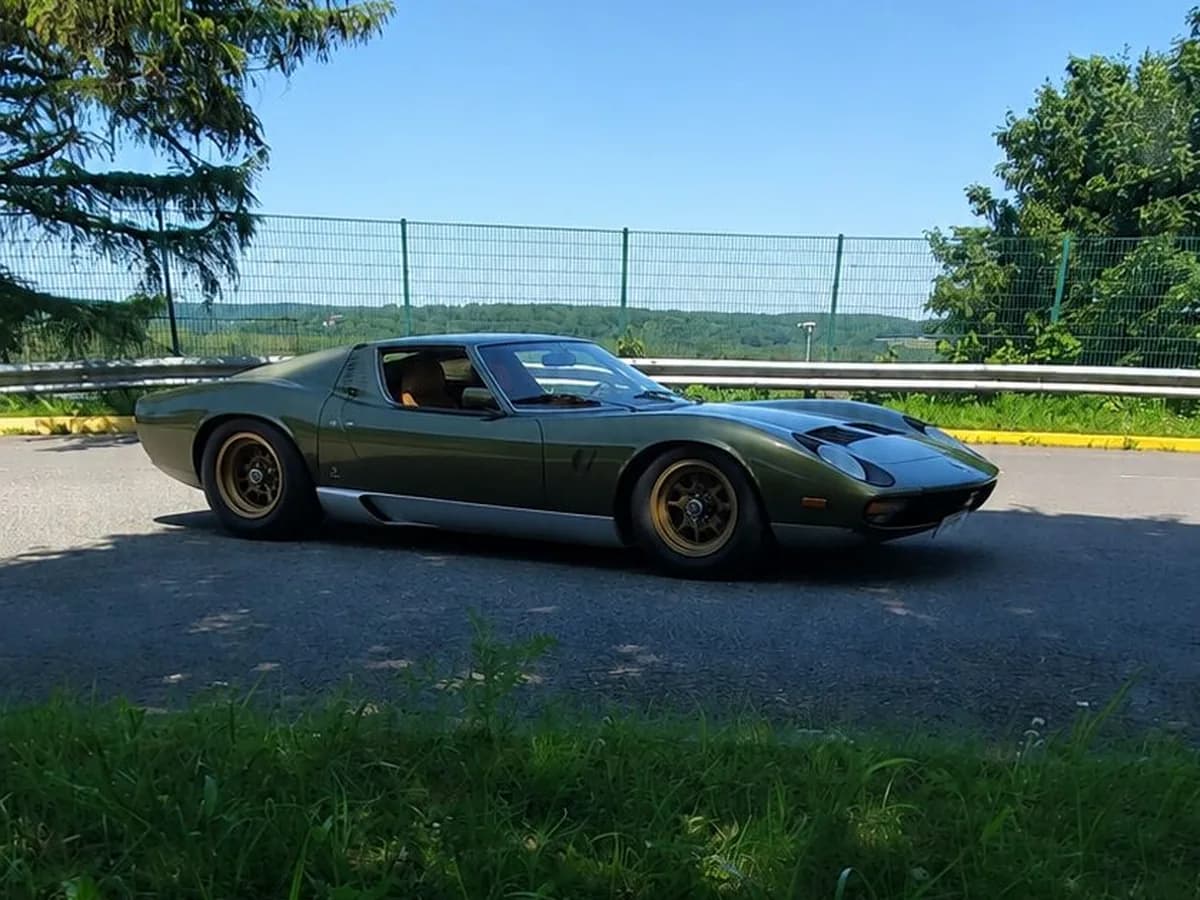
Lamborghini Miura photos
Model summary
Data from the ScanRacer library, organized to compare versions quickly.
Model introduction
Presented at the Geneva Motor Show in March 1966, the Lamborghini Miura was Lamborghini’s first production car with a mid-mounted engine. Its 4.0-liter V12 was installed transversely behind the cockpit, allowing a short wheelbase while giving the car an exceptionally low profile. Designed by Marcello Gandini for Carrozzeria Bertone, the Miura combined a competition-inspired layout with a two-seat grand touring body. Lamborghini’s historical material lists the initial P400 at 350 CV and gives the model a 280 km/h top speed. Its arrival helped establish the word “supercar” in automotive journalism. For the 1966 model year, the ScanRacer reference corresponds to the first-series Miura, before the later P400 S and P400 SV developments. The car’s importance rests on both its engineering layout and the influence of its design.
History
The Miura project emerged in the early 1960s around a mid-engine layout developed by engineers Giampaolo Dallara and Paolo Stanzani. Ferruccio Lamborghini approved the idea even though the configuration was still unusual for a road car from the company. A bare chassis was shown at the 1965 Turin Motor Show with the V12 mounted transversely behind the cockpit. Bertone was then asked to create the bodywork, and Marcello Gandini produced a shape defined by its low nose, rounded wheel arches, and distinctive eyelash-like trims around the headlights. The complete P400 was unveiled at Geneva in March 1966. The P400 name referred to the engine position and an approximately four-liter displacement. Lamborghini states that 265 P400 cars were built between 1966 and 1968, followed by the P400 S launched in 1969. The S added power together with detail and comfort improvements. The P400 SV arrived in 1971 with a more sporting setup, wider tracks, and revised transmission arrangements. Production of the regular series ended in 1973. The Miura later became a cultural icon through film appearances and celebrity ownership, but its lasting significance is more firmly connected to its transverse mid-engine layout, compact chassis, and the way its design influenced later high-performance road cars.
Generations
The Miura is not divided into modern-style generations, but into three principal production developments. The P400 was the original version, introduced from 1966. It used Lamborghini’s 3,929 cc V12 in a transverse mid-mounted position and is listed by Lamborghini at 350 CV. Its styling contained the best-known features of the first series, including the eyelash headlamp surrounds and the relatively restrained trim details associated with early cars. The P400 S, launched in 1969, retained the same basic architecture but added improvements to comfort, equipment, and presentation. Lamborghini lists its output at 370 CV. In 1971, the P400 SV became the range’s more performance-focused evolution. Its quoted output rose to 385 CV, while the car received wider tracks, broader rear wheel arches, revised suspension and chassis settings, and separate lubrication systems for the engine and gearbox. The headlight eyelashes were generally deleted on the SV. Alongside these three regular production versions, Lamborghini produced or converted a small number of special cars, including the experimental Jota, SVJ examples, and Bertone’s unique Roadster. These cars are historically important, but they should not be treated as a separate mass-production generation. The 1966 car belongs to the original P400 phase.
Key differences
The main differences between Miura versions concern their level of development rather than a completely new architecture. The 1966 P400 represents the original formula: a transverse V12, very low body, eyelash headlamp surrounds, and a quoted output of 350 CV. The P400 S kept that foundation but added 20 CV, comfort upgrades, and presentation changes. The P400 SV went further with 385 CV, wider tracks and rear arches, revised suspension, and separate lubrication systems for the engine and gearbox. These visual and technical clues are useful, but they do not always prove a car’s identity. Restorations, period conversions, and later modifications can alter an individual example. Production totals also differ between historical sources because counting methods are not always identical. For a definitive identification, the chassis number, factory documentation, and consistency of the major components are more reliable than appearance alone. A 1966 car should generally be assessed as an early P400, although individual specification details may vary according to production sequence, market, and subsequent restoration history.
Photo recognition
A Miura is first identified by its extremely low body, long front hood, and cockpit positioned near the center of the car. The side air intakes and rounded rear haunches frame an engine cover that dominates the tail. Early P400 cars use the famous eyelash trims around the headlights. The slatted rear window is another characteristic feature, helping manage airflow and heat around the engine compartment. For a 1966 car, the most useful approach is to look for early-series details rather than relying on paint color or badging. Headlamp and window trim, steering wheel design, wheels, upholstery, and instrument layout can help place an example within the production sequence, but restoration work often changes these parts. Eyelashes alone are not conclusive: later cars may have been fitted with them, while restored early cars may have lost them. A reliable identification should therefore combine visual evidence with the chassis number, factory records, and the history of the individual vehicle.
Important versions
The P400 was the original Miura, introduced in 1966 with a 350 CV transverse V12. The P400 S arrived in 1969 with 370 CV and improvements to comfort and trim. The P400 SV, launched in 1971, was the most developed regular production version, with 385 CV, wider tracks, and revised suspension. The Jota was an experimental prototype developed by Bob Wallace in 1970 and was not an ordinary production variant. The SVJ cars were extremely limited road-going interpretations inspired by that project. Bertone’s Miura Roadster, shown in 1968, was a unique styling exercise. Within the supplied ScanRacer context, the available reference is the 1966 Miura Base, corresponding to the first P400 series.
References
- Lamborghini History - MiuraAutomobili Lamborghini
- Lamborghini Miura - Technical Specifications, Pictures, PerformanceAutomobili Lamborghini
- Lamborghini Miura: The History of the First Standard Production SupercarAutomobili Lamborghini
- Lamborghini Miura: Born IncomparableAutomobili Lamborghini Museum
- https://www.lamborghini.com/en-en/history/miura?adlt=strict&redig=A1015A941EAC469D89A61431597D36EC&toWww=1lamborghini.com
- https://www.lamborghini.com/de-en/geschichte/miura?_escaped_fragment_=&cHash=bfed36705219561c648c937fff25ae78lamborghini.com
- https://www.opumo.com/magazine/1971-lamborghini-miura-p400-sv/opumo.com
Technical specifications
Structured data available for versions linked to this model.
| Version | Power | Torque | Top speed | Drivetrain | Fuel |
|---|---|---|---|---|---|
| — | 350 CV at 7,000 rpm | — | — | Rear-wheel drive / Five-speed manual | — |
Frequently asked questions
- What years was the Lamborghini Miura produced?
- ScanRacer's referenced versions cover 1966.
- How many Lamborghini Miura examples are documented on ScanRacer?
- 17 published scans from 17 members, with the latest photo added in October 2026.
- What is the power output of the Lamborghini Miura?
- The sourced technical data lists 350 CV at 7,000 rpm.
What about the car you photographed?
Upload a photo to get a suggested make, model and likely year.
No account needed for the result · Publish only if you choose