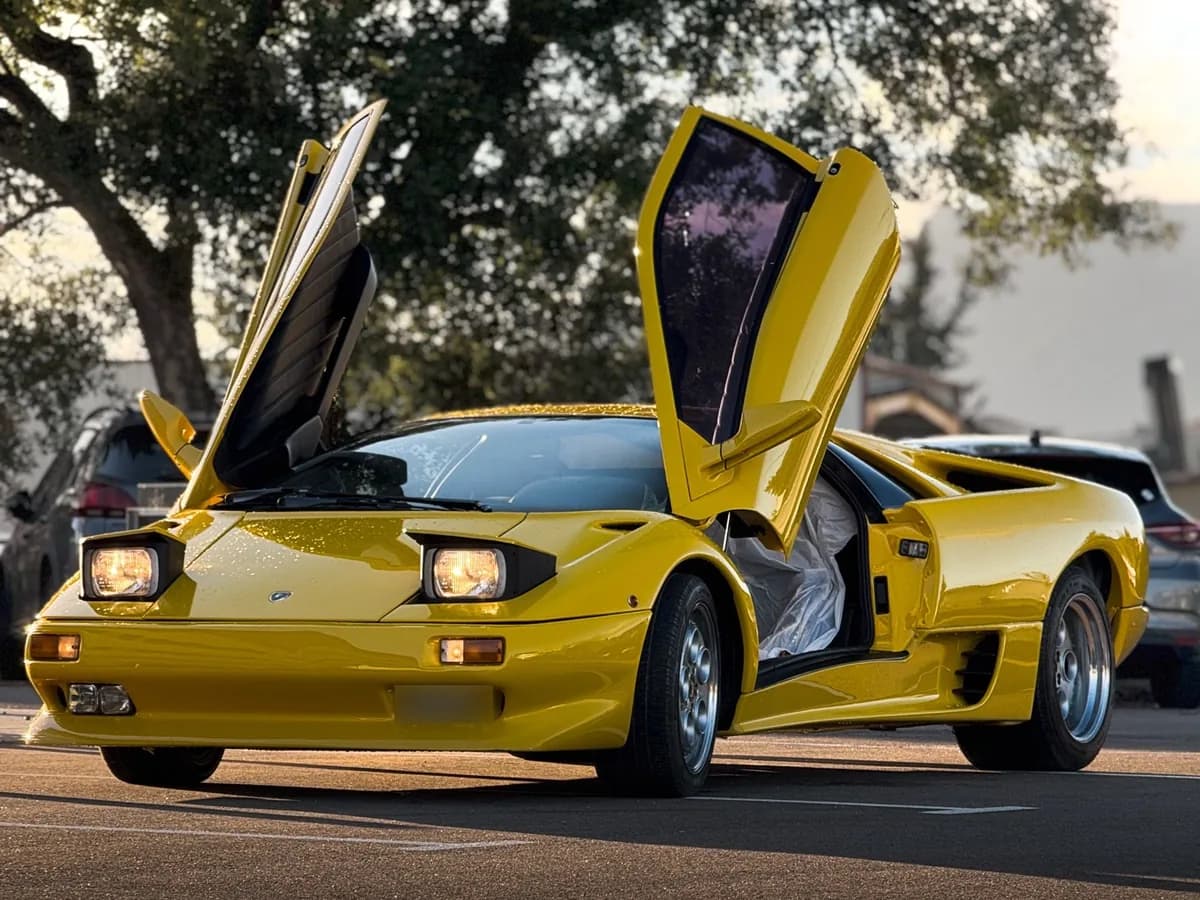
Lamborghini Diablo Coupé 1990
Unveiled at the Hotel de Paris in Monte Carlo on January 21, 1990, the Lamborghini Diablo replaced the Countach with a new interpretation of the brand’s mid-engined V12 formula. Its design followed Marcello Gandini’s work while introducing smoother surfaces, improved interior space, and a more contemporary aerodynamic profile. The original berlinetta used a 5.7-liter V12 rated at 492 CV by Lamborghini, driving the rear wheels through a five-speed manual gearbox. With a claimed top speed above 200 mph, the Diablo immediately became Sant’Agata’s flagship supercar. The 1990 model represents the first rear-wheel-drive generation, before Lamborghini expanded the range with the four-wheel-drive VT and later performance-focused derivatives.
Curious about this car?
Explore Diablo, then try your own photo.
No account needed for the result · Publish only if you choose
History
Development of the Countach replacement began in the mid-1980s under the Project 132 designation. Marcello Gandini produced an early, sharply creased design that continued the visual language of the Countach. After Chrysler acquired Lamborghini in 1987, the project received additional funding and engineering scrutiny. The body was subsequently revised with smoother surfaces intended to improve aerodynamic performance, safety, and production feasibility. The finished car retained the classic Lamborghini proportions, a mid-mounted V12, and vertically opening doors, but presented them in a more modern form. Lamborghini revealed the Diablo in Monte Carlo in January 1990, with production beginning during the same year. Its 5.7-liter V12 was derived from the Countach Quattrovalvole unit and gained electronic fuel injection. The original car remained rear-wheel drive and used a five-speed manual transmission. Compared with the Countach, it offered a more accommodating cabin and a greater emphasis on everyday usability without abandoning its extreme performance.
Latest scans
Photos added by the community for this page.
Anecdotes
The name Diablo refers to a famous fighting bull, continuing Lamborghini’s long-standing connection with bull-related model names. The car also retained the vertically opening doors that had become a defining feature of the Countach. Period coverage emphasized how the Diablo preserved the visual drama of its predecessor while translating that theme into a smoother, more aerodynamic 1990s shape. Its Monte Carlo launch gave the new flagship an appropriately theatrical debut and helped establish it among the fastest production supercars of its era.
Production
Lamborghini built the Diablo from 1990 until 2001, when the model’s place in the range was taken by the Murciélago. The manufacturer records total Diablo production at 2,903 cars across the full production period. That figure includes the various generations, body styles, special editions, and competition-related derivatives, so it should not be interpreted as the production total for the 1990 model year alone. Early cars were built in the original rear-wheel-drive configuration with the 5.7-liter V12. Year-by-year and trim-specific totals are omitted here because published figures are not consistently presented across the available sources.
Press reception
Contemporary automotive publications treated the Diablo as a serious successor to the Countach, while acknowledging the difficulty of following such an iconic car. Road & Track praised its design for carrying the Countach’s proportions and visual aggression into a smoother, more modern form. Period testing also highlighted the roomier cabin, improved ergonomics, and exceptional V12 performance. Later assessments commonly described the Diablo as more usable than the Countach, but never ordinary or effortless. The original car retained a demanding character, shaped by its manual steering, gated manual gearbox, rear-wheel-drive layout, and naturally aspirated engine. Its appeal came from combining greater refinement with the physical intensity expected of a Lamborghini flagship.
Evolution
Variants
References
- Lamborghini History - DiabloAutomobili Lamborghini
Confirme la présentation en 1990, la configuration berlinetta à propulsion, le moteur V12 de 5,7 litres, la puissance de 492 CV, l’arrivée de la transmission intégrale VT en 1993 et la production totale de 2 903 exemplaires.
- Lamborghini V12 History: DiabloAutomobili Lamborghini
Documente la période de production 1990-2001, le rôle historique de la Diablo et le total officiel de 2 903 unités.
- Lamborghini Diablo: Everything You Need to Know About the Ultimate ’90s SupercarMotorTrend
Apporte des éléments sur le développement du modèle, le lancement à Monte-Carlo, la transmission manuelle à cinq rapports, les caractéristiques du V12 initial et l’évolution des variantes.
- 1990 Lamborghini Diablo Is Even More Sensational Than the CountachRoad & Track
Source d’époque reprise par la publication pour le style, la filiation avec la Countach, l’ergonomie, la conception du châssis, la boîte à cinq rapports et la réception initiale.
- Lamborghini Diablo (1990-2001) used car reviewRAC Drive
Source secondaire établie sur l’histoire du modèle, le rôle de Marcello Gandini, l’influence de Chrysler, l’évolution vers la VT et l’appréciation de la presse et des conducteurs.
- https://en.wikipedia.org/wiki/Lamborghini_Diabloen.wikipedia.org
Source found by OpenAI web search for this vehicle page.
- https://albaco.com/products/lamborghini_diablo_brochure_usalbaco.com
Source found by OpenAI web search for this vehicle page.
- https://classics.honestjohn.co.uk/reviews/lamborghini/diablo/classics.honestjohn.co.uk
Source found by OpenAI web search for this vehicle page.