
Diablo
Introduced in 1990 as the successor to the Countach, the Lamborghini Diablo marked a new stage for Sant’Agata Bolognese’s mid-engined V12 flagship. Its first 5.7-liter twelve-cylinder engine produced 492 CV, while the body retained Lamborghini’s distinctive scissor doors. The Diablo initially arrived as a rear-wheel-drive berlinetta, then expanded with the all-wheel-drive VT, the Roadster, and several limited or competition-oriented versions. The ScanRacer library covers the 1990 Coupé and the 1995 Roadster, two significant points in that development. Lamborghini built 2,903 Diablos in total before the model was replaced by the Murciélago in 2001. Together, the early coupe and first production roadster illustrate how the Diablo moved from a raw Countach successor toward a broader and more technically developed flagship range.
What about the car you photographed?
Upload a photo to get a suggested make, model and likely year.
No account needed for the result · Publish only if you choose
Variants by year
Make: Lamborghini · Model: Diablo
2 / 2 versions shown
1995

1990
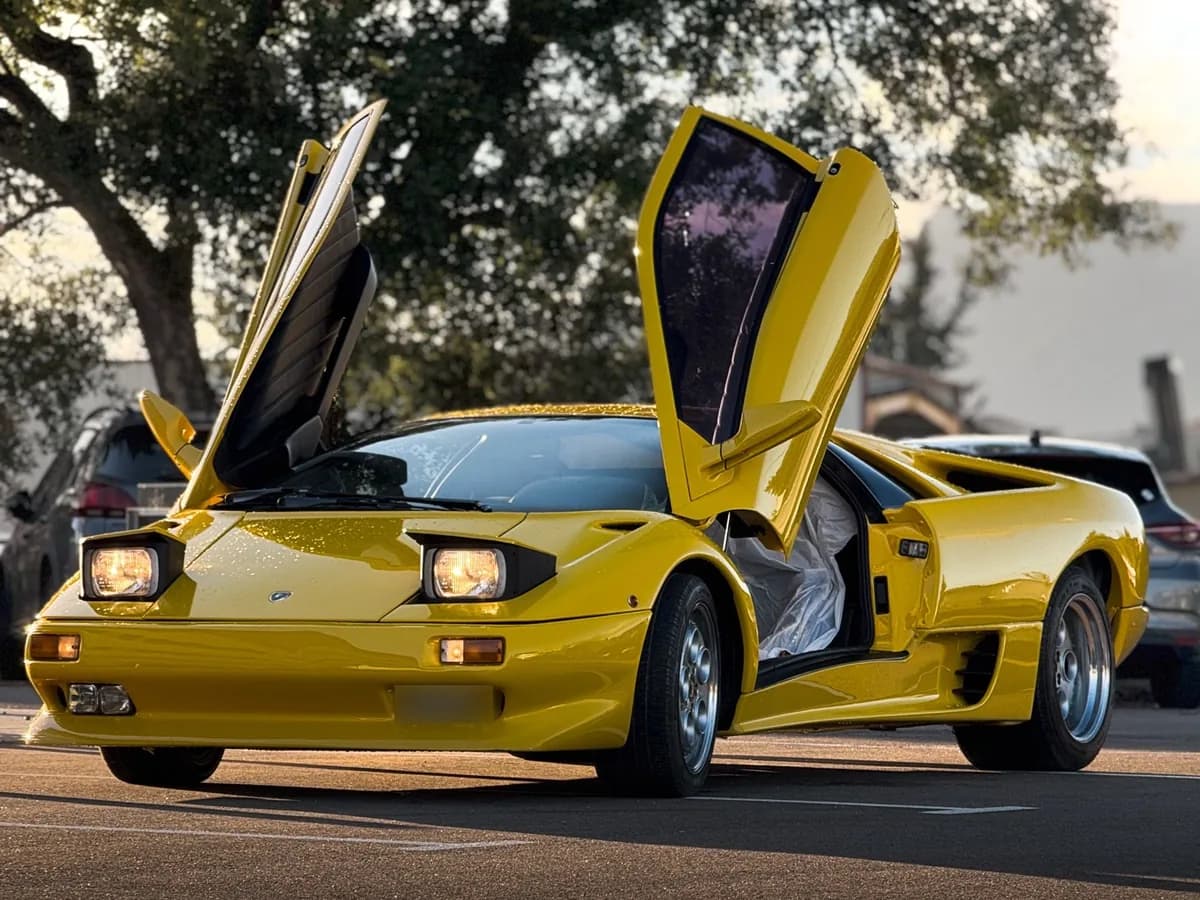
Lamborghini Diablo photos
Model summary
Data from the ScanRacer library, organized to compare versions quickly.
Model introduction
Introduced in 1990 as the successor to the Countach, the Lamborghini Diablo marked a new stage for Sant’Agata Bolognese’s mid-engined V12 flagship. Its first 5.7-liter twelve-cylinder engine produced 492 CV, while the body retained Lamborghini’s distinctive scissor doors. The Diablo initially arrived as a rear-wheel-drive berlinetta, then expanded with the all-wheel-drive VT, the Roadster, and several limited or competition-oriented versions. The ScanRacer library covers the 1990 Coupé and the 1995 Roadster, two significant points in that development. Lamborghini built 2,903 Diablos in total before the model was replaced by the Murciélago in 2001. Together, the early coupe and first production roadster illustrate how the Diablo moved from a raw Countach successor toward a broader and more technically developed flagship range.
History
The project intended to replace the Countach was completed under American management after Chrysler acquired Lamborghini in 1987. The Diablo was unveiled in Monaco in January 1990 and immediately became the company’s flagship. Its layout followed Lamborghini’s established formula: a longitudinally mounted, mid-engined V12, rear-wheel drive, and a two-seat cabin. According to Lamborghini, the original 5.7-liter engine used four valves per cylinder and produced 492 CV. The most significant early development arrived in 1993 with the Diablo VT, Lamborghini’s first grand touring model equipped with all-wheel drive. The same period brought the SE30 limited series, created to mark the company’s thirtieth anniversary. In 1995, the Diablo SV introduced a more overtly sporting direction, while the VT Roadster became Lamborghini’s first series-produced open-top V12. The Roadster was offered exclusively with all-wheel drive. Following Lamborghini’s entry into the Audi-Volkswagen Group in 1998, the Diablo received substantial styling and mechanical updates. The redesign, led by Luc Donckerwolke, formed part of the third series, which also introduced a 6.0-liter engine. Production ended in 2001, when the Diablo was succeeded by the Murciélago. Its eleven-year career therefore spans Chrysler-era development, limited-run specials, and the first major technical refinement associated with Audi ownership.
Generations
Lamborghini did not officially present the Diablo as a sequence of completely separate generations, but its development can be understood through three broad stages. The first was the 1990 berlinetta. It featured pop-up headlights, rear-wheel drive, and a 5.7-liter V12 producing 492 CV. This configuration forms the basis of the 1990 Coupé listed in the library. The second stage began with the 1993 Diablo VT. Its viscous-coupling all-wheel-drive system significantly changed the car’s traction and handling while preserving the character of the mid-engined V12 layout. The VT’s mechanical and styling improvements were later carried across other versions. The 1995 Diablo SV remained rear-wheel drive but adopted a more performance-focused specification. The VT Roadster, introduced in the same year, added an open body and became one of the most distinctive members of the Diablo family. The third stage was the late-1990s facelift. Pop-up headlights were replaced by fixed units, the body became more angular, and the cabin was updated. Final versions used a 6.0-liter engine and benefited from more developed mechanical and safety equipment. Lamborghini also identifies ABS as a first for the brand on these later cars. This was a substantial evolution of the Diablo rather than an entirely new model.
Key differences
The 1990 Coupé and the 1995 Roadster represent two different approaches. The early Coupé is the most direct expression of the Diablo formula: fixed roof, rear-wheel drive, and relatively uncompromising presentation. It belongs to the first series, with pop-up headlights and a 5.7-liter V12 producing 492 CV. The 1995 Roadster was derived from the Diablo VT and therefore used all-wheel drive. Its open body incorporated a removable roof and styling changes suited to the conversion. It was not simply a coupe with the roof removed; the Roadster was a specific factory derivative developed to retain the model’s structural integrity and visual identity. Comparing two cars therefore requires more than checking the body shape: the transmission, production year, trim, and factory documentation are all relevant. Power output alone is not a reliable identification method. Special versions such as the SE30, SV, GT, and later 6.0 cars had their own specifications, while individual cars may have been fitted with replacement wheels, spoilers, or body panels. A dependable identification should combine visible details with original paperwork and the chassis number. Market equipment can also vary, so regional specification should be treated cautiously.
Photo recognition
A first-series Diablo can usually be recognized by its extremely low stance, scissor doors, and pop-up headlights set into the nose. The rear bodywork appears especially broad and muscular compared with the front, a contrast also highlighted in Lamborghini’s historical description of the model. The 1990 Coupé should be associated with rear-wheel drive, while the 1995 Roadster belongs to the VT family and uses all-wheel drive. The Roadster is identified by its removable roof and the altered upper bodywork behind the cabin. An air intake, rear wing, or particular wheel design should not be treated as conclusive evidence, because these parts may have been changed during the car’s life or fitted as aftermarket equipment. Late-1990s facelifted Diablos replaced the pop-up headlights with fixed units and adopted more angular body surfaces. To distinguish a Coupé, VT, SV, Roadster, or limited edition, the most reliable method is to combine visual inspection with the production year, drivetrain, engine specification, identification plates, chassis number, and Lamborghini documentation. Regional equipment differences should also be considered before assigning a precise version.
Important versions
The original 1990 Diablo established the family with a 5.7-liter V12 and rear-wheel drive. The VT, launched in 1993, added all-wheel drive and became one of the model’s most important technical developments. The SE30, presented that year to celebrate Lamborghini’s thirtieth anniversary, brought a more exclusive and focused specification with a quoted output of 523 HP. In 1995, the SV remained rear-wheel drive but adopted a sportier character, while the VT Roadster introduced Lamborghini’s first series-produced open-top V12 body. Later versions included the facelifted SV, the 6.0-liter GT, and the VT 6.0. Lamborghini quotes 575 CV for the GT. These later cars should not be confused with the early Coupés and Roadsters, even though they share the Diablo name. Limited production, competition derivatives, and market-specific equipment make original documentation particularly important when identifying a high-value example.
References
- Lamborghini History - DiabloAutomobili Lamborghini
- Lamborghini Diablo’s 30th anniversary with Cesare CremoniniAutomobili Lamborghini
- Milestones: Diablo, a new recordAutomobili Lamborghini
- Lamborghini Diablo: Everything You Need to Know About the Ultimate ’90s SupercarMotorTrend
- Lamborghini Diablo (1990-2001) used car reviewRAC Drive
- https://www.carcollectorinternational.com/research/buyers-guides/lamborghini/diablocarcollectorinternational.com
- https://www.lamborghini.com/en-en/history/diablo?sword_list%255B0%255D=lamborghini&sword_list%255B1%255D=diablolamborghini.com
Frequently asked questions
- What years was the Lamborghini Diablo produced?
- ScanRacer's referenced versions cover 1990 - 1995.
- How many Lamborghini Diablo examples are documented on ScanRacer?
- 10 published scans from 8 members, with the latest photo added in September 2026.
What about the car you photographed?
Upload a photo to get a suggested make, model and likely year.
No account needed for the result · Publish only if you choose