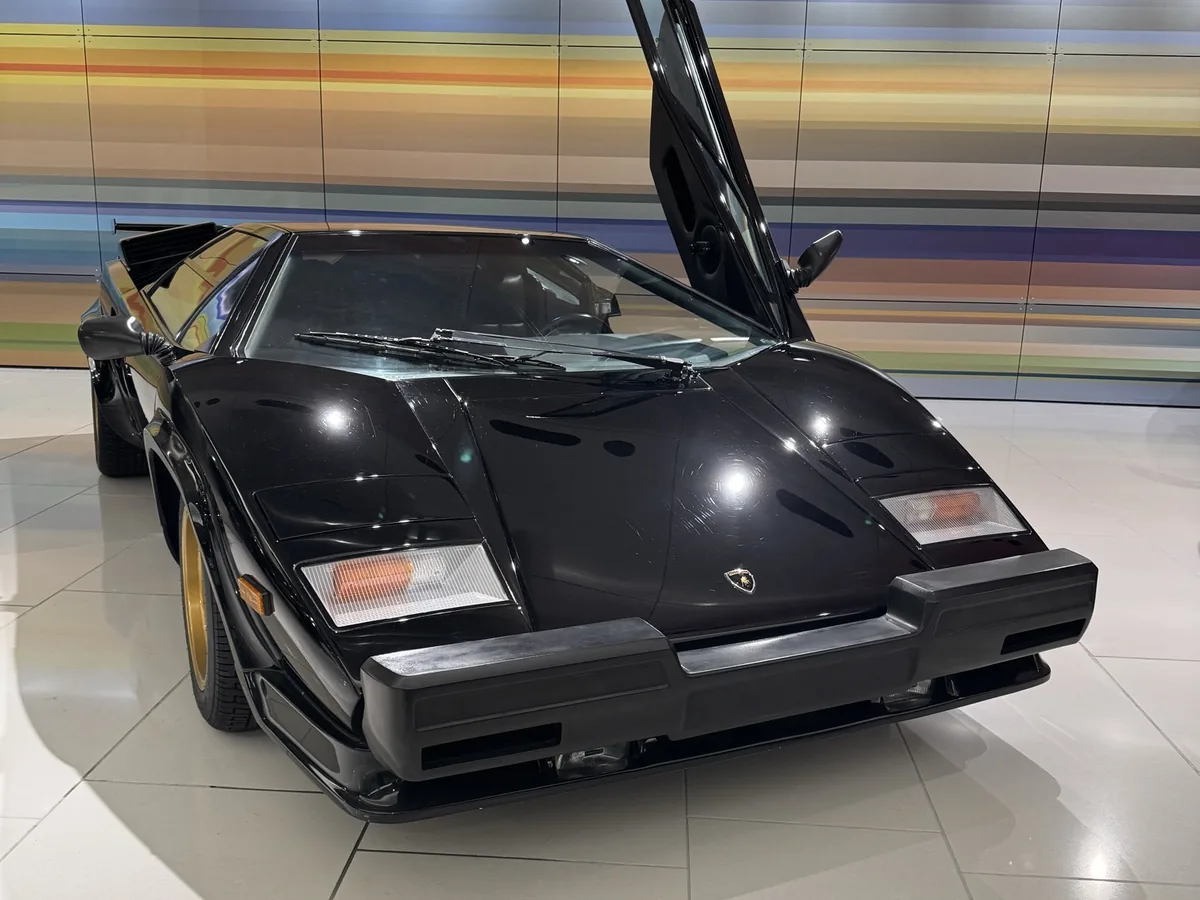
Lamborghini Countach LP5000 S Quattrovalvole 1985
Introduced in 1985, the Lamborghini Countach LP5000 S Quattrovalvole was the most substantial mechanical development of the Countach before the 25th Anniversary model. Its V12 grew to 5.2 liters and gained four valves per cylinder, with the carbureted version rated at 455 CV. The wedge-shaped body designed by Marcello Gandini remained instantly recognizable, while a raised engine cover was added to accommodate the larger power unit. Scissor doors, widened wheel arches, and a longitudinal mid-mounted engine continued to define the car’s dramatic identity. Built from 1985 to 1988, the Quattrovalvole marked the final major technical evolution of the original Countach design before Lamborghini replaced it with the Diablo in 1990.
Curious about this car?
Explore Countach, then try your own photo.
No account needed for the result · Publish only if you choose
History
The Countach originated with the LP 500 prototype shown at the Geneva Motor Show on March 11, 1971. After several prototypes, three years of development, and extensive road testing, Lamborghini began production of the LP400 in 1974. The range then progressed through the LP400 S in 1978 and the 5000 S in 1982. The latter used a 4.8-liter V12 with electronic ignition management and greater torque, according to Lamborghini’s official history. In 1985, the company revised the engine again: displacement increased to 5.2 liters and the cylinder heads adopted four valves per cylinder. The resulting Countach Quattrovalvole became the most powerful version of the family at that stage. Its raised engine cover is the clearest visual sign of the change. Production continued until 1988, when the extensively revised Countach 25th Anniversary replaced it in the range.
Latest scans
Photos added by the community for this page.
Anecdotes
Countach production remained highly manual at Sant’Agata Bolognese. Lamborghini records that body panels were shaped, checked against wooden templates, and adjusted on the body structure before being welded. As a result, cars built to the same specification could show small individual differences. The Quattrovalvole was also presented at the Geneva Motor Show in March 1985, continuing the model’s connection with one of Europe’s most important venues for high-performance cars.
Production
The Lamborghini Countach Quattrovalvole was built from 1985 to 1988, before the 25th Anniversary model arrived. Production totals differ between published references: Lamborghini’s own historical account states 631 cars, while some specialist compilations list 610. The discrepancy may result from different counting methods or production definitions, so neither figure should be presented without qualification. Regardless of the total used, the QV was produced in limited numbers compared with volume-built grand tourers. Its later production period also coincided with the Countach’s broader international availability, supported by the model’s approval for sale in the United States. Individual market versions and factory specifications should be considered when assessing surviving examples.
Press reception
Established automotive publications have generally treated the Countach as both a styling landmark and a serious performance car of its period. MotorTrend presents the 1985 LP5000 QV as a major update centered on a 5.2-liter V12 and four-valve cylinder heads, while distinguishing the output of carbureted and fuel-injected versions. That coverage reflects the car’s dual identity: it preserved the Countach’s theatrical appearance while adding a more advanced engine specification. Positive assessments tend to focus on its status as an emblematic supercar and design statement, rather than on comfort, practicality, or ease of operation. Contemporary market specification remains important when interpreting performance claims.
Evolution
Variants
References
- MilestonesAutomobili Lamborghini
Supports the 1982 5000 S development, the 1985 Quattrovalvole launch, engine displacement, valve configuration, power figures, and model chronology.
- 50 Years Ago the First Countach in Sant’Agata BologneseAutomobili Lamborghini
Supports the Countach timeline, production totals by version, manual body construction, and the 1985–1988 Quattrovalvole period.
- The Ferruccio Lamborghini Museum in Funo at the Motor Valley Fan ZoneFerruccio Lamborghini Museum
Supports the 1985 presentation, 5,187 cm³ V12, 455 hp rating, four-valve heads, and the model’s design characteristics.
- Lamborghini Countach: History, Generations, Specifications, PhotosMotorTrend
Supports the evolution from LP5000 S to LP5000 QV, carbureted and fuel-injected power figures, American-market bumper differences, and the model’s period reputation.
- Lamborghini Countach LP5000 Quattrovalvole – Specs & PerformanceLamboCARS
Supports the body style, five-speed manual transmission, rear-wheel drive, and specialist production estimate of 610 units.
- https://automotivehistory.org/last-lamborghini-countach/automotivehistory.org
Source found by OpenAI web search for this vehicle page.
- https://en.wikipedia.org/wiki/Lamborghini_Countachen.wikipedia.org
Source found by OpenAI web search for this vehicle page.
- https://www.classic.com/m/lamborghini/countach/lp5000-quattrovalvole/classic.com
Source found by OpenAI web search for this vehicle page.