
9
Presented at the 1981 Frankfurt Motor Show, the Renault 9 is a four-door compact sedan developed for family buyers seeking an affordable and versatile car. Its transverse-engine, front-wheel-drive layout reflected Renault’s technical direction at the beginning of the 1980s. The three-box body distinguished it from the Renault 11, its closely related hatchback sibling introduced later on the same basic platform. Named European Car of the Year for 1982, the Renault 9 also became part of Renault’s international strategy, with market-specific adaptations produced in several regions. In North America, it was developed into the Renault Alliance, assembled by American Motors in Wisconsin. The 1981 model year represents the beginning of the first series, identified by its restrained styling, conventional sedan proportions and extensive use of bright exterior trim. Early cars were positioned as practical, economical family transport rather than performance models.
Variants by year
1981
Model summary
Data from the ScanRacer library, organized to compare versions quickly.
Model introduction
Presented at the 1981 Frankfurt Motor Show, the Renault 9 is a four-door compact sedan developed for family buyers seeking an affordable and versatile car. Its transverse-engine, front-wheel-drive layout reflected Renault’s technical direction at the beginning of the 1980s. The three-box body distinguished it from the Renault 11, its closely related hatchback sibling introduced later on the same basic platform. Named European Car of the Year for 1982, the Renault 9 also became part of Renault’s international strategy, with market-specific adaptations produced in several regions. In North America, it was developed into the Renault Alliance, assembled by American Motors in Wisconsin. The 1981 model year represents the beginning of the first series, identified by its restrained styling, conventional sedan proportions and extensive use of bright exterior trim. Early cars were positioned as practical, economical family transport rather than performance models.
History
The Renault 9 project emerged in the second half of the 1970s, as Renault sought to replace its compact family saloons positioned between the Renault 5 and Renault 18. The company chose a conventional three-box design, one that could be adapted more easily to different markets than the distinctive Renault 14. The car was officially presented at Frankfurt in 1981 before entering the market as a four-door sedan. The Renault 11 later joined the range with a hatchback body, adding greater cargo flexibility while sharing the same broad engineering family. The Renault 9 quickly gained major recognition by winning the 1982 European Car of the Year award. Its appeal came less from a single breakthrough than from a balanced combination of interior space, reasonable fuel economy, ride comfort and manageable ownership costs. Renault also used the model as part of a global strategy, producing or marketing adapted versions outside Europe. In North America, the car became the Renault Alliance, assembled by American Motors and modified for local safety, emissions and equipment requirements. The European range expanded through additional engines, higher trim levels and eventually Turbo derivatives. A more substantial facelift arrived for the 1987 model year, bringing a revised front end and a more integrated appearance. French production ended toward the close of the 1980s, although the Renault 9 and related derivatives continued to be built or sold for longer periods in selected countries.
Generations
The Renault 9 is commonly divided into two main European phases. Phase 1 covers the first years of production, beginning in 1981. It is identified by angular bodywork, a separate grille, generally black or partly bright-finished bumpers and a deliberately conventional exterior presentation. Entry-level cars used small-displacement petrol engines, while the range later expanded with larger engines and better-equipped trim levels. The GTX and TXE versions illustrate Renault’s move toward more upscale equipment during the middle of the decade. A styling update arrived before the larger redesign associated with 1986, including the use of a four-headlamp front treatment on certain versions and the introduction of the Renault 9 Turbo. Phase 2, introduced for the 1987 model year, brought the Renault 9 visually closer to the Renault 11. It featured a redesigned front end, smoother surfaces, a more integrated grille and, depending on trim, body-coloured bumpers. The interior was updated as well. The phase distinction is useful when identifying a car, although timing could vary between markets and inventories. Overseas production did not always follow the French calendar exactly. A 1981 Renault 9 therefore belongs to the first series, but its engine, trim and equipment may still vary according to the country where it was sold. The North American Alliance should be treated as a related market adaptation rather than an identical European specification.
Key differences
Differences between Renault 9 models are not limited to trim badges. Early cars could use 1.1- or 1.4-litre petrol engines, with transmissions and equipment varying by market. More expensive versions generally added comfort features, improved interior presentation and, depending on the year, extra instrumentation or convenience equipment. Larger 1.7-litre engines appeared later in the European career of the model. The clearest visual distinction is between Phase 1 and Phase 2 cars. The first series emphasizes bright trim, straight-edged styling and a separate grille. The second series uses a smoother front end, differently shaped lamps and more colour-coordinated exterior finishing. The Renault 9 Turbo stands apart through its turbocharged engine, aerodynamic details, dedicated wheels and sportier cabin treatment. North American cars sold as the Renault Alliance were not simply rebadged European Renault 9s. They received changes to meet local safety and emissions rules, along with different bumpers, equipment and styling details. Model names and specifications could therefore differ considerably between countries. Identification should rely on the bodywork, year, engine, market and factory documentation rather than on the trim name alone.
Photo recognition
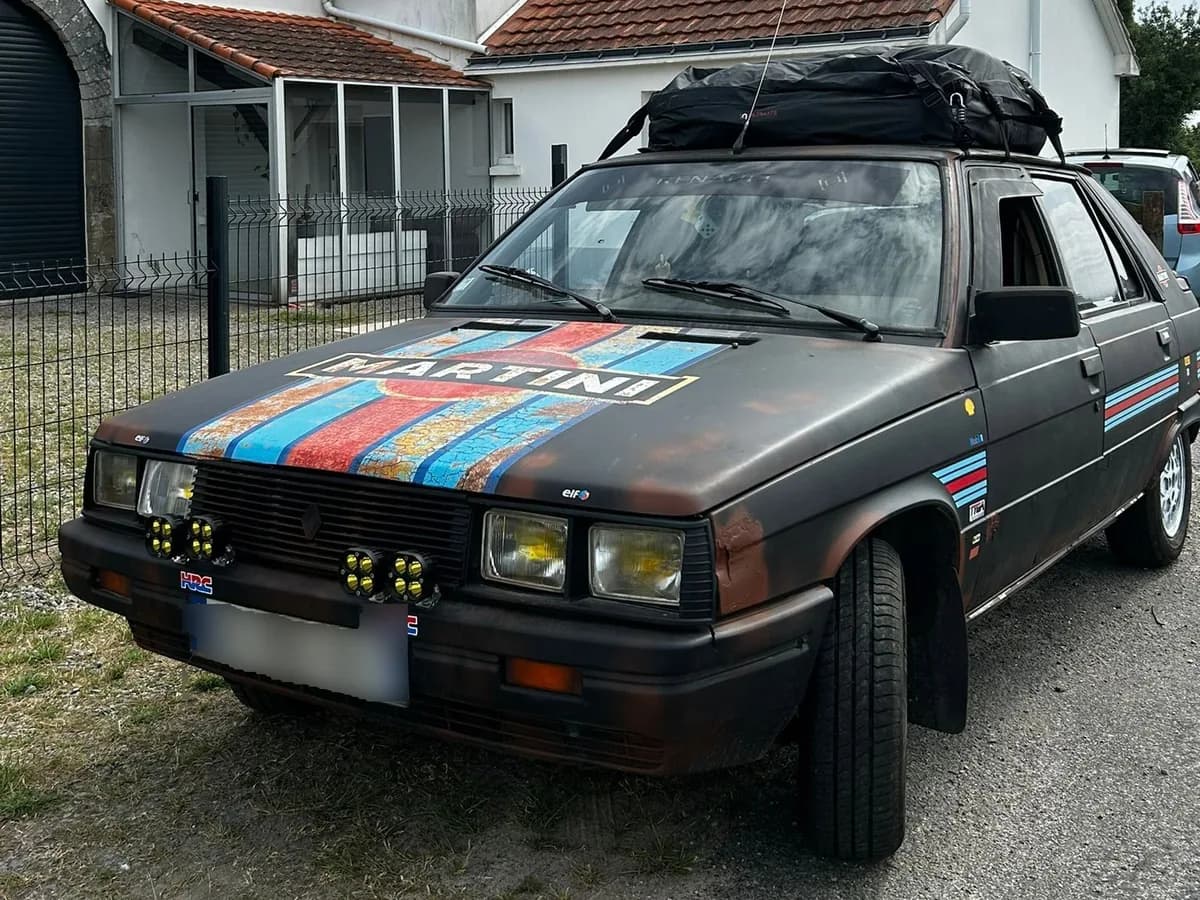
A Renault 9 is first identified by its four-door three-box sedan body and separate trunk. It should not be confused with the Renault 11, which uses a hatchback and two-box profile. On a Phase 1 car, look for angular surfaces, a distinct grille, bright window surrounds and other polished details that give the sedan a traditionally styled appearance. Early versions generally have a simple front end with two main headlamps. Later cars may use four headlamps at the front, followed by a fully redesigned Phase 2 nose. The later version is identified by smoother surfaces, a more integrated grille and, on some trims, bumpers painted to match the body. A Renault 9 Turbo adds distinctive clues such as alloy wheels, sportier bumpers, side graphics and a more performance-oriented interior. For a 1981 car, the combination of four-door sedan proportions, first-phase styling and bright exterior trim is the most useful starting point. However, replacement parts, optional equipment and regional specifications can make visual identification less certain. The VIN plate, engine code, period brochure and market-specific details should be checked before assigning a precise version.
Important versions
The 1981 base version represents the entry point to the Renault 9 range, emphasizing straightforward mechanical specification, restrained styling and less equipment than the higher trims. GTX and TXE versions later strengthened the model’s comfort-oriented image with larger engines and richer equipment, depending on the market. Introduced during the middle of the decade, the Renault 9 Turbo became the main sporting derivative, combining a turbocharged 1.4-litre engine with dedicated exterior and interior details. The Renault Alliance is also an important international derivative. Built in North America by American Motors, it retained the Renault 9’s basic engineering while receiving modifications for local regulations and customer expectations. Names such as Broadway, TSE, GTX and TXE should not be treated as universal specifications: their equipment and mechanical content varied according to country and model year. Period documentation is therefore essential when identifying a particular car.
The name “9” follows Renault naming, with its rules and its exceptions. Decode a Renault name
References
- Heritage — Renault 9Renault UK Press Office
- Renault 9/Alliance and 11/EncoreHemmings
- Renault R9 1981-1989Auto Encyclopédie
- Renault 9 and 11 Club de France — Renault 9Renault 9 et 11 Club de France
- 1981 Renault 9 phase-I Sedan specificationsAutomobile-Catalog
- https://www.encyclautomobile.fr/fr/encyclauto/automobile/renault/renault-9.htmlencyclautomobile.fr
- https://classic-parts-finder.com/en/car-parts/renault/9-alliance-broadway-11-encore-r9-r11/documentation-accessories/r9-phase-1-sales-brochure_6706classic-parts-finder.com
Frequently asked questions
- What years was the Renault 9 produced?
- ScanRacer's referenced versions cover 1981.
- How many Renault 9 examples are documented on ScanRacer?
- 2 published scans from 2 members, with the latest photo added in September 2026.