
Carrera GT
Presented at the 2000 Paris Motor Show, the Porsche Carrera GT is a two-seat, mid-engined supercar built around a naturally aspirated 5,733 cc V10. Its carbon-fibre monocoque, lightweight cockpit, six-speed manual transmission, and active aerodynamic elements reflect solutions developed from a racing programme. For the 2003 model year, Porsche listed 450 kW, or 612 hp, a top speed of 330 km/h, and a 0–100 km/h time of 3.9 seconds. The Carrera GT therefore represents a distinctly mechanical approach to performance, combining rear-wheel drive, a manual gearbox, and a competition-influenced chassis with a removable-roof roadster body. Rather than being a high-volume sports car derivative, it was conceived as a highly focused flagship showcasing Porsche engineering.
What about the car you photographed?
Upload a photo to get a suggested make, model and likely year.
No account needed for the result · Publish only if you choose
Variants by year
Make: Porsche · Model: Carrera GT
1 / 1 versions shown
2003
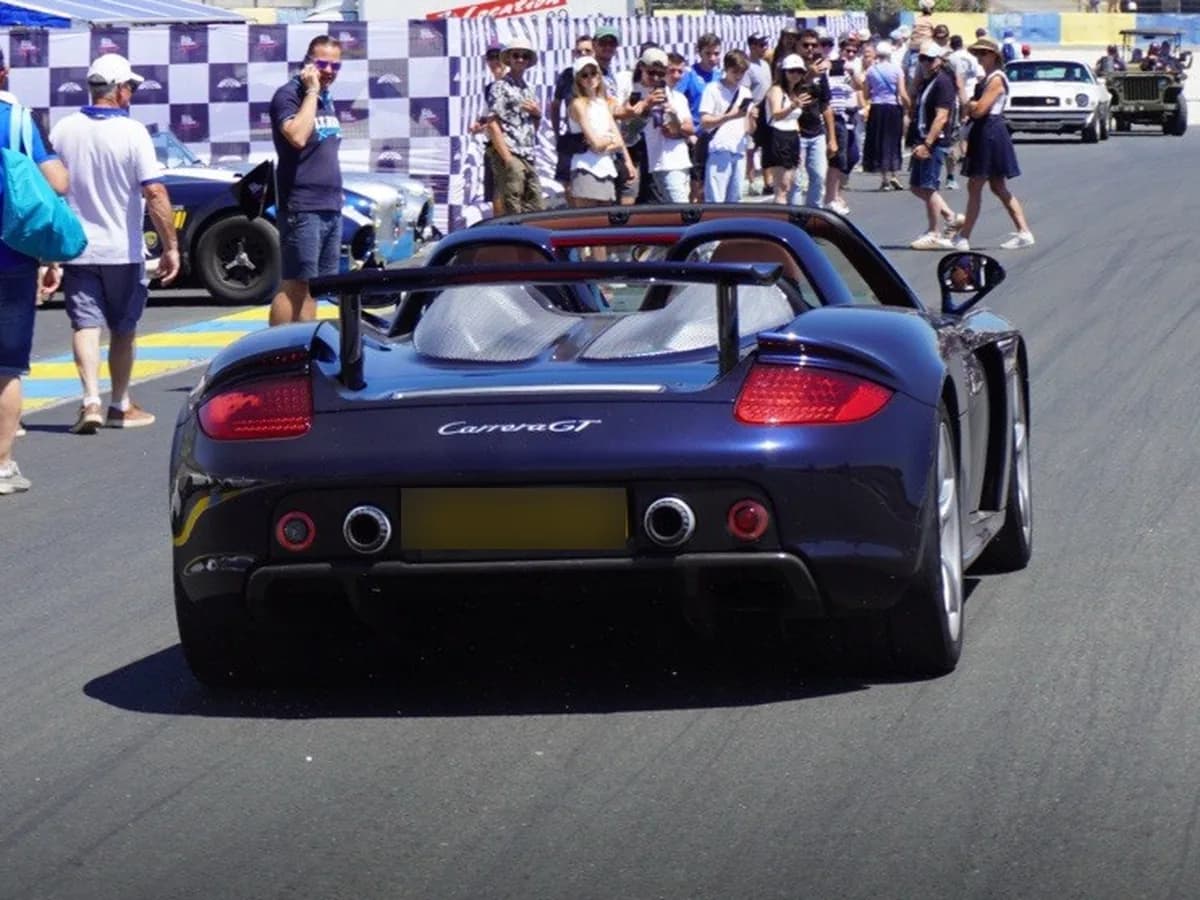
Porsche Carrera GT photos
Model summary
Data from the ScanRacer library, organized to compare versions quickly.
Model introduction
Presented at the 2000 Paris Motor Show, the Porsche Carrera GT is a two-seat, mid-engined supercar built around a naturally aspirated 5,733 cc V10. Its carbon-fibre monocoque, lightweight cockpit, six-speed manual transmission, and active aerodynamic elements reflect solutions developed from a racing programme. For the 2003 model year, Porsche listed 450 kW, or 612 hp, a top speed of 330 km/h, and a 0–100 km/h time of 3.9 seconds. The Carrera GT therefore represents a distinctly mechanical approach to performance, combining rear-wheel drive, a manual gearbox, and a competition-influenced chassis with a removable-roof roadster body. Rather than being a high-volume sports car derivative, it was conceived as a highly focused flagship showcasing Porsche engineering.
History
The Carrera GT project received approval in February 1999 with the stated aim of bringing racing technology reliably to the road. Porsche then showed a near-production prototype in Paris on September 28, 2000. The concept was connected to an abandoned endurance-racing programme: its naturally aspirated V10 and several engineering principles grew from work intended for a Le Mans project. Strong interest in the prototype led Porsche to approve production, initially planned around 1,000 cars to support the required investment. Series production began at Porsche’s Leipzig facility in autumn 2003. Assembly remained highly manual, and the final total exceeded the original target: Porsche records 1,270 Carrera GTs built by May 6, 2006. That brief production run gives the car a distinctive place in the company’s modern history. The Carrera GT was not an evolution of an established range such as the 911; it functioned instead as an independent technology flagship. Development included extensive chassis testing by Walter Röhrl, whose work helped refine the suspension and road behaviour, including testing carried out at the Nürburgring.
Generations
The Carrera GT is not divided into several clearly named generations. Available historical and technical material presents it as a single model line produced over a short period from autumn 2003 to May 2006. Within the 2003 library context, the listed car is the base version, with no documented separation into multiple generations, body styles, or engine families. That does not mean the 2000 concept and production car were identical. The Paris prototype established the overall layout, while the road car introduced production-specific details such as conventional instrumentation, a carbon-fibre passenger cell, a two-panel removable roof, and equipment intended for road use. Any differences found between individual cars should therefore be treated as equipment, market, or production-year distinctions unless Porsche documentation identifies a formal change. It is more accurate to describe the Carrera GT as one production model with possible specification variations than to create an unsupported generation structure.
Key differences
The Carrera GT is defined first by its layout: a naturally aspirated V10 mounted behind the cabin, rear-wheel drive, and a six-speed manual gearbox. Porsche’s 2003 data lists 612 hp from the 5,733 cc engine, while the technical sheet gives a maximum engine speed of 8,900 rpm for a powerplant rooted in endurance-racing development. The central structure and body use carbon fibre, with chassis and cockpit components designed around weight reduction. The car also stands apart through ceramic composite brakes, magnesium wheels, a twin-plate ceramic clutch, and a retractable rear wing. These features are not documented as separate trim levels in the available 2003 information; they form part of the Carrera GT’s overall engineering concept. The Base designation should therefore not be interpreted as a stripped-down mechanical version. It identifies the production model recorded for the year, with no confirmed evidence of a higher-performance engine or chassis derivative within the 2003 range.
Photo recognition
A Carrera GT can be identified by its extremely low roadster profile, twin roll hoops behind the seats, and large side air intakes built into the bodywork. The roof consists of two removable carbon-fibre panels stored in the front compartment. At the rear, a ventilated engine cover exposes the V10, while the rear wing rises automatically at higher speeds. Large-diameter wheels secured by a central nut and high-mounted exhaust outlets further reinforce the car’s competition-inspired appearance. Inside, the high-mounted gear lever on the central console is one of the model’s most distinctive details. Visible carbon structure and composite seats provide additional clues. Visual identification should still be checked against vehicle documentation, because paint, equipment, original market, and later modifications can differ from one car to another. These details help distinguish a genuine production Carrera GT from a concept, replica, or extensively modified example.
Important versions
For the 2003 model year, the recorded version is the Carrera GT Base. Porsche’s reference material describes the production car with a naturally aspirated 5,733 cc V10, 612 hp, a six-speed manual gearbox, and a stated top speed of 330 km/h. The available Porsche sources do not document a more powerful mechanical variant or an alternative body style for this model year. The production car should be distinguished from the Carrera GT prototype shown in Paris in 2000. That prototype established the technical and visual direction, but some specifications and equipment details changed before series production. Differences between individual cars should therefore be attributed cautiously to equipment, market specification, or options rather than automatically treated as a separate official version.
The name “Carrera GT” follows Porsche naming, with its rules and its exceptions. Decode a Porsche name
References
- Porsche Carrera GTPorsche Newsroom
- Porsche Carrera GT technical data sheetPorsche Museum
- 2004 Porsche Carrera GT - First Drive ReviewCar and Driver
- Tested: 2004 Porsche Carrera GT Defines MagnificentCar and Driver
- https://www.cars.com/research/porsche-carrera_gt-2004/specs/cars.com
- https://www.kbb.com/porsche/carrera-gt/2004/kbb.com
- https://www.carcollectorinternational.com/research/buyers-guides/porsche/carrera-gtcarcollectorinternational.com
Frequently asked questions
- What years was the Porsche Carrera GT produced?
- ScanRacer's referenced versions cover 2003.
- How many Porsche Carrera GT examples are documented on ScanRacer?
- 16 published scans from 14 members, with the latest photo added in October 2026.
What about the car you photographed?
Upload a photo to get a suggested make, model and likely year.
No account needed for the result · Publish only if you choose