Mitsubishi L200 2015
Introduced in 2015, the Mitsubishi L200 Base belongs to the Japanese pickup’s fifth generation. It replaced a model that had been on sale for nine years and brought a substantially revised chassis, more aerodynamic bodywork and a cabin designed to offer greater passenger comfort. European-market versions used Mitsubishi’s 2.4-litre 4N15 diesel engine, with six-speed manual and automatic transmission options depending on specification. The name “Base” should be treated cautiously because trim names, body styles and equipment differed between countries. Regardless of market, the 2015 L200 remained a working pickup first, combining a separate-frame chassis with practical load-carrying ability, towing capacity and selectable or more advanced four-wheel-drive systems. Its significance lies in how Mitsubishi attempted to make a traditional utility vehicle quieter, more efficient and easier to use without abandoning its off-road purpose.
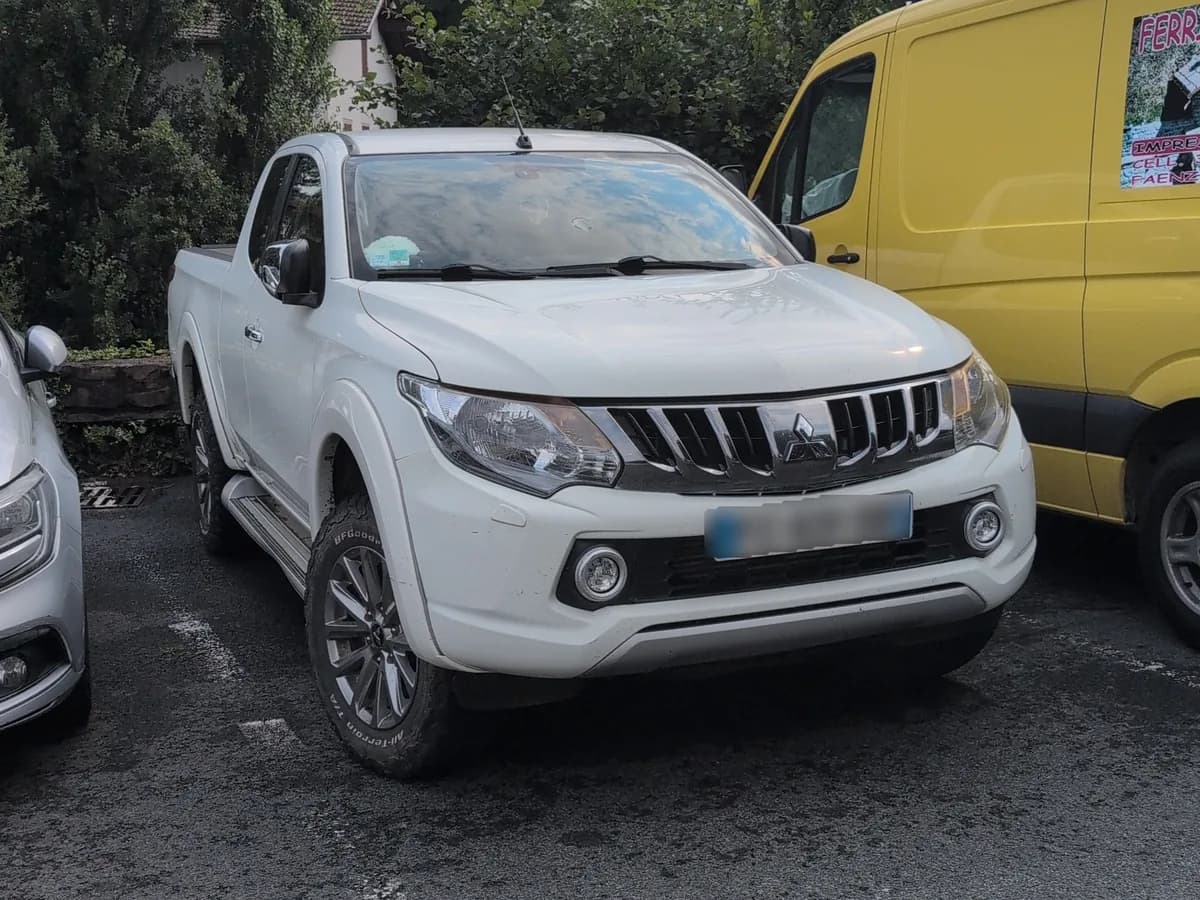
Curious about this car?
Explore L200, then try your own photo.
No account needed for the result · Publish only if you choose
History
The fifth-generation Mitsubishi L200 first appeared as the Triton or Strada in some markets before reaching Europe during 2015. Mitsubishi showed the European-specification truck at the Geneva Motor Show in March 2015, with market launches following during the summer and autumn. It replaced the fourth-generation L200 after nine years of production. Rather than presenting the newcomer as a simple facelift, Mitsubishi described it as a comprehensive redesign covering the frame, suspension, aerodynamics, interior and safety equipment. The separate-frame architecture and rear leaf springs preserved the truck’s working credentials, while revised suspension and steering were intended to improve stability and everyday drivability. European models used the new 4N15 2.4-litre diesel in two output levels. Entry versions generally used selectable four-wheel drive, while higher-specification models could be equipped with Super Select 4WD-II. Body styles and trim names varied by country, so a generic “Base” designation does not identify one universal equipment package.
Latest scans
Photos added by the community for this page.
Anecdotes
The fifth-generation L200 retained Mitsubishi’s distinctive “J-line”, the side character line linking the cab visually with the load bed. The same vehicle was also sold under different names in other regions, most notably Triton and Strada. Mitsubishi placed unusual emphasis on efficiency for a traditional pickup, highlighting CO2 emissions of 169 g/km for certain European manual versions at launch. That figure was not universal, however, because emissions varied with engine output, body style and transmission. The truck’s identity was therefore shaped by both its global design and its market-specific configurations.
Production
No source consulted establishes a production total specifically for the 2015 Mitsubishi L200 Base. The vehicle belonged to a globally distributed pickup family, with production closely associated with Mitsubishi Motors facilities in Thailand. During the 2015 European launch campaign, Mitsubishi stated that the outgoing fourth generation had exceeded 1.3 million vehicles produced by September 2014. A separate company communication referred to more than four million L200 vehicles sold worldwide since the nameplate’s beginnings. Those figures describe the wider L200 lineage or an earlier generation and should not be presented as the output of the 2015 Base version. Exact volumes also varied by market, cab configuration, drivetrain and trim. For that reason, a precise production number for this individual specification remains unconfirmed.
Press reception
Automotive coverage generally treated the 2015 L200 as a substantial redesign rather than a cosmetic update. L’Argus highlighted the revised frame, engine and cabin while noting that the truck retained the fundamental qualities expected of a working pickup. Motoring Research praised the improvement in ride comfort, stability, refinement and everyday usability, particularly for small-business users who also needed family-friendly transport. Reviews nevertheless made clear that the driving character and equipment depended heavily on trim and transmission. Euro NCAP published a four-star result for the L200 in 2015 in the tested specification. That rating should be read in context, because safety equipment and market specifications were not identical across every global version. Overall, contemporary reception was favorable toward the model’s balance between utility and road manners.
Evolution
The 2015 L200 was more than a styling update. Mitsubishi revised the truck’s frame, suspension, steering, aerodynamics and interior, claiming a 7 percent increase in torsional rigidity and lower emissions than the outgoing model. The new 2.4-litre diesel replaced the previous European powertrain and was offered in two output levels. Passenger comfort also became a stronger priority, with a quieter, more refined cabin and a broader range of safety equipment. The model still retained a clear distinction between work-focused and higher-grade versions. Lower trims combined the less powerful engine with a simpler selectable four-wheel-drive system, while more expensive variants could use the stronger engine and Super Select 4WD-II. Because regional catalogues differed, the exact specification of a vehicle identified only as “Base” cannot be established without a market, body style or vehicle identification number.
Variants
References
- Mitsubishi Motors at the 2015 Geneva International Motor ShowMitsubishi Motors
Official European introduction, engine outputs, dimensions, emissions and Super Select 4WD-II information.
- Mitsubishi presenteert nieuwe L200Mitsubishi Motors Netherlands
Official 2015 press release covering the fifth generation, production context, engine variants, transmissions, chassis development and global sales claims.
- Essai Mitsubishi L200 2015 : Un pick-up pur et durL’Argus
French road test covering the redesigned chassis, engine outputs, body styles, French trim names and contemporary assessment.
- 2015 Mitsubishi L200 reviewMotoring Research
Contemporary driving impressions, UK entry-level equipment context and performance range.
- Mitsubishi L200 - Euro NCAP Results 2015Euro NCAP
Official 2015 safety-test publication and tested-vehicle documentation.
- https://press.mitsubishi.pl/pr/312093/nowe-mitsubishi-l200-zadebiutuje-w-genewie-312093press.mitsubishi.pl
Source found by OpenAI web search for this vehicle page.
- https://www.mitsubishiman.ru/en/L200mitsubishiman.ru
Source found by OpenAI web search for this vehicle page.
- https://www.whatcar.com/mitsubishi/l200/4x4/used-review/n19676whatcar.com
Source found by OpenAI web search for this vehicle page.