
SLR McLaren
Revealed at the Frankfurt Motor Show in September 2003, the Mercedes-Benz SLR McLaren was a supercar created through the collaboration between Mercedes-Benz and McLaren. Customer deliveries began in April 2004, with production taking place at McLaren’s Woking facility in the United Kingdom. The car combined an extensive composite structure, a hand-built supercharged Mercedes-AMG V8 and the high-speed comfort expected of a grand touring flagship. Its range developed from the original coupé into a Roadster and several more extreme limited editions. In the ScanRacer chronology, the coupé is listed for 2003, the Roadster for 2007 and the Speedster for 2009. That final designation corresponds to the SLR Stirling Moss, an open-bodied version without a conventional roof or windscreen that closed the model’s production story.
What about the car you photographed?
Upload a photo to get a suggested make, model and likely year.
No account needed for the result · Publish only if you choose
Variants by year
Make: Mercedes-Benz · Model: SLR McLaren
3 / 3 versions shown
2009

2007

2003
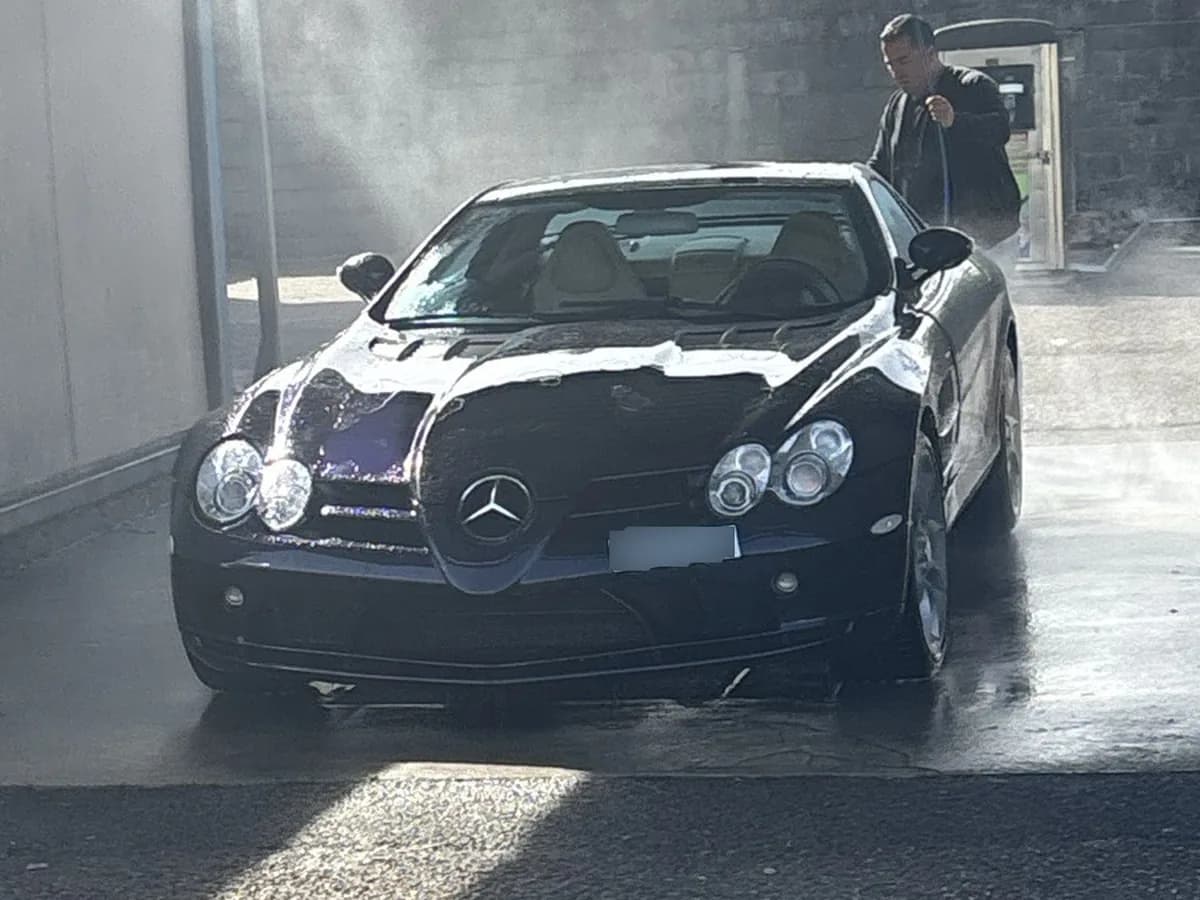
Mercedes-Benz SLR McLaren photos
Model summary
Data from the ScanRacer library, organized to compare versions quickly.
Model introduction
Revealed at the Frankfurt Motor Show in September 2003, the Mercedes-Benz SLR McLaren was a supercar created through the collaboration between Mercedes-Benz and McLaren. Customer deliveries began in April 2004, with production taking place at McLaren’s Woking facility in the United Kingdom. The car combined an extensive composite structure, a hand-built supercharged Mercedes-AMG V8 and the high-speed comfort expected of a grand touring flagship. Its range developed from the original coupé into a Roadster and several more extreme limited editions. In the ScanRacer chronology, the coupé is listed for 2003, the Roadster for 2007 and the Speedster for 2009. That final designation corresponds to the SLR Stirling Moss, an open-bodied version without a conventional roof or windscreen that closed the model’s production story.
History
The SLR McLaren originated with the Vision SLR concept shown in 1999. Mercedes-Benz and McLaren subsequently developed that study into a production car, with the definitive model making its public debut at Frankfurt in 2003. The SLR name connected the project with Mercedes-Benz’s 300 SLR competition cars of the 1950s, while McLaren contributed expertise in high-performance vehicle development and low-volume manufacturing. The first customer cars were delivered in April 2004. Production took place at McLaren’s Woking facility rather than on a conventional Mercedes-Benz mass-production line, reinforcing the car’s exclusive character. Mercedes-Benz stated that total production would not exceed 3,500 cars. The original coupé was followed by the SLR Roadster and a series of special editions linked to Stirling Moss and Denis Jenkinson’s 1955 Mille Miglia victory. The 722 Edition gave the model a sharper sporting focus, followed by the 722 S Roadster and the SLR Stirling Moss. Standard Roadster production ended in May 2009. Stirling Moss production began in June 2009, and the SLR model series concluded in December 2009. This timeline is why the SLR is best understood as a single, highly developed model programme rather than a conventional vehicle line divided into successive generations.
Generations
The SLR McLaren is not divided into generations in the usual automotive sense. It is a single model series, identified in Mercedes-Benz archival material as the 199 series, whose main developments concerned body style and performance specification. The first stage was the C199 coupé, shown in 2003 and delivered from 2004. It established the reference layout, with a closed cabin, upward-opening doors and a long, distinctive profile emphasized by side-exit exhausts. The R199 Roadster followed with a folding fabric roof. Its structure incorporated additional measures around the front pillars to maintain the required rigidity after removing the fixed roof. The powertrain remained closely related to the coupé’s, but the open body changed both the visual character and the touring experience of the car. The final major evolution was the SLR Stirling Moss, often described as a speedster. It discarded the conventional roof and windscreen in favor of twin aerodynamic screens, a design inspired by Mercedes-Benz racing cars and a strictly limited production run of 75 examples. In the ScanRacer nomenclature, these three principal body configurations appear as Coupé, Roadster and Speedster, associated respectively with 2003, 2007 and 2009.
Key differences
The coupé is identified by its fixed roof and enclosed silhouette. It represents the original SLR configuration and provides the reference point for Mercedes-Benz’s published performance data: a hand-built supercharged V8, five-speed automatic transmission, 780 Nm of peak torque and a 0–100 km/h time of 3.8 seconds in archival specifications. The Roadster retains the coupé’s fundamental architecture but replaces the fixed roof with a folding fabric top. Its structure was adapted for open-air use, giving it a different visual identity and touring character. The 722 and 722 S should not be treated as separate generations; they are higher-performance derivatives with increased output, reduced weight and revised aerodynamic or chassis components. The Speedster, represented by the Stirling Moss, is considerably easier to distinguish. It has neither a roof nor a conventional windscreen and uses a dedicated body, revised aerodynamics and a production limit of 75 cars. It was a final special version rather than a standard Roadster with its roof removed.
Photo recognition
The SLR McLaren has several dependable visual identifiers. At the front, its very long bonnet leads to a narrow Mercedes-Benz grille, while the nose and slim headlamps create a pronounced arrow-shaped profile. The upward-opening doors are another defining feature, as are the exhaust outlets mounted in the body sides behind the front wheels. Together, these details distinguish the SLR from many other front-engined supercars. The coupé has a fixed roof and integrated rear glass. The Roadster is identified by its folding fabric top but retains the same distinctive door arrangement. 722 versions generally show more aggressive details, including a deeper front aerodynamic element, dedicated wheels, red badging and darker exterior trim. These clues should still be checked carefully because body panels, wheels and trim can be changed during a car’s life. The Stirling Moss is immediately recognizable through its twin aerodynamic screens, complete absence of a roof and speedster bodywork. A side or three-quarter view will usually separate it from the conventional Roadster. The lack of a windscreen is the most decisive clue, while the limited-production body makes visual confusion with a standard SLR unlikely.
Important versions
The original coupé is the foundation of the range and the body style most directly associated with the SLR’s launch. The Roadster followed with an open body while retaining the model’s essential architecture and engine. Introduced in the mid-2000s, the 722 Edition paid tribute to the Mercedes-Benz 300 SLR driven by Stirling Moss and Denis Jenkinson to victory in the 1955 Mille Miglia; it added more power, weight reduction and a more performance-focused chassis. The 722 S applied the same idea to the Roadster. The SLR Stirling Moss is the rarest and most visually dramatic derivative. Presented as a speedster without a roof or conventional windscreen, it produced 650 hp according to Mercedes-Benz and was limited to 75 examples. In the ScanRacer catalogue, it is represented by the 2009 Speedster variant.
The name “SLR McLaren” follows Mercedes-Benz naming, with its rules and its exceptions. Decode a Mercedes-Benz name
References
- 199 series SLR McLaren High Performance Sports Car, 2004–2009Mercedes-Benz Public Archive
- 2007 Mercedes-Benz SLR McLaren 722 Edition — First DriveCar and Driver
- 2008 Mercedes-Benz SLR McLaren Roadster — First DriveCar and Driver
- 2009 Mercedes-Benz SLR McLaren Stirling MossPetersen Automotive Museum
Frequently asked questions
- What years was the Mercedes-Benz SLR McLaren produced?
- ScanRacer's referenced versions cover 2003 - 2009.
- How many Mercedes-Benz SLR McLaren examples are documented on ScanRacer?
- 27 published scans from 18 members, with the latest photo added in October 2026.
What about the car you photographed?
Upload a photo to get a suggested make, model and likely year.
No account needed for the result · Publish only if you choose