
MC12
Introduced in 2004, the Maserati MC12 is a mid-engined two-seat supercar created to support Maserati’s return to international GT racing. Its road-going form, known as the MC12 Stradale, combines a naturally aspirated 5,998 cc V12, a carbon-fibre monocoque and a distinctive long-tail body. Maserati states that only 50 road cars were produced between 2004 and 2005. The road-legal MC12 uses a coupe-spyder body with a removable hardtop and a six-speed Cambiocorsa automated manual transmission. Although it shares technical roots with the Ferrari Enzo, Maserati made substantial changes to the engine, chassis and aerodynamic package. The 2005 model year therefore belongs to the final production period of the short-lived MC12 Stradale, a homologation-focused road car with a clear connection to Maserati’s GT1 racing programme.
Variants by year
2005
2004

Model summary
Data from the ScanRacer library, organized to compare versions quickly.
Model introduction
Introduced in 2004, the Maserati MC12 is a mid-engined two-seat supercar created to support Maserati’s return to international GT racing. Its road-going form, known as the MC12 Stradale, combines a naturally aspirated 5,998 cc V12, a carbon-fibre monocoque and a distinctive long-tail body. Maserati states that only 50 road cars were produced between 2004 and 2005. The road-legal MC12 uses a coupe-spyder body with a removable hardtop and a six-speed Cambiocorsa automated manual transmission. Although it shares technical roots with the Ferrari Enzo, Maserati made substantial changes to the engine, chassis and aerodynamic package. The 2005 model year therefore belongs to the final production period of the short-lived MC12 Stradale, a homologation-focused road car with a clear connection to Maserati’s GT1 racing programme.
History
The MC12 project grew from Maserati’s plan to return to top-level GT racing after several decades away from the category. Entering a GT class required a homologated road-going basis, so the MC12 Stradale was developed alongside the MC12 GT1 race car rather than as a conventional grand tourer. Its unusually long body was designed by Maserati Centro Stile to support high-speed stability and aerodynamic efficiency. The structure uses a carbon-fibre and Nomex honeycomb monocoque with aluminium front and rear subframes. The road car is powered by a 65-degree, 5,998 cc V12 with dry-sump lubrication and a rear-mounted transaxle. Maserati lists 630 hp at 7,500 rpm and a top speed of 330 km/h. Total Stradale production was limited to 50 cars built across the 2004 and 2005 production years. These road cars fulfilled the homologation requirement, but they should not be confused with the MC12 GT1 competition car or the later MC12 Versione Corse, a non-road-legal track model. On the racing side, the GT1 won the 2005 FIA GT championship, giving the MC12 significance well beyond its tiny production run. The road car is therefore best understood as a highly specialized homologation model shaped by Maserati’s competition programme.
Generations
The MC12 is not generally divided into multiple generations. Road production consisted of one short series, usually identified as the MC12 Stradale, built from 2004 through 2005. A 2005 example therefore belongs to the same brief generation as the 2004 cars, with no documented generational redesign between the two production years. Maserati’s official information lists 50 road cars in total, a mid-engined two-seat layout and the M144 model code. The important distinction is between the different MC12 derivatives. The Stradale is the road-legal version, fitted with a removable hardtop and a specification adapted for public-road use. The MC12 GT1 is the racing car developed for international competition, with its own bodywork, aerodynamic configuration, setup and regulatory limitations. The MC12 Versione Corse arrived in 2006 for private customers seeking a dedicated track experience. It was not road legal and was limited to 13 cars: one prototype and 12 customer examples. These derivatives share a common family identity, but they are not interchangeable. In particular, the Versione Corse should not be treated as a higher trim level of the 2005 road car, and the GT1’s race specifications should not be applied directly to the Stradale.
Key differences
No major annual update for the 2005 road car is clearly established by the sources reviewed. It is the second and final production year of the MC12 Stradale, retaining Maserati’s published core specification: a naturally aspirated 5,998 cc V12, 630 hp, a six-speed Cambiocorsa transmission, a carbon-fibre and Nomex monocoque, and a 330 km/h top speed. The library context lists one 2005 variant named Base, so undocumented trim or mechanical distinctions should not be added. The most important difference is the vehicle’s identity. A 2005 MC12 Stradale is a road-legal homologation car, while the MC12 GT1 is a racing machine. The Versione Corse, introduced from 2006, is a separate track-only derivative with 755 hp and no road homologation. Its power, weight and aerodynamic data should not be transferred automatically to the road-going MC12. Likewise, the race car’s results and competition setup describe the GT1 programme rather than the equipment fitted to every Stradale. For identification purposes, production year alone is not enough; body configuration, road equipment and provenance are also relevant.
Photo recognition
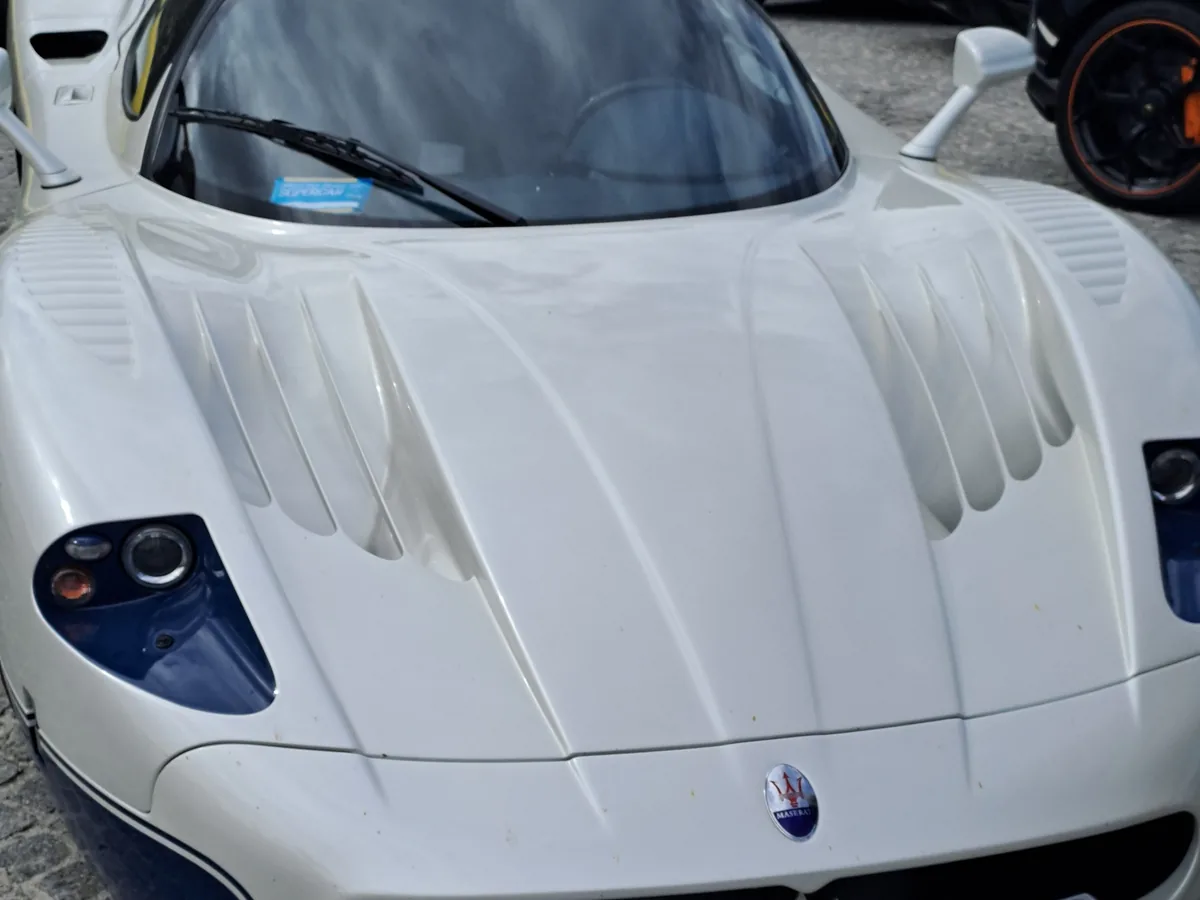
The MC12 is immediately recognizable by its exceptionally long, low silhouette, pointed nose, wide rear haunches and extended tail designed to support aerodynamic efficiency. The two-seat mid-engined body has a removable hardtop; Maserati describes the configuration as a coupe-spyder. Large side air intakes are prominent, while the rear glass and engine cover reveal the V12 mounted behind the cabin. Proportion is a more reliable clue than paintwork, since exterior colours and liveries can vary. Look for the road car’s civil interior, the absence of the full GT1 competition configuration and the removable roof rather than a fixed racing body. A large rear wing, exposed race hardware or a visible roll cage does not by itself identify a Stradale; those features may point to a competition car or a Versione Corse. For a vehicle described as a 2005 model, the production year, chassis number and original documentation remain important. They help separate a road-legal MC12 Stradale from the visually related GT1 and later track-only derivatives.
Important versions
The key version is the MC12 Stradale, the road-going derivative built in 2004 and 2005, with total production limited to 50 cars. It provided the homologation basis for the MC12 GT1 and used Maserati’s 5,998 cc V12, rated by the manufacturer at 630 hp. The MC12 GT1 was the competition version associated with Maserati’s return to FIA GT racing and won the 2005 championship. The MC12 Versione Corse followed in 2006 as a track-only derivative derived from the GT1. It was not road legal, produced 755 hp and was limited to 13 cars, comprising one prototype and 12 customer vehicles. It should therefore be treated as a separate special model, not as a higher specification of the 2005 road-going MC12.
References
- MC12 StradaleMaserati
- MC12 Versione CorseMaserati
- Maserati MC12: First DriveRoad & Track
- Maserati MC12 First Drive ReviewCar and Driver
- MC Hammered: Road Testing the Ferrari-Enzo-Based Maserati MC12MotorTrend
- https://www.classicdriver.com/en/article/maserati-mc12classicdriver.com
- https://www.maseraticlub.co.uk/wp-content/uploads/2018/04/mc12.pdfmaseraticlub.co.uk
Frequently asked questions
- What years was the Maserati MC12 produced?
- ScanRacer's referenced versions cover 2004 - 2005.
- How many Maserati MC12 examples are documented on ScanRacer?
- 5 published scans from 4 members, with the latest photo added in August 2026.