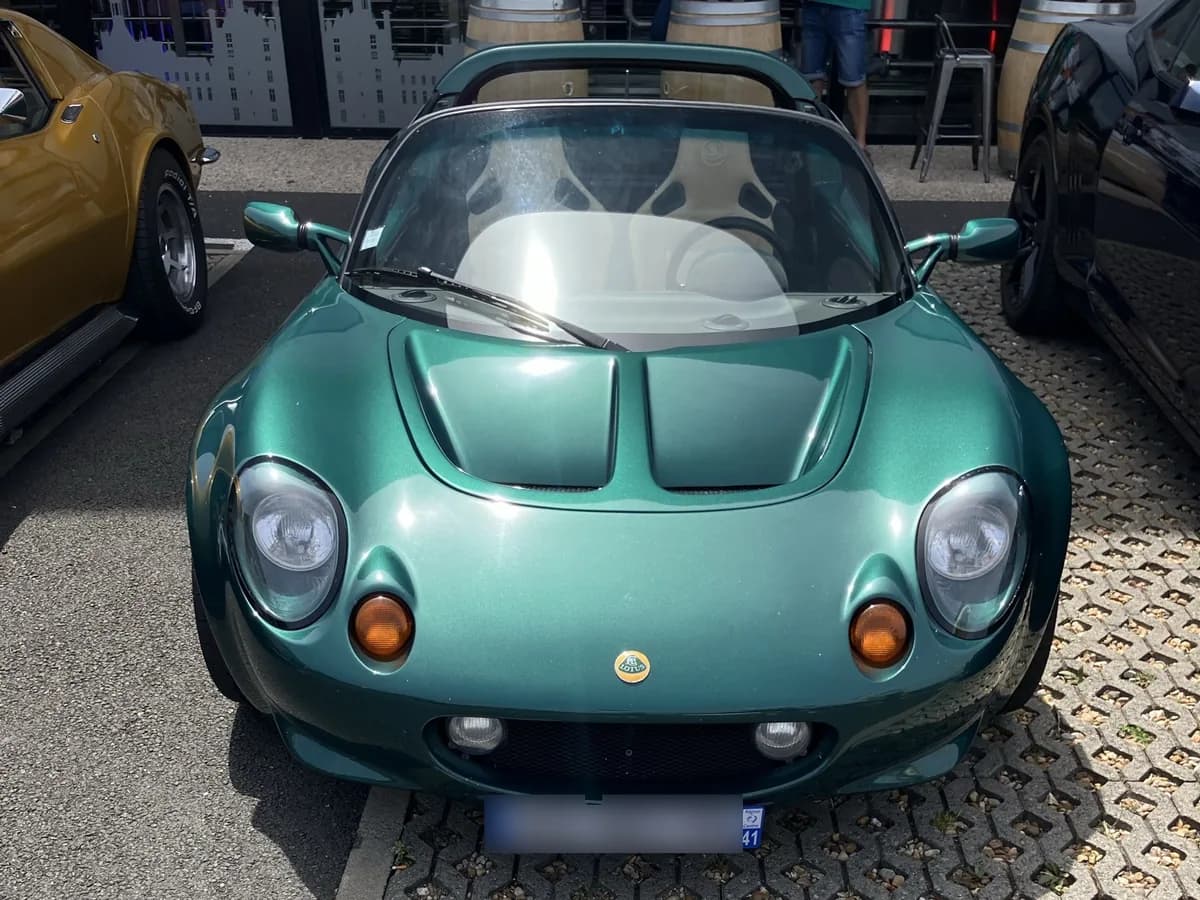
Lotus Elise Series 1 1996
The Lotus Elise Series 1 arrived in 1996 with an unusually lightweight construction: a bonded and extruded aluminium chassis, a composite body and a Rover K-Series engine mounted transversely behind the occupants. Sold under Lotus Type 111, this strict two-seat roadster placed steering feel, cornering ability and driver involvement above comfort or equipment. Its 1,796 cc four-cylinder engine produced 118 bhp and drove the rear wheels through a five-speed manual transmission. Depending on the source and specification, kerb weight was reported at roughly 725 kg, allowing the Elise to reach 100 km/h in about 5.9 seconds. The first Elise represented Lotus’s return to a compact, focused sports car built around simplicity, low mass and direct mechanical responses.
Curious about this car?
Explore Elise, then try your own photo.
No account needed for the result · Publish only if you choose
History
The Lotus Elise was shown publicly at the Frankfurt Motor Show on 12 September 1995 and entered production in 1996. Identified by Lotus Type 111, the project was intended to bring the company back to a relatively accessible sports car whose main strengths were agility and low weight. Its bonded, extruded aluminium chassis was the key engineering feature, combining structural rigidity with a very low mass. A composite body, sparse equipment and limited emphasis on outright power followed the same philosophy. The mid-mounted Rover K-Series 1.8i engine produced 118 bhp and drove the rear wheels. Production began at Hethel in Norfolk. Demand soon exceeded expectations, prompting Lotus to increase output during 1997; some cars for overseas markets were also assembled in Malaysia. The Elise name came from Elisa Artioli, the granddaughter of Romano Artioli, who was Lotus chairman when the car was launched.
Latest scans
Photos added by the community for this page.
Anecdotes
The Elise name refers to Elisa Artioli, the granddaughter of Romano Artioli, who led Lotus at the time of the car’s launch. Before receiving its production name, the project was presented as Type 111. The car’s Frankfurt debut in 1995 came several months before the first series-production examples reached customers in 1996.
Production
Production of the Lotus Elise Series 1 began at Lotus’s Hethel factory in Norfolk. Demand quickly exceeded the company’s initial expectations, so Lotus increased output during 1997 and used a Proton assembly line in Malaysia for some export markets. Estimates for total Series 1 production differ depending on whether special derivatives and market variations are included, but several specialist sources cite approximately 8,600 cars built between 1996 and 2001. That figure should be treated as an estimate for the Series 1 family rather than a precise factory total for the 1996 model year alone. Series 1 production ended when the Series 2 replaced it in the early 2000s.
Press reception
The Elise received strong attention from automotive journalists, who focused on its low weight, communicative steering and highly effective chassis rather than on headline engine output. Autocar’s 1996 assessment highlighted handling it considered exceptional for the class. Reviews also identified compromises inherent in the design, including difficult entry, a cramped cabin, limited sound insulation and minimal equipment. In later retrospectives, publications such as Autocar, evo and Top Gear continued to treat the Series 1 as a benchmark for small, driver-focused sports cars. Its critical success was matched by demand strong enough to require Lotus to increase production soon after launch. The car’s reputation therefore rested on a distinctive driving experience rather than luxury, practicality or outright power.
Evolution
Variants
References
- Lotus Elise – Iconic Sports CarLotus Cars
Supports the Type 111 identity, production period, engine, power range, transmission and Lotus production statistics.
- Lotus Elise Series 1, 1997British Motor Museum
Supports the launch history, 1,796 cc engine, 118 bhp output, convertible body style, mid-mounted engine, rear-wheel drive and the Elisa Artioli name origin.
- Lotus Elise S1Lotus-Library
Supports Series 1 identification, 1996 production, Rover K-Series engine, 118 bhp output and the specialist estimate of approximately 8,600 examples.
- Used Lotus Elise S1 reviewevo
Supports the Series 1 production period and its continuing reputation as a defining lightweight Lotus sports car.
- Used buying guide: Lotus EliseAutocar
Supports contemporary press reception, the 1996 launch price and later retrospective assessment of the Elise’s handling.
- PH Buying Guide: Lotus Elise S1PistonHeads
Supports the development of Sport 190 and Sport 135 derivatives and the commonly cited Series 1 production estimate.
- https://www.lotuscars.org.uk/elise.htmllotuscars.org.uk
Source found by OpenAI web search for this vehicle page.
- https://en.wikipedia.org/wiki/Lotus_Eliseen.wikipedia.org
Source found by OpenAI web search for this vehicle page.