
Rally 037
Introduced in 1982, the Lancia Rally 037 was a two-seat sports car developed around the Abarth SE037 project to return Lancia to international rallying. Its structure combined a central cell derived from the Lancia Beta Montecarlo with front and rear tubular frames, while Pininfarina designed the body and Abarth developed the mechanical package. The road-going Stradale used a supercharged 2.0-liter Fiat four-cylinder producing 205 hp. The 037 became best known in competition, helping Lancia win the 1983 World Rally Championship for Manufacturers despite the growing advantage of four-wheel-drive rivals. ScanRacer associates the model with three 1982 variants: Base, Sport, and Stradale. These labels should be treated as library categories rather than as a fully documented factory trim hierarchy, since the available historical sources primarily distinguish between the road homologation car and its competition derivatives.
Variants by year
1982
Model summary
Data from the ScanRacer library, organized to compare versions quickly.
Model introduction
Introduced in 1982, the Lancia Rally 037 was a two-seat sports car developed around the Abarth SE037 project to return Lancia to international rallying. Its structure combined a central cell derived from the Lancia Beta Montecarlo with front and rear tubular frames, while Pininfarina designed the body and Abarth developed the mechanical package. The road-going Stradale used a supercharged 2.0-liter Fiat four-cylinder producing 205 hp. The 037 became best known in competition, helping Lancia win the 1983 World Rally Championship for Manufacturers despite the growing advantage of four-wheel-drive rivals. ScanRacer associates the model with three 1982 variants: Base, Sport, and Stradale. These labels should be treated as library categories rather than as a fully documented factory trim hierarchy, since the available historical sources primarily distinguish between the road homologation car and its competition derivatives.
History
The SE037 project was developed in the early 1980s as Lancia’s replacement for the Fiat 131 Abarth Rally in international competition. Lancia, Abarth, and Pininfarina chose a purpose-built layout rather than adapting a conventional sedan: the central passenger cell of the Beta Montecarlo provided the starting point, while tubular structures were added at the front and rear. This arrangement improved access to the mechanical components and allowed the car to be adapted rapidly for rally use. Its composite bodywork, including removable front and rear panels, emphasized low weight and serviceability. The road version was unveiled at the 1982 Turin Motor Show to meet Group B homologation requirements. Lancia states that 200 examples were produced for this purpose. The competition car made its debut at the Costa Smeralda Rally in April 1982, followed by a full World Rally Championship campaign in 1983. Walter Röhrl won the Monte Carlo Rally, and Lancia secured the Manufacturers’ title. The 037 remains historically distinctive because it was the last two-wheel-drive car to win that championship against increasingly dominant four-wheel-drive rivals. (media.stellantis.com)
Generations
The Rally 037 is not divided into generations in the usual production-car sense. Its short career is better understood as a family of configurations built around the same technical cell. The Stradale was the road-homologation model: it retained the twin-cam, 16-valve two-liter engine mounted longitudinally in a mid-rear position, with a supercharger and rear-wheel drive. The rally car followed the same basic concept but added more functional bodywork, larger aerodynamic devices, competition safety equipment, and surface-specific suspension and drivetrain settings. Competition documentation also distinguishes an Evolution 1 and an Evolution 2. The latter increased displacement to approximately 2.1 liters and delivered a substantial power increase, but these were racing developments rather than separate road-car generations. Within the ScanRacer classification, Base and Sport can therefore be interpreted as competition or configuration categories, while Stradale clearly identifies the road-oriented model. The available sources do not establish a precise factory definition or separate 1982 chronology for all three library labels, so they should not be presented as confirmed production generations. (media.stellantis.com)
Key differences
The clearest distinction is between the Stradale and the competition cars. The Stradale had a road-oriented interior, less extreme bodywork, and a quoted output of 205 hp. Rally versions used a more stripped-back presentation, removable body panels, more pronounced aerodynamic equipment, and settings intended for performance and rapid servicing. Competition specifications list approximately 255 to 280 hp for Evolution 1 cars and 310 to 325 hp for Evolution 2 cars, with the latter increasing displacement to 2,111 cc. However, none of the sources consulted defines the ScanRacer names Base and Sport as two separate Lancia retail trims. They are therefore best treated as editorial or configuration categories rather than fixed mechanical specifications. Any detailed distinction between those two labels would require a specific period catalogue, homologation document, or ScanRacer variant record. (media.stellantis.com)
Photo recognition
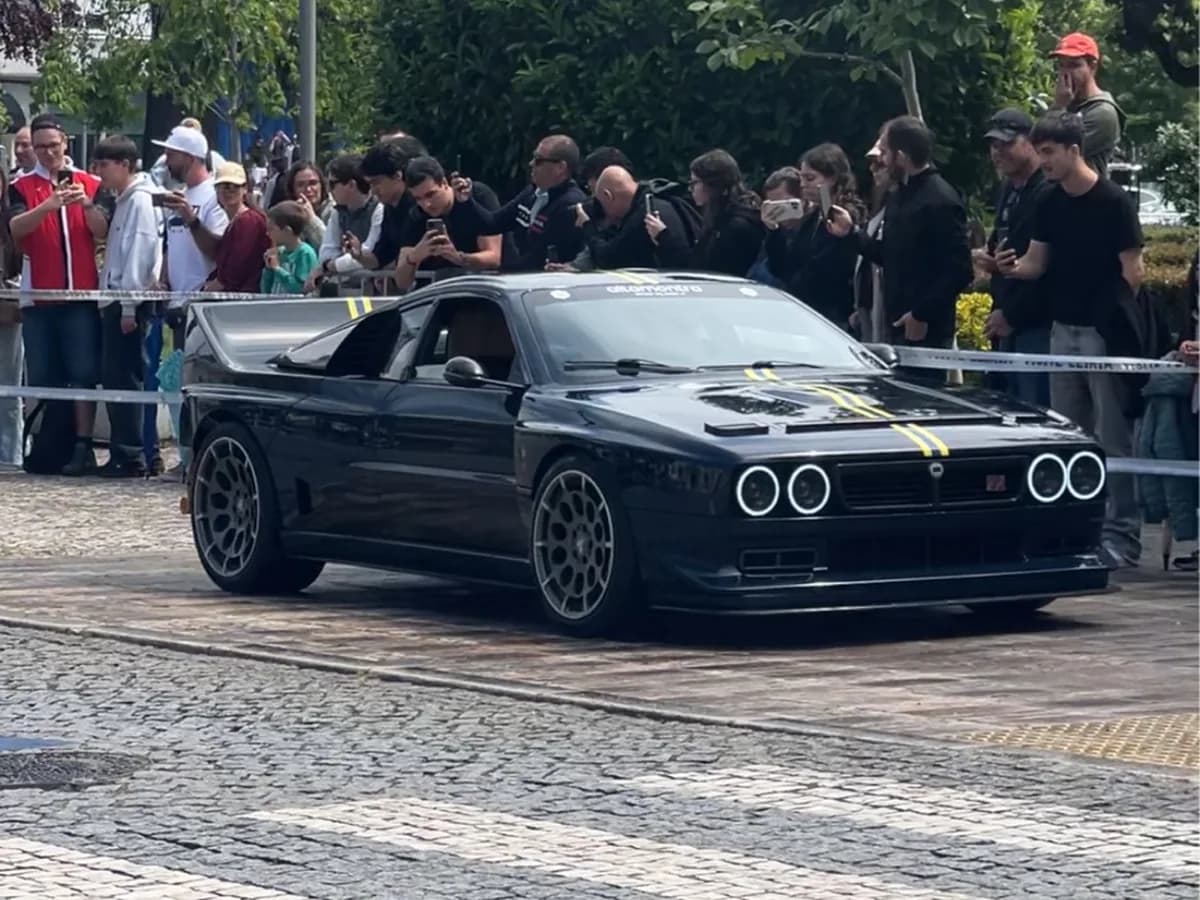
A Rally 037 is immediately recognizable by its very low profile, angular bodywork, and cabin positioned between two technical compartments. It has the proportions of a mid-engine berlinetta, with broad fenders, composite body panels, and front and rear sections designed for rapid removal. The Stradale is generally more restrained than a works rally car: it may lack the widest competition arches, rally equipment, and the large rear wing associated with championship cars. Competition examples often carry team livery, additional spotlights, surface-specific wheels and tires, and a highly stripped-out cockpit. The supercharged four-cylinder engine, rear-wheel drive, and mixed central-cell and tubular-frame construction are useful technical clues, but they cannot authenticate a car by themselves. Proper identification requires checking the chassis number, homologation documents, and conversion history, because some Stradale cars may later have received rally-style bodywork or equipment. Visual appearance alone is therefore insufficient when determining whether an example is an original competition car, a road car, or a modified replica. (media.stellantis.com)
Important versions
The Stradale was the road-homologation version, produced in small numbers to make Group B competition possible. It used the supercharged two-liter engine rated at 205 hp and is the most relevant reference for road use. The competition cars formed the model’s best-known branch. Evolution 1 cars produced substantially more power than the Stradale, while Evolution 2 cars adopted an engine enlarged to approximately 2.1 liters and delivered a further increase in output. In 1983, the rally 037 won the World Rally Championship for Manufacturers with Lancia. ScanRacer retains Base and Sport as 1982 library categories, but the historical sources consulted do not establish an exact factory specification corresponding to either label. They should therefore be presented cautiously rather than as confirmed commercial trim names.
References
- 40 years ago, Lancia won its fifth World Constructors' Championship with the legendary Rally 037Lancia / Stellantis Media
- The journey towards the Lancia Design Day: the 'brutal' design of Stratos, Rally 037 and DeltaLancia / Stellantis Media
- Lancia Rally 037 - Technical information race versionLanciaRally037.com
- https://www.media.stellantis.com/es-es/lancia/press/hace-40-anos-lancia-gano-su-quinto-campeonato-mundial-de-constructores-con-el-mitico-rally-037media.stellantis.com
- https://www.autobild.de/artikel/lancia-rally-037-kimera-evo37-fahrbericht-preis-restomod-technische-daten-21111643.htmlautobild.de
Frequently asked questions
- What years was the Lancia Rally 037 produced?
- ScanRacer's referenced versions cover 1982.
- How many Lancia Rally 037 examples are documented on ScanRacer?
- 4 published scans from 4 members, with the latest photo added in September 2026.