
F-Type
Unveiled in 2012 and introduced to the market from 2013, the Jaguar F-Type marked the British brand’s return to the heart of the two-seat sports-car segment. It drew on the spirit of the E-Type without being a direct technical continuation, using a front-engine layout, an aluminium-intensive body and predominantly rear-wheel drive. The range began with a two-seat convertible before expanding rapidly with a fixed-roof coupé. Across its early model years, Jaguar offered supercharged four-, six- and eight-cylinder engines, several power outputs, manual and automatic transmissions, and, on selected derivatives, all-wheel drive. The F-Type is readily associated with its compact proportions, driver-focused cockpit, deployable rear spoiler and distinctive exhaust note. Its combination of design, mechanical variety and open or closed body styles made it one of Jaguar’s defining modern sports cars.
Variants by year
2019
2013
Model summary
Data from the ScanRacer library, organized to compare versions quickly.
Model introduction
Unveiled in 2012 and introduced to the market from 2013, the Jaguar F-Type marked the British brand’s return to the heart of the two-seat sports-car segment. It drew on the spirit of the E-Type without being a direct technical continuation, using a front-engine layout, an aluminium-intensive body and predominantly rear-wheel drive. The range began with a two-seat convertible before expanding rapidly with a fixed-roof coupé. Across its early model years, Jaguar offered supercharged four-, six- and eight-cylinder engines, several power outputs, manual and automatic transmissions, and, on selected derivatives, all-wheel drive. The F-Type is readily associated with its compact proportions, driver-focused cockpit, deployable rear spoiler and distinctive exhaust note. Its combination of design, mechanical variety and open or closed body styles made it one of Jaguar’s defining modern sports cars.
History
The F-Type was unveiled at the 2012 Paris Motor Show as Jaguar’s first completely new two-seat sports car in several decades. The first cars sold from 2013 were convertibles powered by either a supercharged 3.0-litre V6 or a supercharged 5.0-litre V8. Jaguar positioned the car as a more compact and more focused sports model than the XK, prioritising agility, driver involvement and a direct mechanical character. The coupé joined the range for the 2015 model year. Its all-aluminium fixed-roof structure delivered greater torsional rigidity than the convertible and allowed Jaguar to introduce the V8-powered F-Type R Coupé. This derivative quickly became one of the family’s performance benchmarks, combining high output with an active differential and torque-vectoring-by-braking technology. For the 2016 model year, Jaguar substantially broadened the line-up with all-wheel drive, a six-speed manual gearbox on selected versions and the 550PS F-Type R Convertible. The SVR arrived for 2017, raising the supercharged V8’s output to 575PS and adding more serious performance hardware. The 2018 model year brought the most visible update within the period covered here: revised front-end styling, full-LED headlights, lighter seats, updated technology and a turbocharged 2.0-litre Ingenium four-cylinder. These changes expanded the range while preserving the F-Type’s core identity.
Generations
Throughout the 2013-2019 period, the Jaguar F-Type belongs to a single generation, although that generation received a substantial update for the 2018 model year. Early cars, first in convertible form and then as coupés, are identified by larger-looking headlights and more traditionally shaped front air intakes. Their engine range included supercharged 3.0-litre V6 units in 340PS and 380PS forms, together with a supercharged 5.0-litre V8 whose output varied by model year and body style. The coupé is not a separate generation. It uses the same core F-Type architecture while replacing the fabric roof with a fixed aluminium structure and adding a more useful rear load area. R and SVR models are high-performance derivatives within that same generation. All-wheel drive became available progressively on selected powertrains, while the manual gearbox remained limited to particular configurations and markets. The 2018 model year should be understood as a facelift rather than a generational change. Its main visual clues include slimmer full-LED headlights, revised bumpers, simplified air intakes, lighter seats and the introduction of a turbocharged 2.0-litre four-cylinder engine. The aluminium-based structure, two-seat cabin, overall silhouette and front-engine sports-car layout remained fundamentally unchanged from the original F-Type.
Key differences
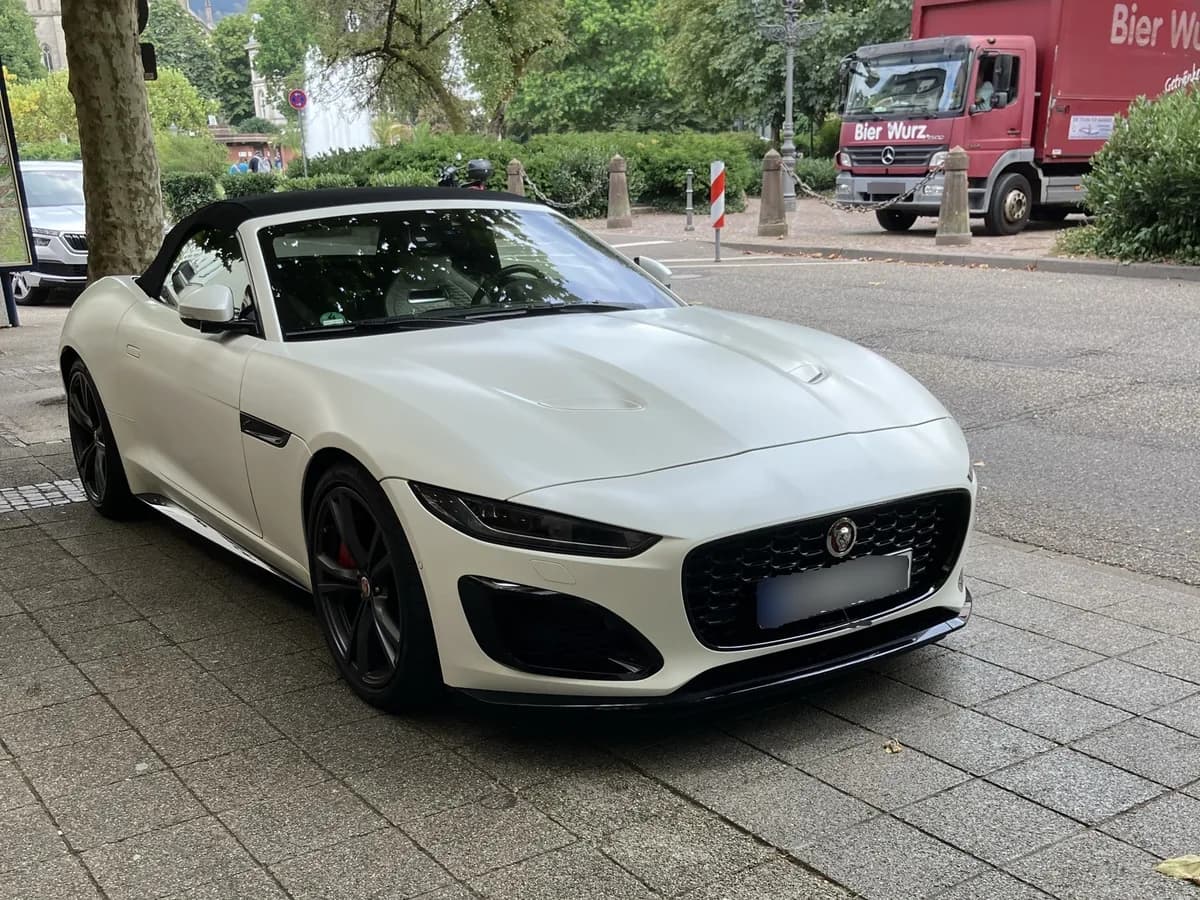
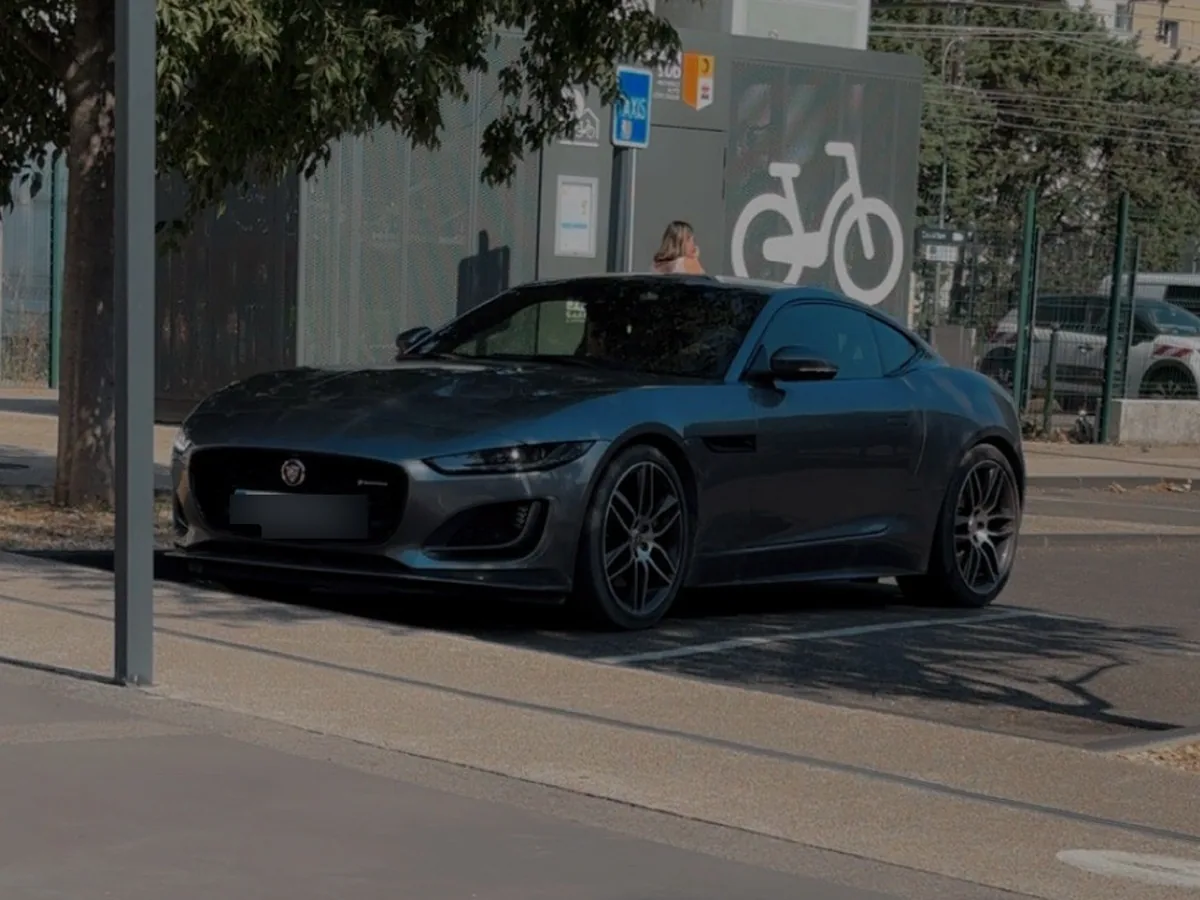
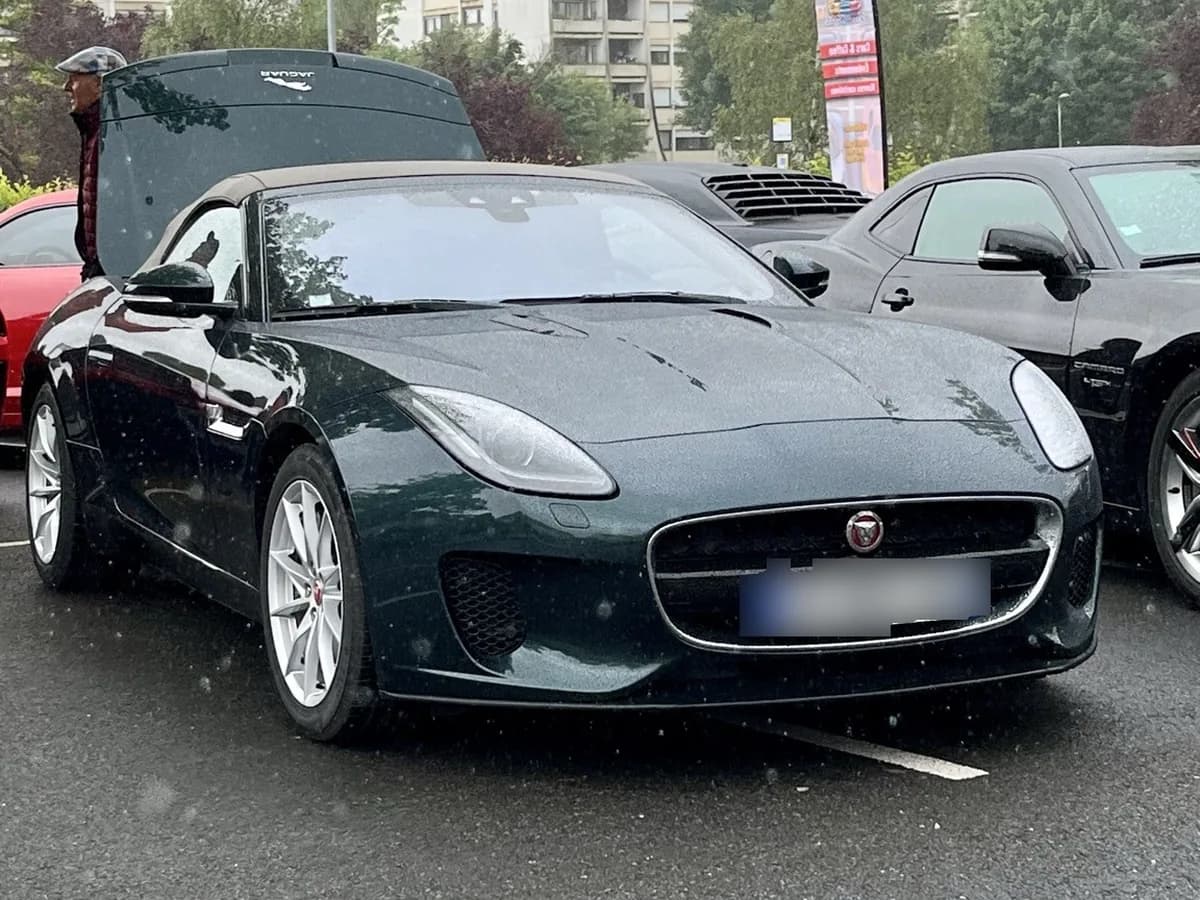
The clearest distinction is between the Convertible and Coupé. The Convertible uses a fabric roof and prioritises open-air driving, while the Coupé has a fixed aluminium roof, a stiffer body structure and a more useful rear load area. Both body styles nevertheless share the same two-seat cabin concept and much of their mechanical architecture. Differences between individual derivatives then depend mainly on engine, drivetrain and specification. V6-powered F-Types are generally lighter and more progressive than the V8 cars, while R and SVR models add stronger braking hardware, more focused chassis tuning and distinctive exterior details. All-wheel drive improves traction, but it was not offered with every engine or in every market. The 2018 facelift is identifiable by its revised front end and full-LED headlights. It also introduced the turbocharged Ingenium four-cylinder, the R-Dynamic designation and expanded infotainment and driver-assistance equipment. Model names, transmissions and standard features can differ between markets and model years, so precise identification should always be checked against the production year, specification sheet and vehicle identification number.
Photo recognition
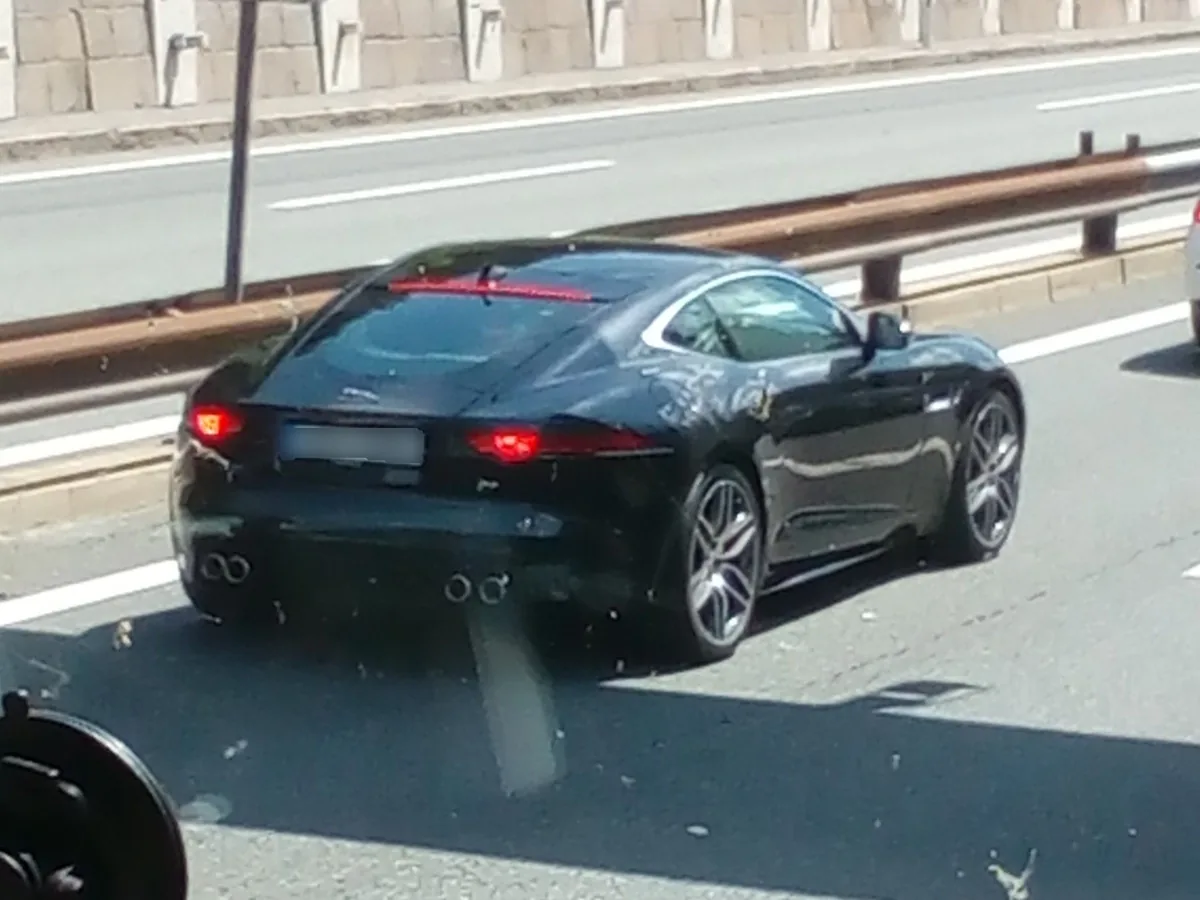
Early F-Type models can be recognised by their very low stance, long bonnet, rear-set cabin and retractable door handles. The Convertible is immediately distinguished by its fabric roof, while the Coupé has a sweeping fixed roof leading to a rear hatch. Both versions use a deployable rear spoiler that rises automatically at higher speeds. Cars built before the 2018 facelift generally have thicker-looking headlights and front air intakes with a busier, more divided appearance. From 2018 onward, the headlights became slimmer and fully LED, with Jaguar’s distinctive J-blade light signature. The bumpers and air intakes were also revised, although exact details vary with trim level and market. Badges are useful for identifying performance derivatives, including “R”, “SVR”, “S”, “R-Dynamic” and “400 SPORT”. V8 cars often have larger exhaust outlets, while the highest-performance models receive specific wheels, brakes and aerodynamic details. These visual clues should be treated as guidance rather than proof: factory options, replacement parts and market-specific equipment can make one derivative resemble another.
Important versions
Notable derivatives include the F-Type S, one of the early performance versions, using a 380PS supercharged 3.0-litre V6. The early F-Type V8 S combines the supercharged 5.0-litre V8 with 495PS and a particularly distinctive exhaust character. Introduced for the 2015 model year, the F-Type R Coupé added a stiffer fixed-roof body and a 550PS V8. The range later expanded with the R Convertible, all-wheel-drive configurations and the limited 400 SPORT edition. Arriving from 2017, the SVR was among the most extreme F-Types available during this period, using a 575PS supercharged V8, dedicated chassis and aerodynamic measures, and a claimed 200mph top speed for the Coupé.
References
- 2014 Jaguar F-TYPEJaguar Media Newsroom
- F-TYPE Coupé Makes Global Motor Show Debuts in Los Angeles and TokyoJaguar Media Newsroom
- Jaguar F-TYPE: A Global Success StoryJaguar Media Newsroom
- The 2017 Jaguar F-TYPEJaguar Media Newsroom
- Jaguar Unveils 2018 F-TYPE Line-Up with All-New Four-Cylinder Engine OptionJaguar Media Newsroom
- The New Jaguar F-TYPEJaguar Media Newsroom
- https://media.jaguar.com/en-us/news/2013/05/jaguar-unveils-global-advertising-campaign-launch-f-typemedia.jaguar.com
- https://archive.jaguar.com/en-us/blog/2013/introducing-jaguar-f-typearchive.jaguar.com
Technical specifications
Structured data available for versions linked to this model.
| Version | Power | Torque | Top speed | Drivetrain | Fuel |
|---|---|---|---|---|---|
| — | 300 ch | — | — | Propulsion / Boîte automatique à 8 rapports | — |
Frequently asked questions
- What years was the Jaguar F-Type produced?
- ScanRacer's referenced versions cover 2013 - 2019.
- How many Jaguar F-Type examples are documented on ScanRacer?
- 14 published scans from 12 members, with the latest photo added in September 2026.
- What is the power output of the Jaguar F-Type?
- The sourced technical data lists 300 ch.