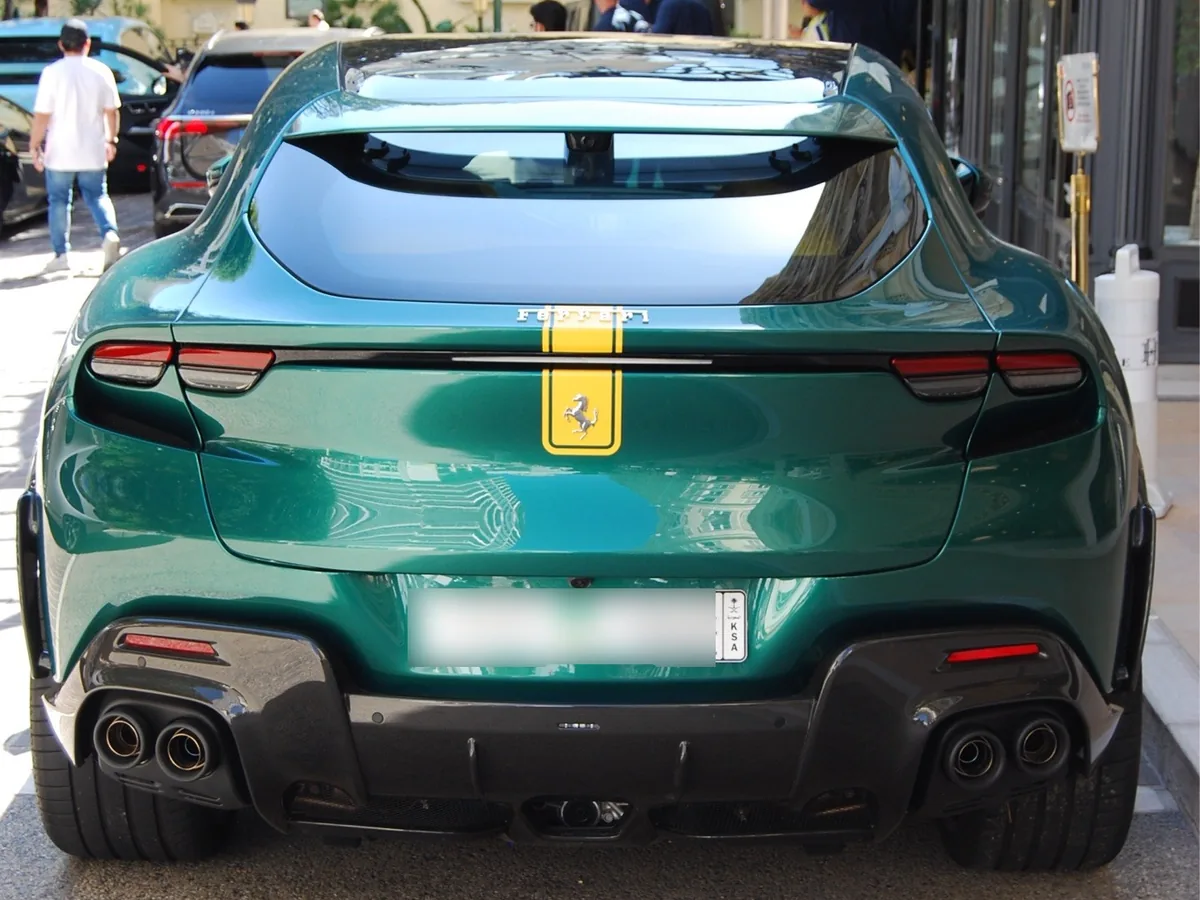
Ferrari SF90 Spider 2020
Unveiled on November 12, 2020, the Ferrari SF90 Spider is the open-top counterpart to the SF90 Stradale. It introduced Ferrari’s plug-in hybrid architecture to a retractable-hardtop spider while retaining the berlinetta’s four-wheel-drive layout. Its 3,990 cc twin-turbocharged V8 produces 780 hp, and three electric motors raise total system output to 1,000 hp. Ferrari quotes 2.5 seconds from 0 to 100 km/h, 7 seconds from 0 to 200 km/h, and a 340 km/h top speed. The electrically operated roof takes roughly 14 seconds to open or close, yet the Spider remains focused on performance rather than touring comfort. With a mid-rear engine, an electric front axle, and a high-voltage battery, the SF90 Spider represents one of Ferrari’s clearest early statements that electrification could enhance, rather than dilute, its flagship sports-car formula.
Curious about this car?
Explore SF90, then try your own photo.
No account needed for the result · Publish only if you choose
History
The SF90 Spider developed directly from the SF90 Stradale, a model Ferrari positioned as a new technological flagship rather than a replacement for an existing car. Ferrari revealed the Spider during a digital event in Maranello on November 12, 2020, describing it as the company’s first series-production plug-in-hybrid spider. It shares the Stradale’s core layout: a mid-rear twin-turbocharged V8, an electric motor positioned between the combustion engine and gearbox, and two independent electric motors driving the front wheels. This arrangement creates all-wheel drive without a conventional mechanical connection between the axles. The major engineering change is the retractable hardtop, which allows the car to retain a closed-berlinetta profile while providing open-air driving. Ferrari stated that deliveries were expected to begin in 2021 following the 2020 unveiling. The SF90 Spider therefore belongs to Ferrari’s regular sports-car range rather than to a strictly limited family such as the Icona or XX programmes.
Latest scans
Photos added by the community for this page.
Anecdotes
Ferrari introduced the SF90 Spider online on November 12, 2020, during a period when the company was using digital launches for new models. It became Ferrari’s first series-production spider with a plug-in-hybrid powertrain. One of its most distinctive details appears with the roof lowered: the engine bay remains prominently visible, allowing the twin-turbocharged V8 to form part of the car’s visual presentation rather than being completely hidden beneath an opaque cover.
Production
Ferrari unveiled the SF90 Spider in 2020 and stated that deliveries were expected to begin in 2021. The company classified it within its series-production sports-car range using plug-in-hybrid technology, alongside the SF90 Stradale. Ferrari also describes its overall strategy as low-volume production designed to preserve exclusivity, but the sources consulted do not provide an official total production figure specifically for the SF90 Spider. It should therefore not be presented as a numbered limited edition. Exact production totals, market-by-market allocations, and the number of cars equipped with Assetto Fiorano are not established here. Ferrari’s public reporting confirms the model’s place in the regular range, but does not identify a definitive lifetime unit count for the Spider.
Press reception
Specialist reviews generally praised the SF90 Spider’s hybrid power delivery, sophisticated roof system, and ability to use electric front motors for all-wheel drive. Top Gear noted that the Spider retained the Stradale’s essential performance while making the engineering package especially impressive for a regular production car. The same review criticized its limited practicality, high price, and occasionally unusual four-wheel-drive feel. In its test of the SF90 Stradale, Motor Sport Magazine praised the immediate response, road usability, and track capability, while questioning the weight created by the extensive electronic and hybrid systems. Those observations are relevant to the Spider because the two cars share their core powertrain, but they should not be treated as a substitute for testing every Spider configuration or option package.
Evolution
Variants
References
- SF90 Spider: beyond imaginationFerrari
Supports the November 12, 2020 unveiling, the model’s status as Ferrari’s first production plug-in-hybrid spider, and its relationship with the SF90 Stradale.
- SF90 Spider Technical Specification SummaryFerrari
Supports the engine, electric system, combined power, gearbox, drivetrain, dimensions, weight, acceleration, and top-speed specifications.
- Ferrari SF90 Spider: Ferrari HistoryFerrari
Supports the 2020 model-year historical listing, 3,990 cc V8, 780 cv output, and 340 km/h top speed.
- Ferrari NV 2020 Annual ReportFerrari N.V.
Supports the SF90 Spider’s inclusion in Ferrari’s sports range, its series-production PHEV positioning, the 2020 unveiling, expected 2021 deliveries, and Ferrari’s low-volume production strategy.
- Ferrari SF90 Spider reviewTop Gear
Supports the independent press assessment of performance, roof packaging, practicality, price, and the reviewer’s overall verdict.
- Ferrari SF90 review: the new heavyweightMotor Sport Magazine
Supports the independent assessment of the shared SF90 powertrain, road and track behavior, hybrid-system response, and concerns about weight and practicality.
- Pure emotionFerrari Magazine
Supports details about the retractable hardtop, three electric motors, four driving modes, visible engine bay, and the Assetto Fiorano package.
- https://www.ferrari.com/en-EN/corporate/articles/sf90-xx-stradale-and-sf90-xx-spider-the-first-road-going-cars-in-the-xx-programmeferrari.com
Source found by OpenAI web search for this vehicle page.