
F40
Introduced in 1987 to mark Ferrari’s 40th anniversary, the F40 is a two-seat berlinetta powered by a twin-turbocharged V8 and developed with a strong emphasis on low weight and direct driver involvement. Its 2,936 cc engine produced 478 hp according to Ferrari’s historical specifications, while the body used extensive composite construction. Ferrari quoted a 324 km/h top speed and a 0–100 km/h time of 4.1 seconds, placing the F40 among the most uncompromising road cars of the late 1980s. Its large rear wing, NACA-style air intakes and stripped-back cabin became defining visual and technical features. The F40 also holds a special place in Ferrari history as the last road car personally commissioned and approved by Enzo Ferrari. Rather than pursuing comfort or electronic assistance, its engineering focused on performance, lightness and a close connection between driver and machine.
What about the car you photographed?
Upload a photo to get a suggested make, model and likely year.
No account needed for the result · Publish only if you choose
Variants by year
Make: Ferrari · Model: F40
2 / 2 versions shown
1989

1987
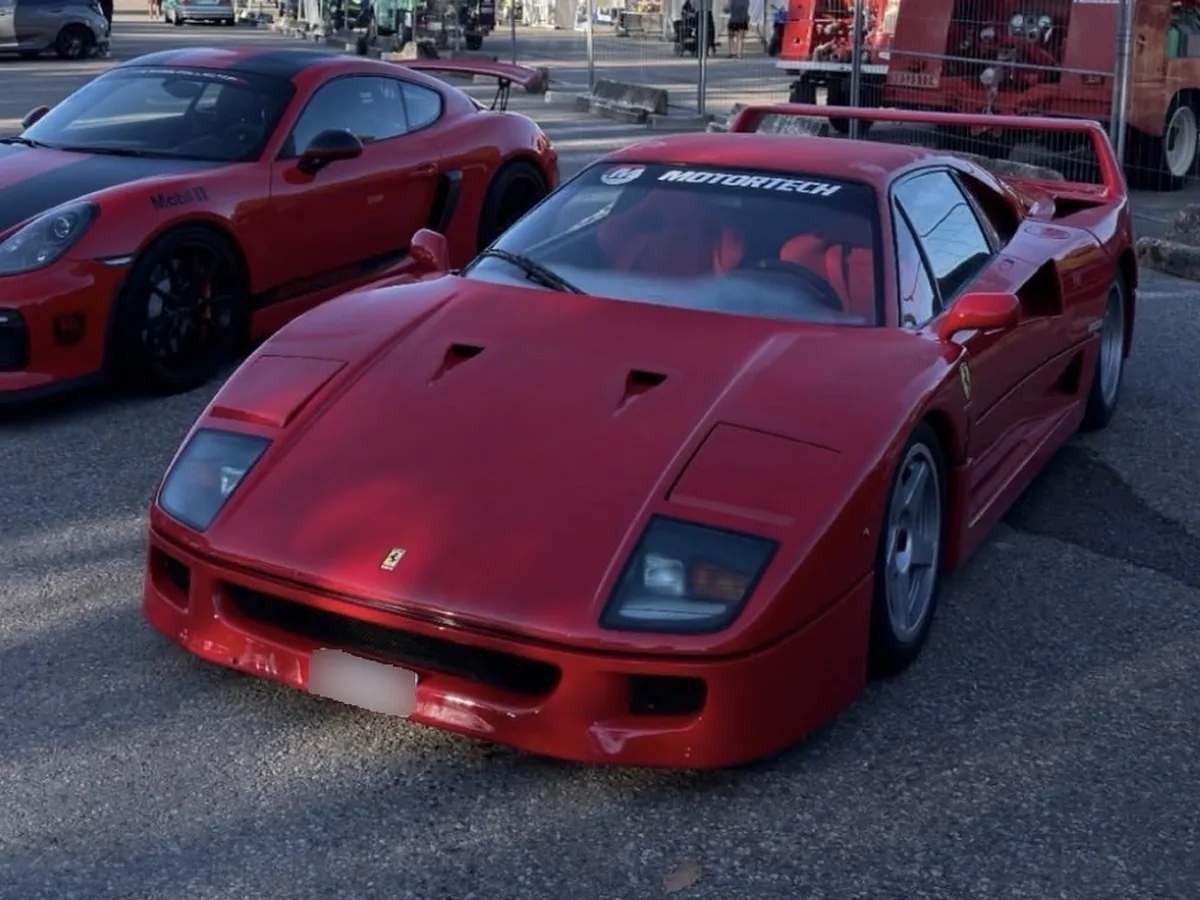
Ferrari F40 photos
Model summary
Data from the ScanRacer library, organized to compare versions quickly.
Model introduction
Introduced in 1987 to mark Ferrari’s 40th anniversary, the F40 is a two-seat berlinetta powered by a twin-turbocharged V8 and developed with a strong emphasis on low weight and direct driver involvement. Its 2,936 cc engine produced 478 hp according to Ferrari’s historical specifications, while the body used extensive composite construction. Ferrari quoted a 324 km/h top speed and a 0–100 km/h time of 4.1 seconds, placing the F40 among the most uncompromising road cars of the late 1980s. Its large rear wing, NACA-style air intakes and stripped-back cabin became defining visual and technical features. The F40 also holds a special place in Ferrari history as the last road car personally commissioned and approved by Enzo Ferrari. Rather than pursuing comfort or electronic assistance, its engineering focused on performance, lightness and a close connection between driver and machine.
History
The F40 project grew directly from Ferrari’s work on the 288 GTO and the 288 GTO Evoluzione. Engineer Nicola Materazzi, whose background included turbocharging and Ferrari competition projects, played an important role in developing the new berlinetta. The car was unveiled in July 1987 and appeared publicly at the Frankfurt Motor Show later that year. Its name referred to the forty years since Ferrari began building road cars. The F40 combined a tubular steel chassis with composite structural and body components, while Pininfarina was responsible for the dramatic exterior design. Ferrari described a body made from eleven major panels, helped by large one-piece front and rear sections. Power came from a longitudinally mounted 90-degree V8 at the rear, fitted with twin turbochargers and twin intercoolers. A five-speed manual gearbox transmitted the power to the rear wheels. Ferrari originally expected production to remain highly limited, but demand quickly exceeded those forecasts. Ferrari’s own historical material states that more than 1,300 examples were built over roughly five years. The F40 therefore became more than an anniversary model: it established a lasting reputation as one of the most distinctive and technically focused Ferrari road cars of the 1980s.
Generations
The Ferrari F40 is not divided into several generations in the usual automotive sense. It represents a single production lineage, launched in 1987 around a consistent layout: a two-seat berlinetta, a rear-mounted longitudinal twin-turbo V8, a five-speed manual gearbox and rear-wheel drive. Ferrari’s published specifications associate the road car with 2,936.25 cc of displacement, 478 hp and a quoted top speed of 324 km/h. Its development is better understood through the distinction between the standard road car and later competition derivatives. The road-going F40 already placed strong emphasis on low weight, using a tubular chassis, composite materials and a deliberately simple cabin. Two years after the original model’s debut, Ferrari developed the F40 Competizione after a request from the French importer, who wanted to enter a car in the 24 Hours of Le Mans. That derivative received a more powerful engine, modified suspension and dedicated aerodynamic equipment. It is therefore more accurate to describe the F40 as a single road-car generation accompanied by specialized racing derivatives, rather than as a model with several successive road-going generations.
Key differences
The main distinction is between the road-going F40 and the F40 Competizione. The standard car produced 478 hp, used a five-speed manual gearbox and featured composite body construction intended to reduce weight. Its suspension settings, dimensions and aerodynamic package were designed for an extremely focused road car, even though the result was far more uncompromising than most contemporary production models. The F40 Competizione appeared in 1989 after a competition-oriented request connected with the 24 Hours of Le Mans. Ferrari lists 700 hp and a quoted top speed of 367 km/h for this derivative, together with modified suspension and dedicated aerodynamic components. The first two examples were known as F40 LM before the broader Competizione name was adopted for a total of roughly ten cars. Those figures should not be applied to every F40, because they describe separate configurations. Later owner modifications and specialist conversions can also make an individual car difficult to classify from photographs alone. Chassis documentation and period records remain more reliable than appearance when verifying a specific example.
Photo recognition
An F40 is first identified by its extremely low, angular shape, which was developed around significant aerodynamic requirements. The nose has a sharply sloping bonnet, small openings and pop-up headlights on standard production examples. Large side intakes feed the engine and intercoolers, while the rear is dominated by a fixed wing and an engine cover that may be transparent or extensively vented, depending on the configuration. The body uses a small number of large panels, including substantial one-piece sections at the front and rear. Five-spoke wheels and very wide tyres add to the car’s broad stance, while the cabin is recognizable for its simple materials, bucket seats and driver-focused instrumentation. Identification requires caution because replicas, cosmetic conversions and F40 Competizione cars can look similar. A larger wing, wider bodywork or a higher claimed output may indicate a racing derivative, but appearance alone cannot authenticate a chassis. Factory records, chassis numbers, period photographs and documented specifications are more dependable when verifying a particular car.
Important versions
The 1987 standard road car is the core F40 configuration. It combines the 2,936 cc twin-turbocharged V8, extensive composite construction, a five-speed manual gearbox and a Ferrari-quoted dry weight of 1,100 kg. It is generally regarded as the reference specification for the model. The F40 Competizione is the most significant competition derivative. Developed in 1989 following a request connected with the 24 Hours of Le Mans, it received a 700 hp engine, modified suspension and dedicated aerodynamic equipment. The first two examples were known as F40 LM, after which Ferrari used the broader Competizione designation for a total production of around ten cars. These racing cars should not be confused with the road-going F40, despite sharing the same fundamental architecture and visual identity.
References
- Ferrari F40 (1987)Ferrari
- F40 - Ferrari HistoryFerrari
- Enzo’s Dream: F40, Extreme Supercar for the FewFerrari
- Lasting Legacy – The Ferrari F40Ferrari Magazine
- Ferrari F40 Competizione (1989)Ferrari
- Enzo’s final masterpiece: The F40Ferrari Magazine
- https://www.ferrari.com/en-EN/magazine/articles/feast-of-ferrari-f40-italy-1992ferrari.com
- https://www.ferrari.com/en-TH/magazine/articles/the-ferrari-f40-revisitedferrari.com
Technical specifications
Structured data available for versions linked to this model.
| Version | Power | Torque | Top speed | Drivetrain | Fuel |
|---|---|---|---|---|---|
| — | 478 chevaux (351,5 kW) à 7 000 tr/min | — | — | Propulsion arrière / Boîte manuelle à 5 rapports | — |
Frequently asked questions
- What years was the Ferrari F40 produced?
- ScanRacer's referenced versions cover 1987 - 1989.
- How many Ferrari F40 examples are documented on ScanRacer?
- 32 published scans from 24 members, with the latest photo added in October 2026.
- What is the power output of the Ferrari F40?
- The sourced technical data lists 478 chevaux (351,5 kW) à 7 000 tr/min.
What about the car you photographed?
Upload a photo to get a suggested make, model and likely year.
No account needed for the result · Publish only if you choose