Power
485 kW (660 hp) at 7,800 rpm
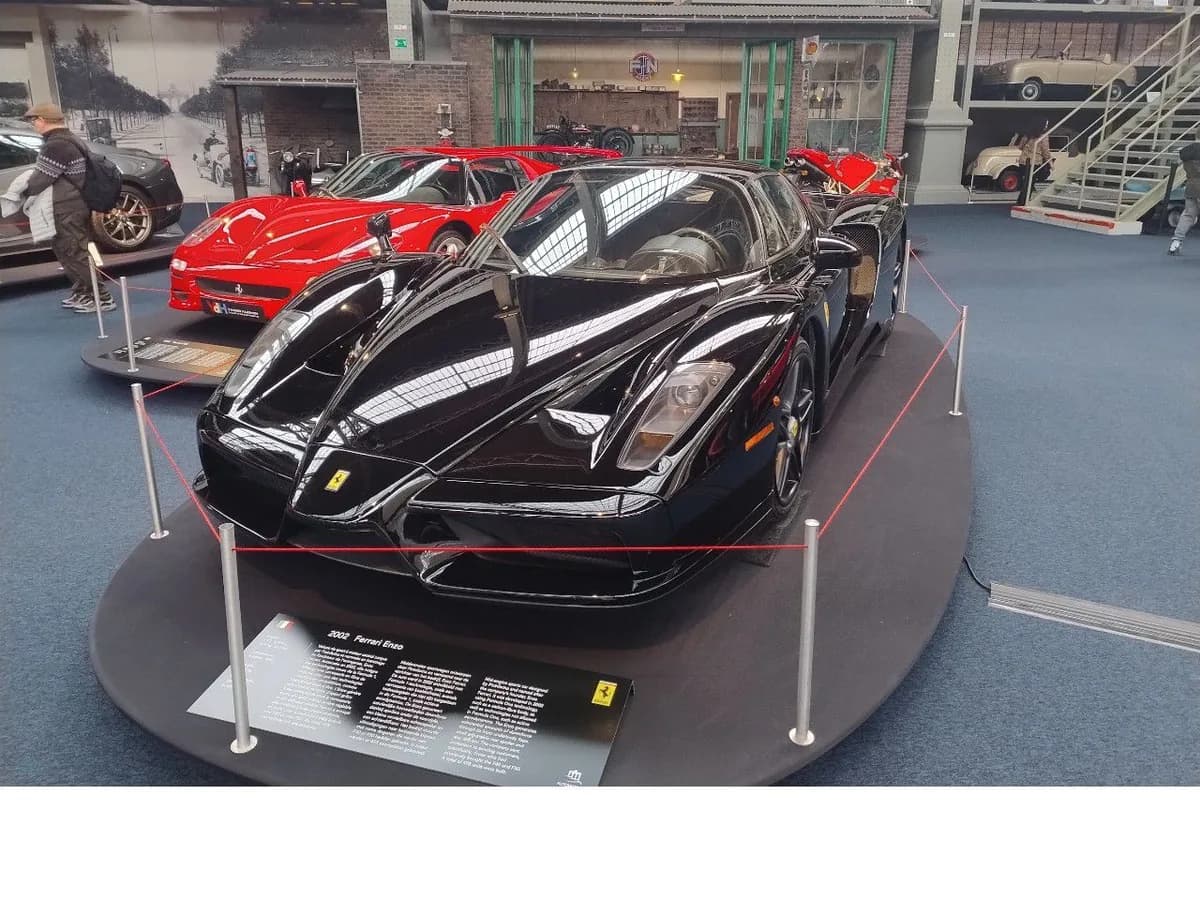
Introduced in 2002, the Ferrari Enzo is a two-seat berlinetta with a rear-mid-mounted V12, developed as Ferrari’s technological flagship. Its name honours Enzo Ferrari, the company’s founder, while its engineering reflects the marque’s extensive competition experience. The naturally aspirated 5,998.80 cc engine produces 660 hp at 7,800 rpm and drives the rear wheels through a six-speed electro-hydraulic transmission. Ferrari quotes a top speed of more than 350 km/h. A carbon-fibre and Nomex honeycomb monocoque, carbon-ceramic brakes and Formula 1-influenced aerodynamics underline the car’s technical purpose. The Enzo followed the 288 GTO, F40 and F50 as Ferrari’s latest limited-production halo car, combining road-car usability with construction methods and driver controls that were unusually close to contemporary racing technology.
Curious about this car?
Explore Enzo, then try your own photo.
No account needed for the result · Publish only if you choose
The Ferrari Enzo was revealed at the 2002 Paris Motor Show, during a period when Ferrari was dominating Formula 1 with Michael Schumacher. It directly followed the F50 in Maranello’s sequence of extreme road-going flagships. Ferrari worked with Pininfarina on a body designed around aerodynamic function rather than conventional elegance. Its sharp nose, flat floor, rear diffuser and movable rear wing help create downforce without relying on the large fixed spoilers associated with the F40 and F50. Beneath the bodywork, a carbon-fibre and Nomex honeycomb structure provides the central foundation. The 6.0-litre V12 is mounted longitudinally behind the cabin and reflects Ferrari’s competition-derived engineering approach. A six-speed automated manual gearbox operated by steering-wheel paddles reinforces that connection with racing technology. Ferrari positioned the Enzo as a road car bringing together its Formula 1 knowledge and production-car requirements. Its deliberately restricted production made it the company’s defining early-2000s halo model.
Photos added by the community for this page.
Source: Ferrari
Ferrari initially planned 399 Enzos for customers. The company later built one additional car and presented it to Pope John Paul II. That example was subsequently sold at auction for charity, which is why references often distinguish the 399 customer cars from the 400th Enzo. The charitable car remains one of the best-known stories connected with the model.
Ferrari announced a customer production run of 399 cars, followed by a 400th example presented to Pope John Paul II and later sold for charity. This distinction accounts for the different totals used in reference works: some describe 399 cars produced for customers, while others refer to 400 Enzos overall when the donated car is included. Automotive retrospectives generally place production in the 2002-2004 period. The available sources do not provide a reliable breakdown by colour, interior specification or other customer-selected equipment, so no further production subdivision is stated here. The Enzo’s restricted output was central to its role as Ferrari’s limited-production flagship of the early 2000s.
Automotive publications generally regarded the Enzo as a technological benchmark for its period. Road tests highlighted the speed of its automated manual gearbox, the output of its naturally aspirated V12 and the effectiveness of its active aerodynamic systems. Car and Driver also noted the distinctive driver interface, including the lack of a conventional automatic mode in its early test car. Later evo retrospectives present the Enzo as an exceptionally fast and technically ambitious Ferrari with a clear connection to the company’s Formula 1 expertise. Styling received a more qualified response: its sharply geometric Pininfarina bodywork is highly functional but less universally admired than some earlier Ferrari designs. Overall, the car’s performance, construction and historical importance have sustained a strongly positive critical reputation.
Supports the 2002 model identification, V12 layout, 5,998.80 cc displacement, 660 hp output and top speed above 350 km/h.
Supports the detailed engine, chassis, bodywork and transmission specifications, including the carbon-fibre and Nomex monocoque and two-seat berlinetta body.
Supports the 2002 Paris presentation, Formula 1-related technology, 399 planned examples and the additional car donated to the Vatican.
Supports the historical position after the F50, the 2002-2004 production period, the FXX relationship, technical development and press assessment.
Supports contemporary press observations about the Enzo name, paddle-operated transmission and driving interface.
Source found by OpenAI web search for this vehicle page.
Source found by OpenAI web search for this vehicle page.
Source found by OpenAI web search for this vehicle page.