
Enzo
Introduced in 2002, the Ferrari Enzo is a two-seat, mid-rear-engined berlinetta developed as a showcase for technology derived from competition. Its naturally aspirated 5,998.8 cc V12 produces 660 hp at 7,800 rpm, while a carbon-fibre and Nomex honeycomb monocoque, six-speed F1-style transmission and carbon-ceramic brakes focus on low weight and rapid responses. Styled by Pininfarina, the Enzo is identified by its very low nose, plexiglass-covered headlamps and heavily sculpted aerodynamic bodywork. In the ScanRacer library, the model is represented by one “Base” version covering the 2002 model year.
What about the car you photographed?
Upload a photo to get a suggested make, model and likely year.
No account needed for the result · Publish only if you choose
Variants by year
Make: Ferrari · Model: Enzo
1 / 1 versions shown
2002
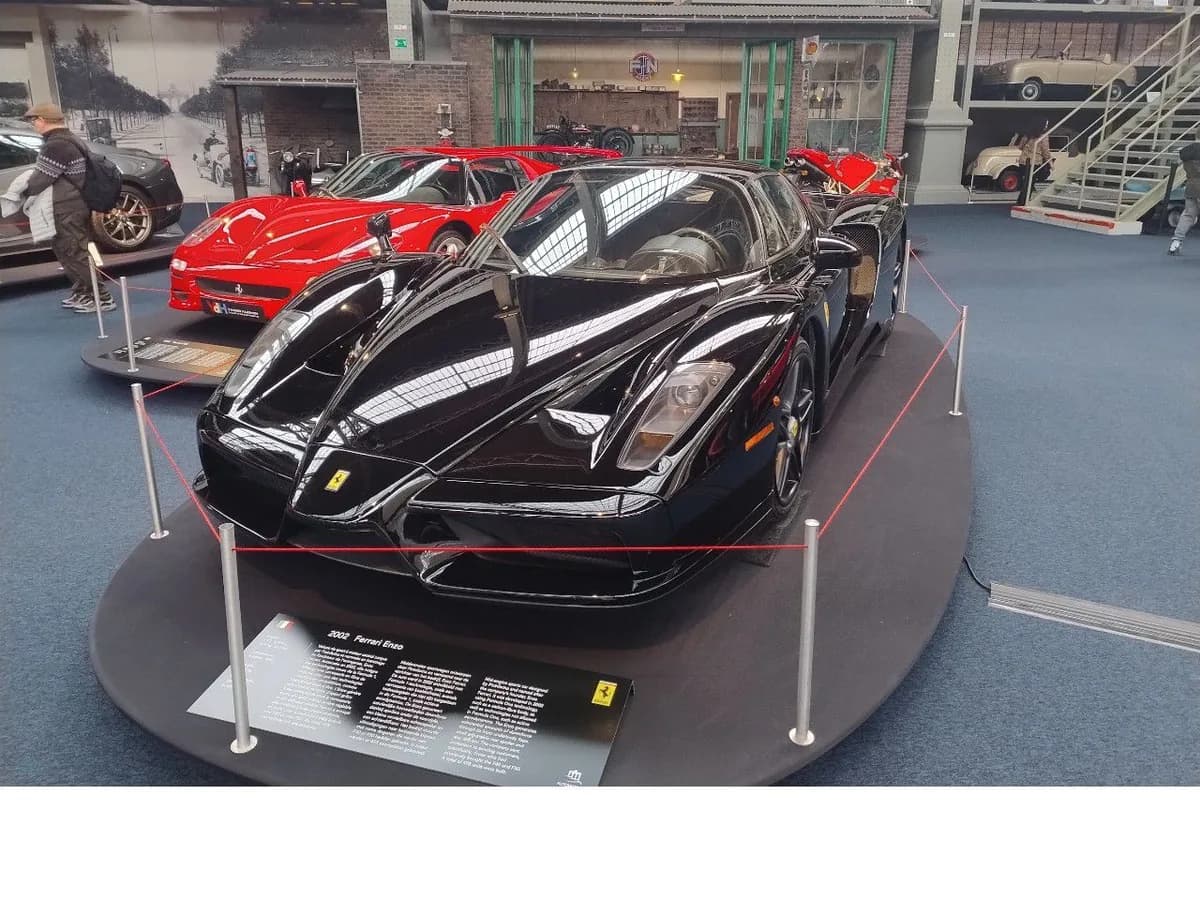
Ferrari Enzo photos
Model summary
Data from the ScanRacer library, organized to compare versions quickly.
Model introduction
Introduced in 2002, the Ferrari Enzo is a two-seat, mid-rear-engined berlinetta developed as a showcase for technology derived from competition. Its naturally aspirated 5,998.8 cc V12 produces 660 hp at 7,800 rpm, while a carbon-fibre and Nomex honeycomb monocoque, six-speed F1-style transmission and carbon-ceramic brakes focus on low weight and rapid responses. Styled by Pininfarina, the Enzo is identified by its very low nose, plexiglass-covered headlamps and heavily sculpted aerodynamic bodywork. In the ScanRacer library, the model is represented by one “Base” version covering the 2002 model year.
History
The Ferrari Enzo appeared in the early 2000s as Ferrari’s ultra-low-volume flagship road car. It followed the F50 in that role and continued Ferrari’s established approach of transferring racing solutions into a road-legal supercar. Ferrari describes the Enzo as a connection between motorsport expertise and road use, with particular emphasis on composite materials, aerodynamic efficiency and the driver interface. The model introduced the F140 engine family, a 65-degree V12 that later became the foundation for numerous Ferrari V12 applications. In the Enzo, the 6.0-litre engine produces 660 hp and drives the rear wheels through an electro-hydraulic six-speed transmission. The car also uses pushrod suspension, electronically controlled dampers and carbon-ceramic brake discs. Ferrari quotes a top speed above 350 km/h and a 0–100 km/h time of 3.65 seconds. Customer production is commonly stated as 399 cars; a special 400th chassis was subsequently built and offered for charitable fundraising. That exceptional car should not be confused with a separate regular production trim.
Generations
The supplied catalogue shows only one Ferrari Enzo generation: a “Base” version assigned to the 2002 model year. That structure fits the car’s position as a limited-production flagship, which did not receive the kind of facelift, mid-cycle phase or broad engine range associated with a high-volume Ferrari model. Its defining specification remains the one introduced in the early 2000s: a naturally aspirated 5,998.8 cc V12, longitudinal mid-rear engine, composite monocoque, six-speed F1-style gearbox and Pininfarina-designed two-seat body. It is more accurate to describe the Enzo as a single production series than to create several generations or technical variants without firm evidence. Differences between individual cars may reflect paint, interior configuration, factory-selected equipment or later alterations, but those details do not automatically establish separate factory versions. The 400th car built for a charitable sale is a special production case rather than a new generation. For the 2002 model year, “Base” should therefore be read as the sole version recorded in the library, not as one trim level within a documented hierarchy of multiple regular Enzo specifications.
Key differences
Compared with a regular-production Ferrari, the Enzo is distinguished by its far more uncompromising engineering focus. Its carbon-fibre and Nomex structure is intended to combine high rigidity with controlled weight, while pushrod suspension and electronically managed dampers follow a racing-influenced layout. The electro-hydraulic paddle-shift gearbox replaces a conventional manual transmission. The body also places unusual emphasis on airflow, combining a low nose, pronounced front fenders, side intakes and a rear diffuser to generate aerodynamic stability. The car should not, however, be described without qualification as a road-legal racing car. It remains a two-seat road berlinetta with a finished cabin, climate control and equipment suitable for road use. The supplied 2002 catalogue does not establish separate regular versions with different engines, power outputs or chassis specifications. Accordingly, the most defensible distinction is between the Enzo’s single documented production specification and individual customer configurations, rather than between multiple factory grades.
Photo recognition
The Enzo is relatively easy to distinguish from a Ferrari F50 or 360 Modena because of its upright nose and exposed aerodynamic treatment. The front end carries a broad central opening, the headlamps sit beneath clear covers and the front fenders rise noticeably around the wheels. In profile, the doors and side intakes give the body a tightly drawn appearance, while the cabin is positioned well forward and the rear terminates in a substantial diffuser. At the back, look for the exposed twin round lamps, metallic exhaust outlets and large black grille openings. The cabin has a clear competition influence, with bucket seats, visible carbon-fibre surfaces and a compact steering wheel carrying multiple controls. Shape alone is not enough to authenticate a car. A reliable identification should also compare the chassis number, identification plates, Ferrari documentation and original specification, because body and interior components may have been replaced or modified over time.
Important versions
The only version recorded in the supplied ScanRacer context is the 2002 Enzo “Base.” Ferrari’s published specification describes one core configuration: a naturally aspirated 5,998.8 cc V12, 660 hp, six-speed F1-style transmission, composite structure and carbon-ceramic brakes. No separate regular factory trim level is confirmed here. The 400th car, built later for a charitable initiative, is a special historical case frequently mentioned in accounts of the model. It should not automatically be added as a separate commercial version unless dedicated catalogue data supports that classification.
References
- Ferrari Enzo (2002)Ferrari
- Enzo Ferrari: Ferrari HistoryFerrari
- All in the Name: The Enzo FerrariFerrari Magazine
- Meeting The Ferrari Enzo (2002)Ferrari Magazine
- https://www.carsart.net/en/download/ferrari/enzocarsart.net
Technical specifications
Structured data available for versions linked to this model.
| Version | Power | Torque | Top speed | Drivetrain | Fuel |
|---|---|---|---|---|---|
| — | 485 kW (660 hp) at 7,800 rpm | — | — | Rear-wheel drive / Electro-hydraulic F1 six-speed transmission with reverse | — |
Frequently asked questions
- What years was the Ferrari Enzo produced?
- ScanRacer's referenced versions cover 2002.
- How many Ferrari Enzo examples are documented on ScanRacer?
- 6 published scans from 6 members, with the latest photo added in September 2026.
- What is the power output of the Ferrari Enzo?
- The sourced technical data lists 485 kW (660 hp) at 7,800 rpm.
What about the car you photographed?
Upload a photo to get a suggested make, model and likely year.
No account needed for the result · Publish only if you choose