Power
618 kW (840 cv) at 9,250 rpm
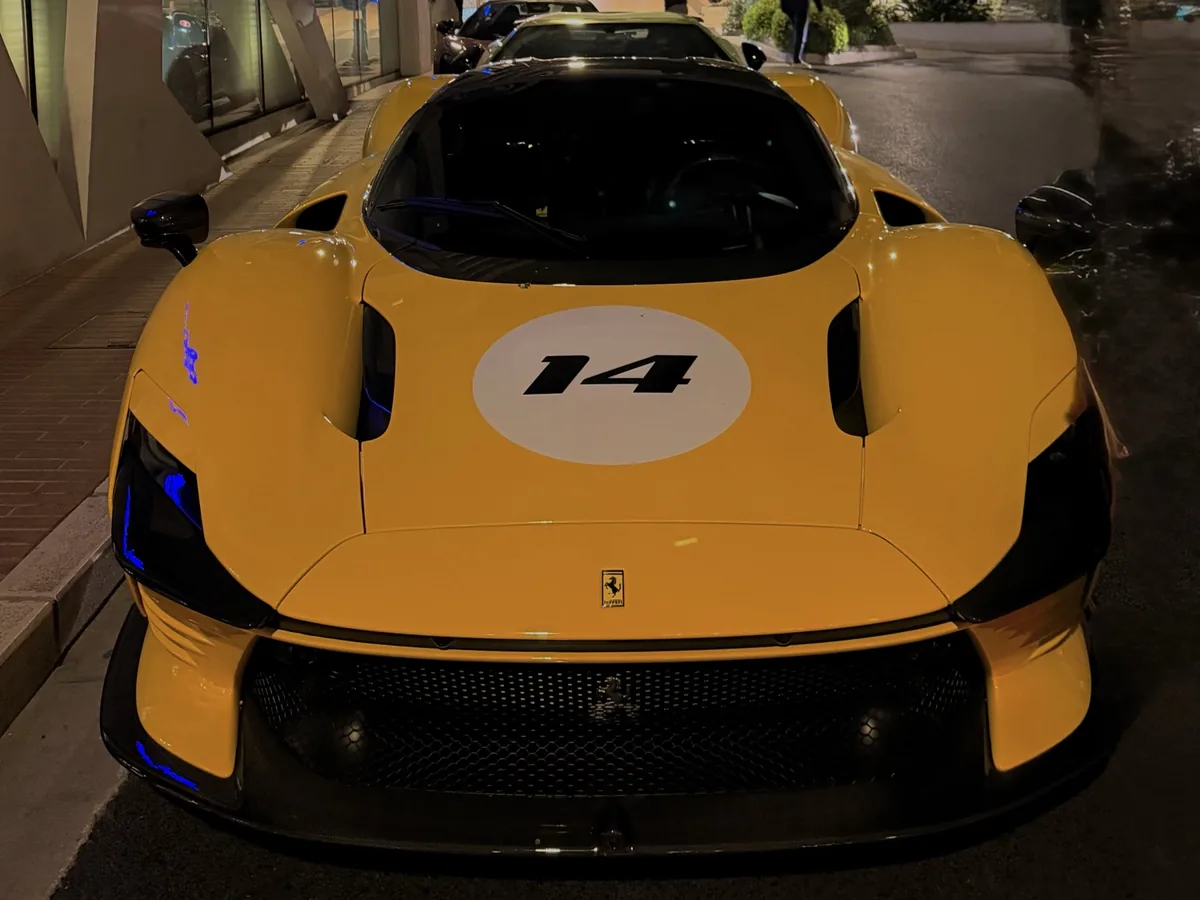
Unveiled at Mugello on November 20, 2021, the Ferrari Daytona SP3 is a two-seat, mid-rear-engined supercar created for Ferrari’s Icona program. Its Targa body uses a removable hard roof and draws heavily from Ferrari’s 1960s sports prototypes, particularly the 330 P3, 330 P4 and 412 P. Beneath its highly sculpted bodywork sits a naturally aspirated 6.5-liter V12 rated by Ferrari at 840 cv. Power is sent through a seven-speed dual-clutch gearbox to the rear wheels. Production is limited to 599 cars, making the Daytona SP3 both a mechanical statement and a carefully controlled collector model. Its appeal rests on the combination of an uncompromised combustion engine, carbon-fiber construction and a design language rooted in Ferrari’s racing history.
Curious about this car?
Explore Daytona SP3, then try your own photo.
No account needed for the result · Publish only if you choose
The Daytona SP3 is the third model created under Ferrari’s Icona program, following the Monza SP1 and SP2. Ferrari revealed it during the 2021 Finali Mondiali at Mugello, alongside historic prototypes that influenced its appearance. The name recalls Ferrari’s 1-2-3 finish at the 24 Hours of Daytona on February 6, 1967, when a 330 P3/4, a 330 P4 and a 412 P took the top three positions. That victory also helped create the informal “Daytona” nickname later associated with the 365 GTB/4, although Daytona was not that car’s official name. The SP3 brings that competition legacy to a road-legal, mid-rear-engined car. Ferrari chose a modern interpretation of its closed-wheel sports prototypes from the 1960s and 1970s, combining a Targa body, carbon-fiber structure and a cockpit focused on the driver. The model later received the 2022 Red Dot: Best of the Best award for its design.
Photos added by the community for this page.
Source: Ferrari
The Daytona name directly recalls Ferrari’s 1967 endurance-racing triumph, but the Daytona SP3 is the first Ferrari road car to use the name officially. At its Mugello presentation, the new car was accompanied by the 330 P3/4, 330 P4 and 412 P prototypes, visually connecting the modern model with its historic racing references. Its design also earned the Red Dot: Best of the Best award in 2022.
Ferrari planned the Daytona SP3 as a limited run of 599 cars. The model was revealed in November 2021 as part of the Icona program, and Ferrari later stated that the original allocation had been sold. Its restricted production supports the car’s collector status, but it does not alter the underlying technical identity: every regular example uses the same mid-rear-engined layout, naturally aspirated V12 and rear-wheel-drive configuration. In July 2025, Ferrari announced one additional Tailor Made example for a charity auction, identified as “599+1.” That car was added after the original allocation and should be understood as a special exception rather than the start of another regular production series.
Specialist publications have generally emphasized the Daytona SP3’s character and design rather than treating it as a straightforward performance exercise. Car and Driver highlighted the combination of dramatic styling, an 829-hp rating in its customary horsepower conversion and extreme exclusivity, while also pointing to the price and restricted access. MotorTrend noted the relationship between the carbon-fiber structure and the LaFerrari Aperta, as well as the role of Ferrari Dynamic Enhancer. Autocar focused on the naturally aspirated V12’s sound and high-revving delivery, arguing that the car is aimed more at experience and character than at outright lap-time supremacy. Across these assessments, the same theme appears: the SP3 is as much an emotional and historical Ferrari as it is a very high-performance road car.
Supports the November 20, 2021 unveiling, Icona positioning, Targa body, 1967 Daytona reference and sports-prototype inspiration.
Supports the engine, displacement, power, torque, rev limit, transmission, dimensions, weight and performance specifications.
Supports the 599-car production limit and the relationship with Ferrari’s Icona program and sports-prototype era.
Supports the 2022 Red Dot design award and the car’s connection to the 1967 Daytona victory.
Supports the rear-wheel-drive layout, seven-speed dual-clutch transmission, contemporary press evaluation and road-car performance context.
Supports the relationship to the LaFerrari Aperta carbon-fiber monocoque and the use of Ferrari Dynamic Enhancer.
Supports the sold-out 599 allocation and the exceptional 599+1 Tailor Made charity-auction car.
Source found by OpenAI web search for this vehicle page.