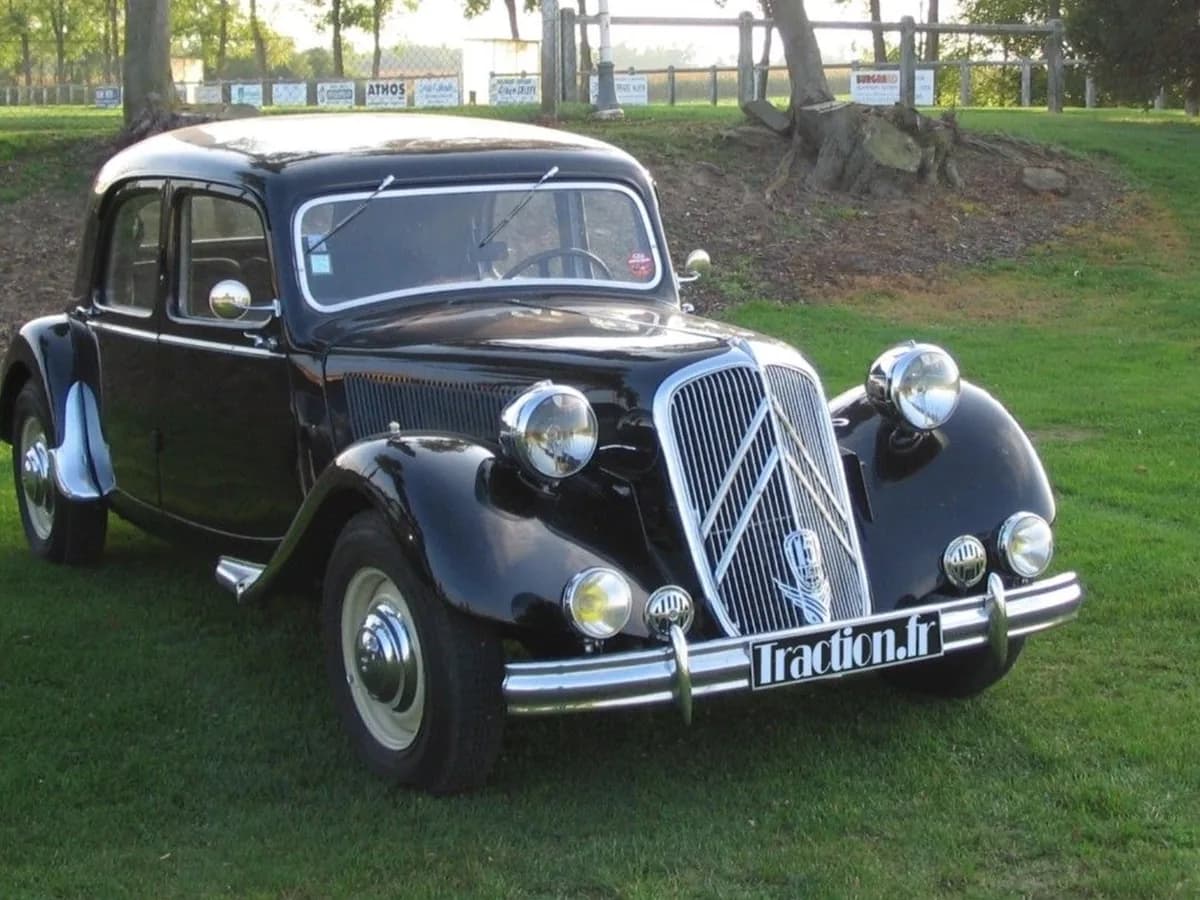
Citroën Traction Avant Berline 1934
The 1934 Citroën Traction Avant Berline belongs to the very first examples of the model family launched that year. It reflects Citroën’s aim to create a car that sat lower, handled more securely, and looked more modern than the rear-wheel-drive cars that preceded it in the range. In this form, the four-door saloon was the most common body style for the 1934 to 1936 period. Its shape carries the cues that make the Traction Avant instantly identifiable: a low stance and enveloping fenders. Early cars can show varying details from one example to another, so year and surviving condition matter a great deal when identifying one today.
History
The Traction Avant was conceived during a difficult period for Citroën, when the company was seeking a major technical and stylistic break from its previous cars. André Citroën wanted a car that was lower, more modern, and more stable than the rear-wheel-drive models in the range, while André Lefèbvre led the engineering work and Flaminio Bertoni contributed to the body design. The 7A was presented on 18 April 1934, and the family was then expanded with the 7 and 11 models. In that setting, the 1934 Berline was the most natural expression of the new car, offering a closed four-door layout suited to everyday touring use.
The launch was ambitious, but the first cars still suffered from development issues, especially around the transmission and build quality. Citroën’s financial problems then led Michelin to take control of the company in 1934. Under this new direction, the Traction Avant was gradually refined and the range grew through additional body styles and variants. The Berline stayed central to the offer because it matched the most common and representative configuration of the Traction Avant in its early years.
Latest scans
Photos added by the community for this page.
Production
Citroën states a total Traction Avant production figure of 759,123 units between 1934 and 1957. The dossier does not provide a specific number for the 1934 Berline, nor a separate breakdown for this body style in the early years. It does, however, clearly indicate that the Berline was one of the most common forms for the 1934 to 1936 period, which explains its central place in the model’s story. Precise identification of an example therefore depends more on body details, date, and serial number than on a production split that is not documented here.
Evolution
Variants
References
- Citroën celebrates 90 years of the Traction Avant, an iconic model with 100 patentsCitroën / Stellantis Media
Supports the April 18, 1934 unveiling, the 7 designation, front-wheel drive, monocoque structure, hydraulic brakes, independent suspension and production through 1957.
- Citroën 11 A Traction AvantMuseo Nazionale dell'Automobile di Torino
Supports the role of André Lefèbvre and Flaminio Bertoni, the load-bearing steel body and the 1934–1957 production period.
- Buying Guide: Citroën Traction Avant (1934-1956)Hagerty UK
Supports the Légère and Normale body families, longer Commerciale and Familiale versions, two-door body styles, Slough-built differences and major mechanical developments.
- Citroën Traction Avant buyer's guideClassics World
Supports early model development, the 7A and 7B sequence, body construction, body-style distinctions and identification cautions.
- Citroën Traction Avant 11A historyCATS Citroën
Used cautiously for early 1934 identification details involving grilles, chevrons, horns, bonnet shutters and windscreen surrounds.
- 100 Jahre Citroën: Traction Avant erstes französisches Fahrzeug mit Frontantrieb in GroßserienproduktionCitroën / Stellantis Media
Supports the 7A introduction and the stated total production figure of 759,123 vehicles from 1934 to 1957.
- https://www.media.stellantis.com/ch-fr/citroen/press/citroen-celebre-les-90-ans-de-la-traction-avant-modele-emblematique-aux-100-brevetsmedia.stellantis.com
Source found by OpenAI web search for this model page.
- https://www.media.stellantis.com/ch-de/citroen/press/citroen-feiert-das-90-jaehrige-jubilaeum-des-traction-avant-des-emblematischen-modells-mit-100-patentenmedia.stellantis.com
Source found by OpenAI web search for this model page.