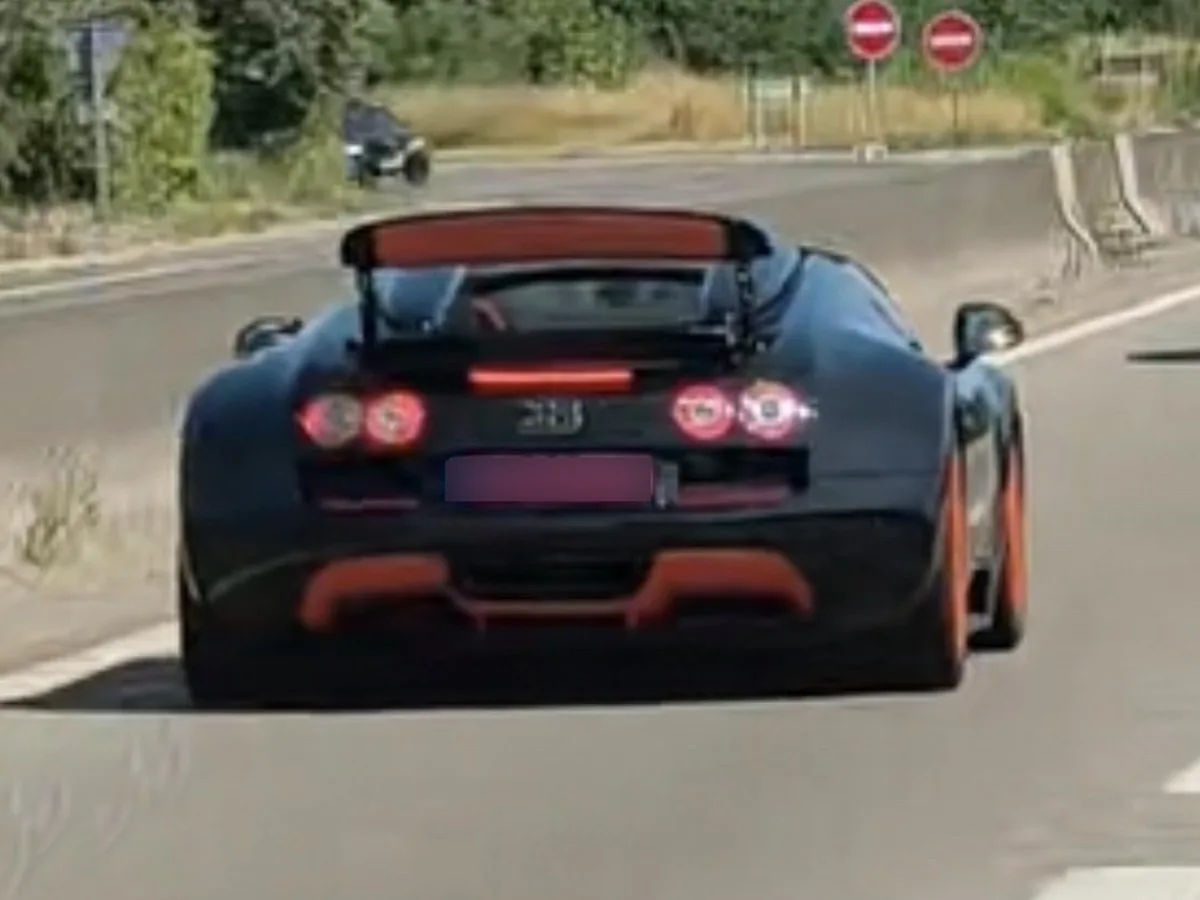
Bugatti Veyron Grand Sport Vitesse Targa 2012
Revealed at the Geneva Motor Show in March 2012, the Bugatti Veyron 16.4 Grand Sport Vitesse is the open-top counterpart to the Veyron Super Sport. Its 7.9-liter W16 produces 1,200 hp and 1,500 Nm, with four-wheel drive and a seven-speed dual-clutch transmission delivering the output to the road. The removable targa-style roof gives the car a roadster layout while preserving the extreme performance associated with the Veyron name. Bugatti quoted a 410 km/h track capability, while normal driving mode limited the car electronically to 375 km/h. In 2013, an official test recorded 408.84 km/h, establishing the Vitesse as the fastest production sports car tested without a fixed roof.
History
The Grand Sport Vitesse was developed to bring the Veyron Super Sport’s powertrain into an open-top car. Bugatti unveiled it at Geneva in 2012 after customers asked for a roadster with the Super Sport’s 1,200-hp output. The engineering work involved more than fitting a larger-output engine. The Grand Sport’s structure was reinforced to compensate for the absence of a fixed roof, while rollover protection and high-speed stability required dedicated development. The 7.9-liter W16 gained four larger turbochargers and new intercoolers. Bugatti also strengthened the drivetrain and revised the ratios of the seven-speed DSG transmission to handle the higher loads. Production began in the summer of 2012, with first customer deliveries expected in the following months. The Vitesse became the final regular development of the Veyron family before the Les Légendes de Bugatti editions and the end of Veyron production in 2015.
Latest scans
Photos added by the community for this page.
Anecdotes
On April 5, 2013, a Bugatti Veyron 16.4 Grand Sport Vitesse driven by Anthony Liu reached an average speed of 408.84 km/h at Volkswagen’s Ehra-Lessien test facility in Germany. The run was completed with the roof removed and the side windows raised. Bugatti thereby established a production-car record for an open-top sports car. The measured result was slightly below the 410 km/h capability quoted by the manufacturer for closed-track conditions.
Production
Bugatti produced 92 examples of the Veyron 16.4 Grand Sport Vitesse, according to figures published by the manufacturer in its retrospective coverage of the Veyron family. These cars formed part of the 150 open-top Veyrons built, alongside the 1,001-hp Grand Sport. Total Veyron production reached 450 cars across coupe and open-top versions. The Vitesse was assembled in Molsheim and entered the market in 2012. The production figure covers special configurations and commemorative editions based on the Vitesse, rather than representing only one exterior specification or a single trim combination.
Press reception
Automotive publications generally treated the Grand Sport Vitesse as an engineering statement rather than an ordinary road car. Road & Track and Car and Driver highlighted its acceleration, top-speed potential and the remarkably direct delivery of the W16 engine. Their reports also pointed to the practical limitations of a car with such extreme performance and price, including the space required to use its capabilities safely. Media coverage consequently focused on the Vitesse’s position as the fastest production roadster of its era, while making clear that its highest performance figures were achieved in controlled, closed-track conditions.
Evolution
Variants
References
- World premiere of the Bugatti Veyron 16.4 Grand Sport VitesseBugatti Newsroom
Supports the 2012 launch, 7.9-liter W16, 1,200 hp, 1,500 Nm, four-wheel drive, seven-speed DSG, speed figures and technical changes.
- Production Begins for Bugatti Veyron 16.4 Grand Sport VitesseBugatti Newsroom
Supports the start of production in July 2012, first customer deliveries and the original market positioning.
- 408.84 km/h: Bugatti Veyron 16.4 Grand Sport Vitesse sets world speed record for open-top production sports carsBugatti Newsroom
Supports the 2013 record, 408.84 km/h result and the model’s market availability from spring 2012.
- Ten Years of the Bugatti Veyron 16.4 Grand Sport VitesseBugatti Newsroom
Supports the model’s relationship to the Super Sport, structural development, 2012 introduction and record context.
- Les 15 ans de la Bugatti Veyron 16.4 – six modèles Veyron inoubliablesBugatti Newsroom
Supports the production figure of 92 Grand Sport Vitesse cars within 150 open-top Veyrons.
- 2012 Bugatti Veyron 16.4 Grand Sport Vitesse ReviewRoad & Track
Supports contemporary road-test context and press discussion of the car’s performance.
- 2013 Bugatti Veyron 16.4 Grand Sport Vitesse First DriveCar and Driver
Supports the targa body description and contemporary performance assessment.
- Bugatti vend la dernière VeyronBugatti Newsroom
Supports the 450-car total, 150 open-top cars, the 2015 end of production and the La Finale Vitesse.