
Type 40
Introduced in 1926, the Bugatti Type 40 was a lightweight touring car built at Molsheim as part of the company’s continuation of the small Brescia Bugattis. Its relatively compact chassis could accept several body styles, including enclosed tourers, torpedoes, roadsters, and Grand Sport bodies supplied or adapted by different coachbuilders. The specification most often associated with the model is a roughly 1.5-liter overhead-camshaft four-cylinder engine producing about 50 hp, as recorded by the Museu do Caramulo for its preserved example. The Type 40 emphasized balance, modest weight, and enjoyable handling rather than outright power. Production continued into the early 1930s, while the Type 40A represented a later development with a larger-displacement engine. The ScanRacer catalog identifies a single 1926 Base variant.
Variants by year
1926
Model summary
Data from the ScanRacer library, organized to compare versions quickly.
Model introduction
Introduced in 1926, the Bugatti Type 40 was a lightweight touring car built at Molsheim as part of the company’s continuation of the small Brescia Bugattis. Its relatively compact chassis could accept several body styles, including enclosed tourers, torpedoes, roadsters, and Grand Sport bodies supplied or adapted by different coachbuilders. The specification most often associated with the model is a roughly 1.5-liter overhead-camshaft four-cylinder engine producing about 50 hp, as recorded by the Museu do Caramulo for its preserved example. The Type 40 emphasized balance, modest weight, and enjoyable handling rather than outright power. Production continued into the early 1930s, while the Type 40A represented a later development with a larger-displacement engine. The ScanRacer catalog identifies a single 1926 Base variant.
History
The Type 40 entered Bugatti’s range in 1926, when the company was seeking a more accessible and versatile car than its prestige models while retaining Ettore Bugatti’s engineering principles. It followed the concept of a relatively light automobile with an overhead-camshaft four-cylinder engine and a chassis that could be adapted to several body designs. The Museu do Caramulo describes a Grand Sport example with a 1,496 cc engine, a four-speed manual gearbox, four-wheel drum brakes, and leaf-spring suspension with friction dampers. Body design also became increasingly important at this point in Bugatti’s history. Bugatti’s own historical material states that Jean Bugatti began developing Type 40 body concepts from 1926, working with designer Joseph Walter. The museum records 780 Type 40 cars built between May 1926 and March 1931. That figure refers to the Type 40 itself in the museum’s account; higher totals sometimes quoted for the wider Type 40 family may include the Type 40A. Introduced in 1930, the Type 40A used a larger approximately 1.6-liter engine and a long chassis.
Generations
The Bugatti Type 40 is not divided into several generations in the modern sense. It was a single model line introduced in 1926, with mechanical and coachwork changes made during its production life. Cars can therefore look notably different without representing separate generations: bodywork depended on the market, the customer’s order, and the coachbuilder, while some chassis were delivered without a complete body. This accounts for the presence of four-seat cars, roadsters, torpedoes, and Grand Sport versions within the Type 40 family. The Type 40A, introduced in 1930, is best treated as a derivative or later development rather than as a new generation of the original model. Bugatti describes it as using a 1.6-liter four-cylinder engine producing about 50 hp, mounted on a long chassis and capable of approximately 130 km/h. ScanRacer’s supplied context lists only one Base variant for 1926. The 1930 Type 40A and later special coachbuilt bodies should therefore not be merged automatically into that 1926 catalog entry.
Key differences
Differences between Type 40 cars are primarily related to bodywork and production date. An open Grand Sport may have a 2+2 layout, narrow fenders, and a single side door, while an enclosed tourer or torpedo has a different profile and interior arrangement. Cars could also be bodied or re-bodied by outside coachbuilders, making visual identification alone unreliable. Mechanically, early cars are generally associated with a roughly 1.5-liter four-cylinder engine. The Type 40A, introduced in 1930, is distinguished by its larger approximately 1.6-liter engine and long chassis. Published figures for power, weight, and top speed may change with the body style, year, and individual car. Specifications from a preserved museum example should therefore not be treated as universal for every Type 40. Chassis records and period documentation remain more reliable than appearance when separating an original Type 40 from a later Type 40A or a re-bodied car.
Photo recognition
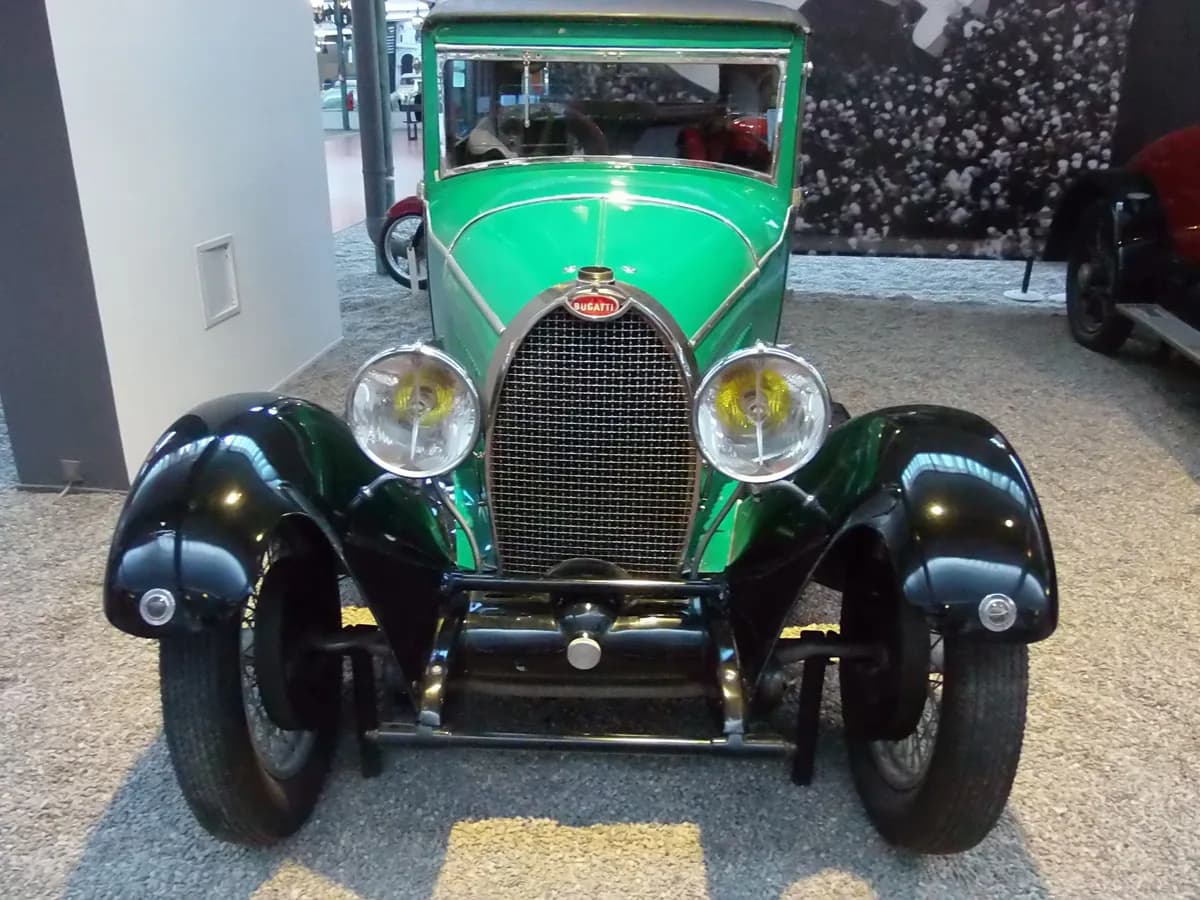
A Type 40 is generally recognized by its compact proportions, narrow long hood, Bugatti horseshoe radiator grille, and wire wheels. Open cars often have separate fenders and a tapered rear profile, although these details vary with the coachwork. A four-seat cabin or a single side door may suggest certain Grand Sport bodies, but neither feature is conclusive on its own. The four-cylinder engine, chassis construction, and stamped identification numbers are more useful for authentication. The chassis plate, engine number, bodywork, and ownership history should be checked together because Type 40 cars were sometimes re-bodied during their lives. A car that looks like a Type 40 may instead be a Type 40A; production year, long-chassis configuration, and engine displacement can help distinguish the later derivative. Modern badges and heavily customized restorations are poor standalone evidence. For a serious identification, period records and matching numbers should take priority over visual resemblance.
Important versions
The Type 40 Grand Sport is one of the best-known configurations. Its open body could accommodate four occupants and highlighted the car’s light chassis and narrow proportions. Enclosed tourers, torpedoes, and roadsters demonstrate the flexibility of the chassis and the importance of independent coachbuilders in Bugatti production. In 1930, the Type 40A introduced a significant development with a 1.6-liter engine, long chassis, and an advertised output of approximately 50 hp. It should not be confused with the 1926 Type 40 Base entry identified in the supplied ScanRacer context. Some Type 40 cars later received special bodies, including touring bodies and shooting-brake conversions. Such changes may post-date original production, however, and should be documented individually rather than treated automatically as factory versions.
References
- Bugatti Type 40 Grand SportMuseu do Caramulo
- https://www.autoevolution.com/bugatti/type-40/autoevolution.com
- https://www.classic.com/m/bugatti/type-40/classic.com
- https://www.ultimatecarpage.com/spec/989/Bugatti-Type-40.htmlultimatecarpage.com
Frequently asked questions
- What years was the Bugatti Type 40 produced?
- ScanRacer's referenced versions cover 1926.
- How many Bugatti Type 40 examples are documented on ScanRacer?
- 3 published scans from 2 members, with the latest photo added in July 2026.