
TT RS
The Audi TT RS is the compact German sports car’s highest-performance derivative, introduced in 2009 with a turbocharged 2.5-liter five-cylinder engine, quattro all-wheel drive and 340 hp. It combines the TT’s compact proportions with RS-specific equipment, including larger air intakes, a lowered chassis, upgraded brakes and a distinctive exhaust note. Two major technical eras are represented between 2009 and 2016. The first is based on the second-generation TT and was later followed by the 360-hp TT RS plus. The second arrived in 2016 on the third-generation TT, bringing an aluminum five-cylinder engine rated at 400 hp and a seven-speed S tronic transmission. Coupé and Roadster body styles were available, although exact equipment, transmissions and market availability could vary by country and model year.
Variants by year
2016
2009
 SR
SRModel summary
Data from the ScanRacer library, organized to compare versions quickly.
Model introduction
The Audi TT RS is the compact German sports car’s highest-performance derivative, introduced in 2009 with a turbocharged 2.5-liter five-cylinder engine, quattro all-wheel drive and 340 hp. It combines the TT’s compact proportions with RS-specific equipment, including larger air intakes, a lowered chassis, upgraded brakes and a distinctive exhaust note. Two major technical eras are represented between 2009 and 2016. The first is based on the second-generation TT and was later followed by the 360-hp TT RS plus. The second arrived in 2016 on the third-generation TT, bringing an aluminum five-cylinder engine rated at 400 hp and a seven-speed S tronic transmission. Coupé and Roadster body styles were available, although exact equipment, transmissions and market availability could vary by country and model year.
History
The TT RS marked the return of Audi’s turbocharged five-cylinder gasoline engine in 2009. The project was developed by quattro GmbH, the performance division that became Audi Sport GmbH in 2016. Its transverse-mounted 2.5-liter engine used TFSI direct injection and produced 340 hp and 450 Nm of torque. The layout echoed Audi’s historic combination of five-cylinder power, turbocharging and quattro drive, which had become prominent in the brand’s 1980s competition cars, although the road car was not a direct technical replica of those rally machines. The TT RS was offered as both a Coupé and a Roadster, with transmission availability varying by market and production period. Audi introduced the TT RS plus in 2012 as a more powerful development of the first series. Its five-cylinder engine produced 360 hp and 465 Nm. In 2016, the TT RS entered a new technical era with the third-generation TT. The revised 2.5 TFSI engine used an aluminum crankcase, produced 400 hp and 480 Nm, and was paired with a seven-speed S tronic dual-clutch transmission. Audi quoted a 0-to-100-km/h time of 3.7 seconds for the Coupé and 3.9 seconds for the Roadster. Exact specifications and availability still depended on the market.
Generations
The first TT RS generation appeared on the second-generation TT, which entered production from 2006. It was defined by a 340-hp 2.5 TFSI five-cylinder engine, quattro all-wheel drive and a more aggressive specification than the standard TT. Visual identifiers included the Singleframe grille, larger air intakes, a lowered body, RS-specific wheels and twin oval exhaust outlets. The TT RS plus, introduced in 2012, retained the same basic platform and body design but raised output to 360 hp. The second TT RS generation arrived in 2016 on the third-generation TT. It brought a extensively revised five-cylinder engine with an aluminum crankcase and a 26-kg weight reduction compared with the previous unit. Output increased to 400 hp, with 480 Nm available across a broad engine-speed range. A seven-speed S tronic dual-clutch transmission became central to the drivetrain, while the quattro system used an electrohydraulic clutch to vary torque distribution between the axles. The 2016 model also introduced the Audi virtual cockpit and, depending on specification, Matrix OLED rear lighting. As a result, the 2016 model year can refer to two distinct TT RS technical generations depending on market and production timing.
Key differences
The Coupé and Roadster share the five-cylinder engine, quattro all-wheel drive and most RS equipment, but their body structures create measurable differences. The Coupé benefits from a fixed roof and a lower body weight, while the Roadster requires additional reinforcement to compensate for the open structure. For the 2016 TT RS, Audi listed a curb weight of 1,440 kg for the Coupé and 1,530 kg for the Roadster, with quoted 0-to-100-km/h times of 3.7 and 3.9 seconds respectively. The Roadster also uses an electrically operated fabric roof and offers less luggage capacity. Figures can vary with wheels, options and national homologation requirements. The main distinction between the regular first-generation TT RS and the TT RS plus is increased engine output, together with selected specification and trim changes, rather than a completely different body design.
Photo recognition
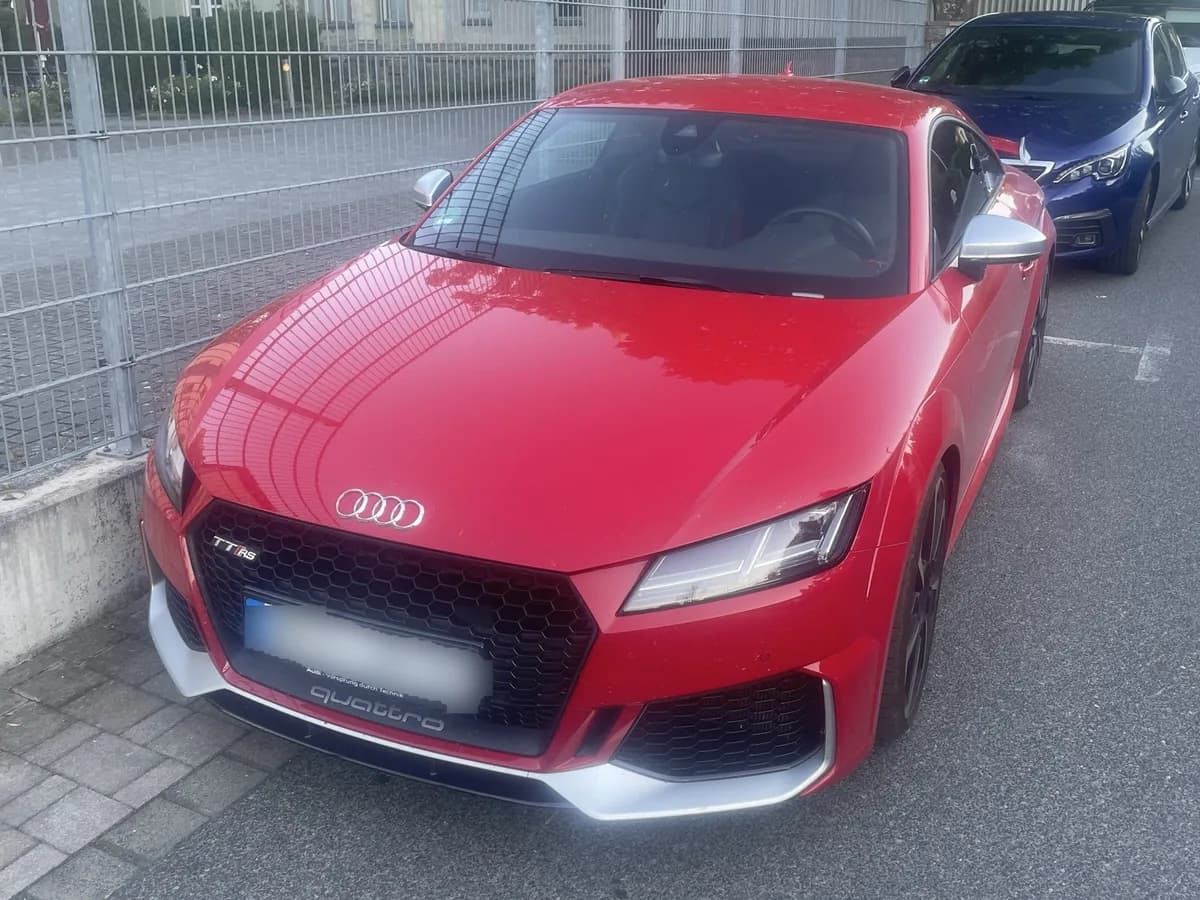
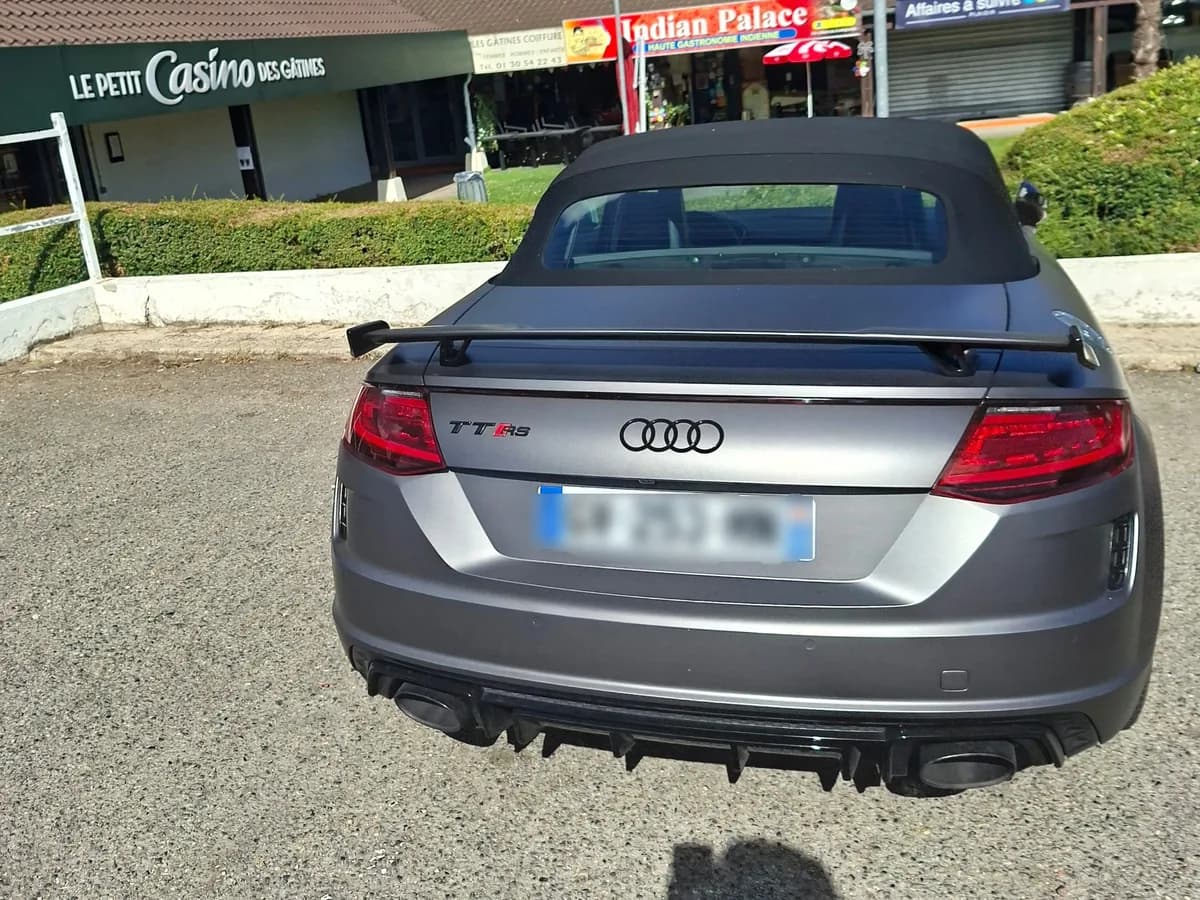
A TT RS can first be identified by the combination of RS details and the compact proportions shared with the wider TT range. On first-generation cars, look for a more open front end, a distinctive Singleframe grille, enlarged air intakes, RS badging and a larger performance exhaust than on regular TT models. The five-cylinder engine also produces a characteristic sound, but noise alone cannot authenticate a car that may have been modified or fitted with an aftermarket exhaust. The 2016 TT RS has a more readily identifiable specification, including a honeycomb Singleframe grille with quattro badging, a more aggressive front bumper, pronounced side sills, a fixed or optional retractable rear wing and two large oval exhaust outlets. Brake calipers may carry RS logos. Matrix OLED rear lights are a useful clue on some 2016 cars, but they were equipment-dependent and should not be treated as standard on every example. For reliable identification, the VIN, factory option codes and manufacturer documentation are more dependable than visual inspection alone.
Important versions
The key versions are the 2009 TT RS, equipped with a 340-hp 2.5 TFSI five-cylinder engine, and the TT RS plus introduced in 2012 with 360 hp. The plus was the most powerful development of the first generation. In 2016, the redesigned TT RS introduced a substantially revised powertrain: a 400-hp 2.5 TFSI engine, 480 Nm of torque and a seven-speed S tronic transmission. It was sold as both a Coupé and a Roadster, with slightly different performance figures because of the Roadster’s added structural reinforcement and weight. Names, transmissions and equipment levels could vary between markets. Any vehicle described as a 2016 model should therefore be checked against its VIN, production date and national specification sheet.
The name “TT RS” follows Audi naming, with its rules and its exceptions. Decode a Audi name
References
- Audi TT RS Coupé and Audi TT RS Roadster – The sporty vanguard of the model seriesAudi MediaCenter
- New Audi TT RS 2016 reviewevo
- https://www.autocar.co.uk/car-review/audi/tt-rs/first-drives/2016-audi-tt-rs-coup%C3%A9-reviewautocar.co.uk
- https://www.cityam.com/audi-tt-rs-review-ferociously-fast-and-deeply-desirable-new/cityam.com
- https://www.rac.co.uk/drive/car-reviews/audi/rs/tt-rs/rac.co.uk
- https://www.stuff.tv/review/audi-tt-rs-2016-first-drive-review/stuff.tv
- https://www.autocarindia.com/car-reviews/2016-audi-tt-rs-review-test-drive-403051autocarindia.com
Technical specifications
Structured data available for versions linked to this model.
| Version | Power | Torque | Top speed | Drivetrain | Fuel |
|---|---|---|---|---|---|
| — | 400 ch, 480 Nm | — | — | quattro / S tronic à 7 rapports | — |
Frequently asked questions
- What years was the Audi TT RS produced?
- ScanRacer's referenced versions cover 2009 - 2016.
- How many Audi TT RS examples are documented on ScanRacer?
- 8 published scans from 8 members, with the latest photo added in August 2026.
- What is the power output of the Audi TT RS?
- The sourced technical data lists 400 ch, 480 Nm.