
SQ9
The Audi SQ9 is the first model to use this name and the performance-oriented member of the new Q9 family, Audi’s three-row full-size SUV. Revealed in the United States on July 28, 2026, it combines a 4.0-liter twin-turbocharged V8 producing 591 hp with rear-biased quattro all-wheel drive. Audi quotes a 0-to-60-mph time of 3.8 seconds, while adaptive air suspension and available towing equipment broaden its everyday usefulness. The cabin can be configured for six or seven occupants, depending on the second-row layout. U.S. deliveries are scheduled to begin in the fourth quarter of 2026, although Audi identifies the vehicle as a 2027 model year. In the ScanRacer context, the library contains one “Base” variant covering the 2026 year.
Variants by year
2026
Model summary
Data from the ScanRacer library, organized to compare versions quickly.
Model introduction
The Audi SQ9 is the first model to use this name and the performance-oriented member of the new Q9 family, Audi’s three-row full-size SUV. Revealed in the United States on July 28, 2026, it combines a 4.0-liter twin-turbocharged V8 producing 591 hp with rear-biased quattro all-wheel drive. Audi quotes a 0-to-60-mph time of 3.8 seconds, while adaptive air suspension and available towing equipment broaden its everyday usefulness. The cabin can be configured for six or seven occupants, depending on the second-row layout. U.S. deliveries are scheduled to begin in the fourth quarter of 2026, although Audi identifies the vehicle as a 2027 model year. In the ScanRacer context, the library contains one “Base” variant covering the 2026 year.
History
The Audi SQ9 establishes a new position within Audi’s SUV lineup. Before its arrival, the brand offered performance derivatives of the Q5, Q7 and Q8, but it did not have a full-size, three-row SUV positioned at the top of its range. The SQ9 therefore arrived alongside the Q9, a model developed with North American luxury-SUV expectations in mind and aimed at vehicles such as the BMW X7 and Mercedes-Benz GLS. Audi revealed the SQ9 on July 28, 2026, in Reston, Virginia. The vehicle was announced primarily for the United States, with customer deliveries scheduled for the fourth quarter of 2026. Audi nevertheless classifies it as a 2027 model year vehicle. That timing accounts for the difference between the 2026 launch and the 2027 designation used in manufacturer and industry communications. The SQ9 is not merely a higher-output Q7. It introduces the Q9 family and adds a twin-turbocharged V8, rear-biased quattro all-wheel drive, an electronically controlled rear differential, rear-wheel steering and dedicated chassis tuning. It is therefore best understood as the first generation of a new model line rather than the continuation of an earlier SQ9 series.
Generations
The Audi SQ9 does not yet have multiple documented generations. The vehicle revealed in 2026 is the first generation, introduced with the Q9 family. Audi describes it as the first SQ9 and as the performance flagship of its new full-size, three-row SUV range. There is therefore no established historical comparison between first- and second-generation models, nor any earlier engine or body-style revision to document. This first generation shares the Q9 family’s general body structure and cabin concept, but it receives hardware specific to Audi’s S performance line. Its 4.0-liter twin-turbocharged V8 produces 591 hp and 590 lb-ft of torque. Power is sent through an eight-speed Tiptronic automatic transmission and a rear-biased quattro system that can favor the rear axle during dynamic driving. The chassis package includes adaptive air suspension, rear-wheel steering and an electronically controlled locking rear differential. Audi officially identifies the vehicle as a 2027 model year, with U.S. deliveries expected in the fourth quarter of 2026. ScanRacer’s available coverage is narrower: it lists the model for 2026 with one “Base” variant. No previous generation, facelift or interim mechanical update should be inferred from that single catalog entry.
Key differences
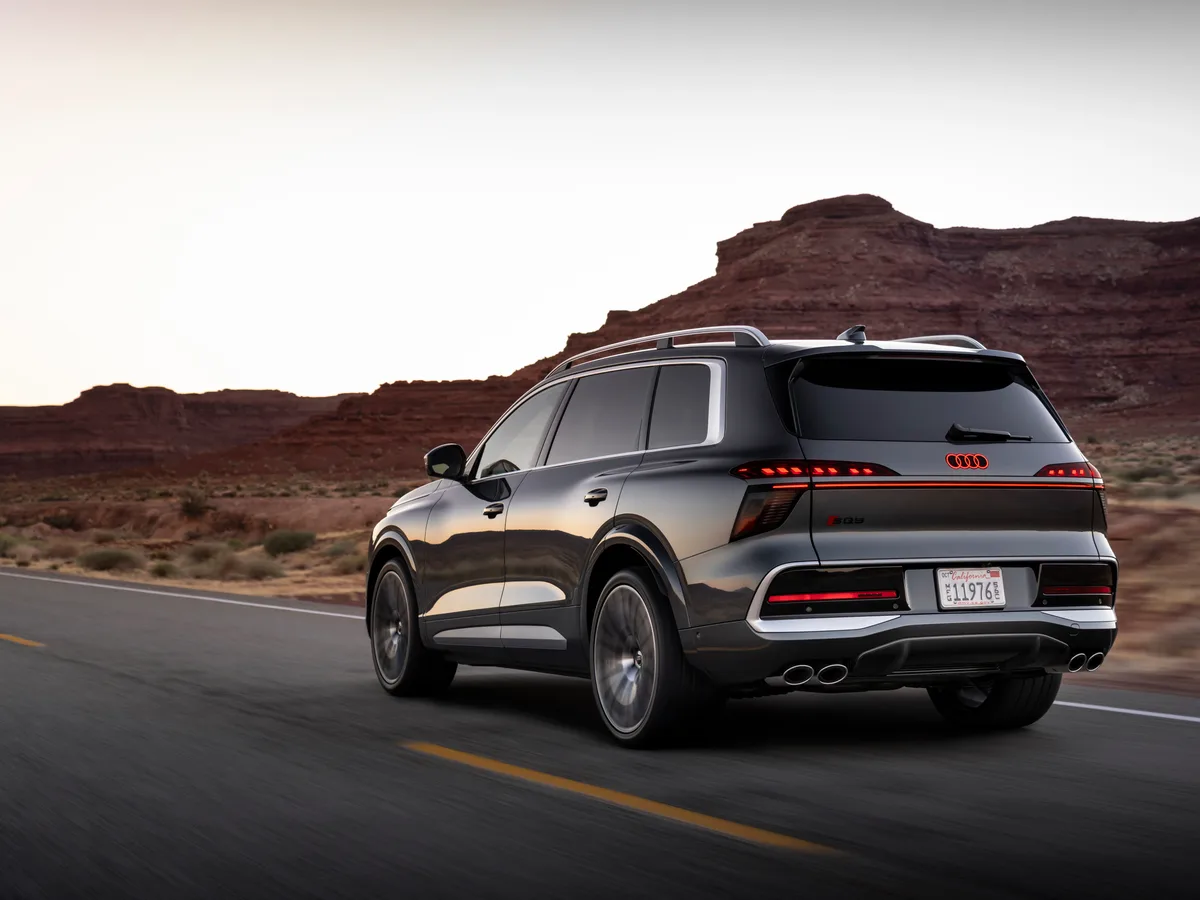
The SQ9 differs from the Q9 mainly through its powertrain and chassis tuning. The North American Q9 uses a twin-turbocharged V6, while the SQ9 receives a 4.0-liter twin-turbocharged V8 rated at 591 hp. The performance model also adds rear-biased quattro all-wheel drive, an electronically controlled rear differential and staggered-width tires that are wider at the rear. Twenty-two-inch wheels are standard, with 23-inch wheels available. The clearest exterior identifiers are the SQ-specific grille, flared wheel arches, more pronounced rear spoiler and four exhaust outlets. The cabin retains the Q9’s overall layout but adds S-branded details, sport seats and distinctive trim depending on specification. Both vehicles remain three-row SUVs and can be configured for six or seven occupants. Equipment may vary by market and option package, so these points should be treated as announced SQ9 characteristics rather than a universal description of every individual vehicle.
Photo recognition
To identify an Audi SQ9, begin with the front and rear of the vehicle. Four exhaust outlets, a more prominent roof spoiler and visibly flared wheel arches form a useful group of clues. The SQ-specific grille and aluminum exterior accents further separate the performance model from the standard Q9, even though both vehicles share the same broad silhouette. Large-diameter wheels and wider rear tires are also associated with the announced SQ9 specification. Inside, look for S badges, sport seats, available carbon-fiber trim and the red-trimmed start button described by automotive reports. The three-row body and full-width OLED rear lighting are shared with the Q9, so neither feature alone confirms an SQ9. The strongest mechanical clue is the 4.0-liter twin-turbocharged V8, although it cannot normally be verified from outside the vehicle. A dependable identification should combine the badges, grille, exhaust outlets, wheel design and vehicle documentation. Because options and market equipment can differ, visual details should be treated as supporting evidence rather than absolute proof.
Important versions
ScanRacer’s available Audi SQ9 coverage is limited to one “Base” variant for the 2026 year. That label describes the catalog entry used in the database and should not be read as proof of a simplified trim level or a complete factory trim hierarchy. Launch information published about the vehicle mainly concerns the SQ9 as the performance member of the Q9 family. Announced choices include six- or seven-seat cabin layouts, 22- or 23-inch wheels, optional sport adaptive air suspension and available high-performance summer tires. These are equipment or configuration choices rather than necessarily separate model variants. No additional trim level, special edition or alternative body style is confirmed by the supplied ScanRacer context.
The name “SQ9” follows Audi naming, with its rules and its exceptions. Decode a Audi name
References
- 2027 Audi SQ9 RevealedAudi press material reproduced by The Auto Channel
- Audi’s flagship SQ9 adds a 4.0-litre twin-turbo V8 to its largest ever carTop Gear
- Audi SQ9 (2026): Luxus-SUV mit V8AUTO BILD
- https://ecoloauto.com/premier-contact-audi-q9-et-sq9-de-grosses-affaires/ecoloauto.com
- https://www.cars.com/videos/audi-goes-big-with-new-q9-sq9-3-row-suvs-6402359642112/cars.com
- https://www.autoblog.com/news/2027-audi-q9-sq9-revealed-full-size-suvautoblog.com
- https://www.tomsguide.com/vehicle-tech/i-just-saw-the-upcoming-2027-audi-q9-and-sq9-and-they-project-turn-signals-onto-the-roadtomsguide.com
Frequently asked questions
- What years was the Audi SQ9 produced?
- ScanRacer's referenced versions cover 2026.
- How many Audi SQ9 examples are documented on ScanRacer?
- 5 published scans from 1 member, with the latest photo added in July 2026.