

Porsche 911 Flachbau RS: key facts
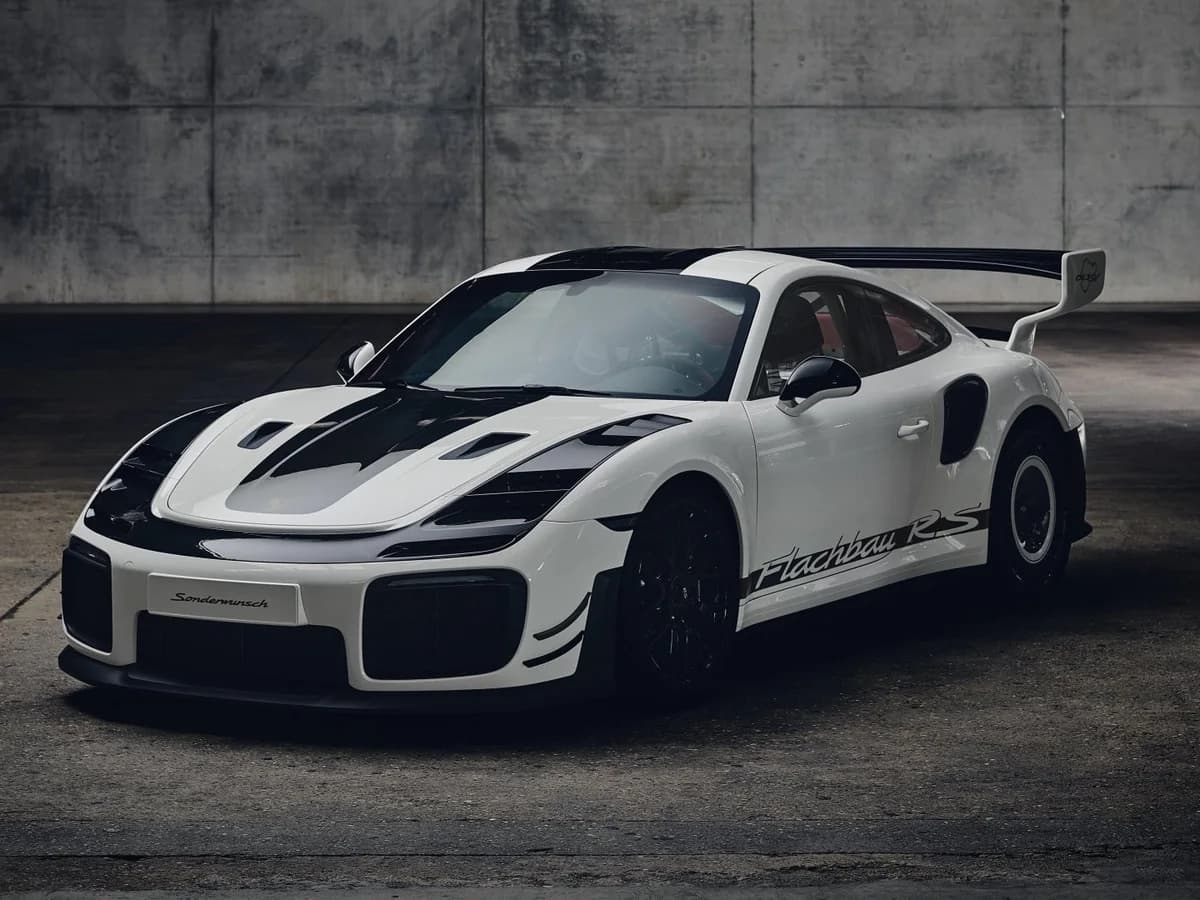
The Porsche 911 Flachbau RS is a factory one-off created by the Sonderwunsch department from a like-new 2018 991.2-generation 911 GT2 RS with the Weissach Package. Revealed in August 2026, the road-legal car reinterprets the slantnose design of the Porsche 935 and the 1980s 911 Turbo Flachbau.
Its drivetrain remains unchanged: the 3.8-litre twin-turbo flat-six retains the GT2 RS's 700 PS and 750 Nm. Developed with Style Porsche, Porsche Motorsport and Manthey, the project instead focuses on bodywork, aerodynamics and weight reduction.
How can you recognize the Porsche 911 Flachbau RS?
Its front end is unmistakable. Lower front wings replace the 911's large round headlamps with three stacked LED modules. The low- and high-beam elements are each less than four centimetres tall, while the daytime-running light measures under two centimetres.
Louvred vents release pressure from the wheel housings. The front bumper, fuel-filler flap and its mechanism were redesigned to suit the Flachbau profile.
Grand Prix White paint is paired with matt black and exposed carbon fibre. A black U-shaped graphic on the bonnet directly recalls the Martini-liveried Porsche 935/78 known as Moby Dick.
A wing inspired by the 911 GT3 R rennsport
The rear wing uses S-shaped mounts inspired by the 911 GT3 R rennsport but sits approximately five centimetres higher. Three manual positions allow the driver to adapt downforce to the track.
At 340 km/h in High Downforce trim, Porsche claims exactly 554 kg of rear-axle downforce. Depending on the selected position, rear downforce rises by two or three percent compared with a similarly adjusted GT2 RS with the Manthey Kit.
The splitter, underbody and diffuser follow Manthey's approach, while carbon aerodiscs on the rear wheels reduce drag.
31.6 kg lighter than before
Porsche removed the PCM infotainment system, audio hardware, much of the sound insulation and several cabin coverings. The wiring loom was simplified and deliberately left exposed behind the seats. Unused mounts and individual wires were also deleted.
The transformation saves 31.6 kg compared with the car before conversion. Porsche does not state a final homologated weight for this exact specification, so simply subtracting that figure from the quoted weight of a standard GT2 RS would be misleading.
A removable emergency box holds the road-mandatory warning triangle and towing eye and can be taken out for track use.
The 700 PS drivetrain remains unchanged
At the owner's request, Porsche retained the GT2 RS powertrain. Its 3.8-litre twin-turbo flat-six produces 515 kW (700 PS) and 750 Nm, driving the rear wheels through a seven-speed PDK transmission.
Reference GT2 RS performance includes a 211 mph top speed and a claimed 0-62 mph time of 2.8 seconds. Those are donor-car figures; Porsche has not published a new Flachbau RS-specific acceleration test.
Three prototypes for one customer car
Development took almost three years. Porsche built three test vehicles to validate lighting, structure and aerodynamics through wind-tunnel work, digital simulation and real-world testing.
Testing included 50 laps of the Nürburgring Nordschleife. Porsche says the rear wing's vibration and durability programme simulated approximately 150,000 km of customer use. Despite that effort, only one customer vehicle carries the plaque “Factory One-Off 2026 | Flachbau RS”.
Visit the Porsche 911 Flachbau RS page in the ScanRacer library for photos and specifications. Figures were checked against Porsche's official release and the 911 GT2 RS technical presentation.
See also
This car was one of the debuts of Monterey Car Week 2026. All the others are gathered in the Monterey Car Week 2026 round-up.