
750S
Introduced on April 25, 2023, the McLaren 750S is a mid-engined, rear-wheel-drive supercar powered by a twin-turbocharged 4.0-liter V8. It succeeds the 720S while retaining a carbon-fiber structure and a seven-speed dual-clutch transmission. The engine produces 750 PS and 800 Nm of torque, with McLaren quoting a 0–100 km/h time of 2.8 seconds. The model was launched simultaneously as a Coupe and a Spider, with the latter using a retractable hardtop. ScanRacer lists both body styles for the 2023 model year. The 750S is best understood as a heavily refined development of the 720S rather than a clean-sheet replacement: McLaren states that approximately 30 percent of its components are new or changed. That approach explains why its silhouette remains familiar while its powertrain, aerodynamics, chassis response, and weight distribution were all carefully revised.
Variants by year
2023

Model summary
Data from the ScanRacer library, organized to compare versions quickly.
Model introduction
Introduced on April 25, 2023, the McLaren 750S is a mid-engined, rear-wheel-drive supercar powered by a twin-turbocharged 4.0-liter V8. It succeeds the 720S while retaining a carbon-fiber structure and a seven-speed dual-clutch transmission. The engine produces 750 PS and 800 Nm of torque, with McLaren quoting a 0–100 km/h time of 2.8 seconds. The model was launched simultaneously as a Coupe and a Spider, with the latter using a retractable hardtop. ScanRacer lists both body styles for the 2023 model year. The 750S is best understood as a heavily refined development of the 720S rather than a clean-sheet replacement: McLaren states that approximately 30 percent of its components are new or changed. That approach explains why its silhouette remains familiar while its powertrain, aerodynamics, chassis response, and weight distribution were all carefully revised.
History
The 750S entered McLaren’s range in April 2023 as the successor to the 720S. McLaren did not start from a blank sheet of paper: the new car retains the carbon-fiber passenger cell, twin-turbocharged 4.0-liter V8, rear-wheel drive, and dual-clutch transmission. Instead, the engineering program focused on extracting more capability from that established platform, drawing on solutions developed for the company’s more track-focused cars. The engine gains lightweight pistons, revised boost pressure, and a sports exhaust with a central outlet. A shorter final-drive ratio sharpens acceleration and improves the sense of urgency through the gears. McLaren also claims a weight reduction of roughly 30 kg compared with the 720S, achieved through carbon-fiber seats, lighter wheels, and numerous smaller revisions. Aerodynamic changes include a redesigned front bumper, a new splitter, enlarged cooling openings, and an active rear wing with 20 percent more surface area. The 750S therefore preserves the road usability associated with the 720S while aiming for quicker responses and greater driver involvement on track. From launch, McLaren offered the model in both Coupe and Spider forms, giving buyers a choice between the fixed-roof car’s lower mass and the open-air character of the retractable-hardtop version.
Generations
The McLaren 750S is not represented as a multi-generation family in the ScanRacer context. It is a single model introduced in 2023 and offered in Coupe and Spider forms. Its direct relationship with the 720S is central to understanding its position in the range. The overall shape, carbon-fiber passenger cell, engine layout, and hydraulic suspension philosophy remain closely related, but McLaren revised a substantial number of components to increase performance without giving up road usability. The 750S can therefore be placed within McLaren’s Super Series lineage, although it is not presented as an entirely separate architecture. Its changes are concentrated on engineering refinement: more power, lower mass, quicker steering, a shorter final drive, and revised aerodynamic surfaces. It is more accurate to describe the car as a major evolution of the 720S than as a wholly new generation. For the 2023 model year represented here, no separate engine outputs or conventional trim hierarchy are indicated. The two principal body styles are Coupe and Spider. McLaren Special Operations commissions may bring distinctive paint, trim, wheels, or aerodynamic equipment, but bespoke editions should not automatically be treated as separate mechanical generations. This distinction matters when identifying cars by model year, body style, or factory personalization.
Key differences
The Coupe and Spider share the same 750-PS twin-turbocharged V8, rear-wheel-drive layout, and core chassis tuning. Their main structural difference is the roof: the Spider uses an electrically operated retractable hardtop, while the Coupe retains a closed body and lower mass. McLaren states that the Spider roof can be operated while moving at moderate speed, although the open-top mechanism adds weight compared with the Coupe. Compared with the 720S, the 750S involves more than a simple name change. Output rises by 30 PS, torque increases, the transmission receives a shorter final-drive ratio, and overall mass falls by approximately 30 kg. The central-exit exhaust, extended front splitter, larger cooling openings, and bigger active rear wing are the most obvious external revisions. Quoted performance is broadly similar between the two body styles, but the Coupe remains the lighter choice and the more natural reference for track-focused driving. Equipment and appearance can vary with McLaren Special Operations options, so not every 750S will look identical.
Photo recognition
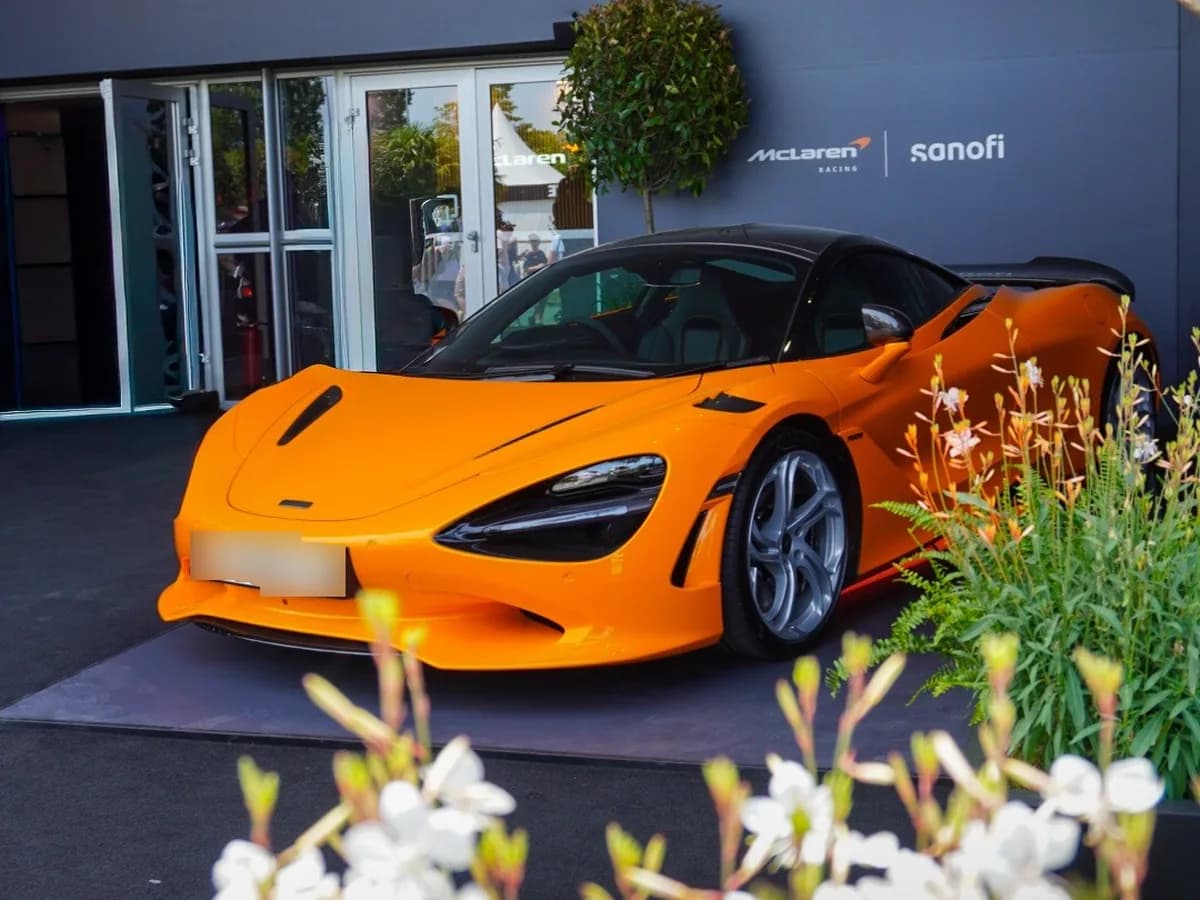
The 750S closely resembles the 720S, so identification is generally easier from the rear than from the side. The clearest clue is the single, high-mounted central exhaust outlet, replacing the 720S’s separated exhausts. Other rear details include a reshaped engine cover and rear mesh area, together with larger openings around the rear wheel arches. At the front, the 750S uses a revised bumper and a longer splitter. The headlight openings, referred to by McLaren as “eye sockets,” are narrower. Its active rear wing is larger, with increased surface area, and can operate as an airbrake as well as a drag-reduction device. These features are more dependable identification points than the badge alone because carbon-fiber parts, paint choices, and MSO personalization can significantly alter the appearance of an individual car. The Coupe and Spider are easiest to separate by their roof design. The Spider has a retractable hardtop and an open silhouette when the roof is stowed; the Coupe keeps a fixed roofline. Buyers should still check the vehicle documentation, since aftermarket exhausts, bodywork, or replacement panels can imitate some of the 750S’s visual cues.
Important versions
For the 2023 model year, ScanRacer identifies two principal versions: the Coupe and the Spider. The Coupe prioritizes lower mass and the rigidity of a closed body. The Spider uses the same basic mechanical package but adds a retractable hardtop, delivering open-air driving without changing the model’s overall positioning. Both body styles use the 4.0-liter twin-turbocharged V8 rated at 750 PS and 800 Nm. McLaren Special Operations can add distinctive paint, upholstery, wheels, or aerodynamic components to individual cars. Those options should be separated from the main body-style classification, however. MSO special commissions and one-off creations are personalized interpretations of the 750S and should not automatically be counted as independent mechanical variants.
References
- The new McLaren 750S: peak supercar performance, pure exhilarationMcLaren Automotive
- McLaren 750S and 750S SpiderMcLaren Automotive
- McLaren 750S Product BrochureMcLaren Automotive
- McLaren 750S First Look: 720S Coupe and Roadster RemasteredMotorTrend
- 2024 McLaren 750S: A Lighter, Mightier, and Subtly Restyled 720SCar and Driver
- 2024 McLaren 750S Review: Brain-BenderCars.com
- https://www.edmunds.com/mclaren/750s/2024/edmunds.com
- https://www.caranddriver.com/mclaren/750scaranddriver.com
Frequently asked questions
- What years was the McLaren 750S produced?
- ScanRacer's referenced versions cover 2023.
- How many McLaren 750S examples are documented on ScanRacer?
- 19 published scans from 14 members, with the latest photo added in September 2026.