
570
The McLaren 570 is a mid-engined sports-car family introduced within McLaren Automotive’s Sports Series, the company’s more accessible range at the time. Its name refers to an advertised output of 570 PS, while the cars use a 3.8-liter twin-turbocharged V8 mounted behind the cabin. The 570S focuses on an intensely sporting experience in coupe form, the 570GT adds a more road-oriented character and extra practicality, and the 570S Spider applies a retractable hardtop to the 570S formula. The 2015-2017 scope includes the 2015 570S, the 2016 570GT, and the 2017 570S Spider, with the shorter S, GT, and S Spider labels appearing alongside the full model names in the reference set.
What about the car you photographed?
Upload a photo to get a suggested make, model and likely year.
No account needed for the result · Publish only if you choose
Variants by year
Make: McLaren · Model: 570
6 / 6 versions shown
2017
2016

2015

McLaren 570 photos
Model summary
Data from the ScanRacer library, organized to compare versions quickly.
Model introduction
The McLaren 570 is a mid-engined sports-car family introduced within McLaren Automotive’s Sports Series, the company’s more accessible range at the time. Its name refers to an advertised output of 570 PS, while the cars use a 3.8-liter twin-turbocharged V8 mounted behind the cabin. The 570S focuses on an intensely sporting experience in coupe form, the 570GT adds a more road-oriented character and extra practicality, and the 570S Spider applies a retractable hardtop to the 570S formula. The 2015-2017 scope includes the 2015 570S, the 2016 570GT, and the 2017 570S Spider, with the shorter S, GT, and S Spider labels appearing alongside the full model names in the reference set.
History
The 570S appeared in 2015 as one of the first models in McLaren’s Sports Series, a range positioned separately from the company’s Super Series and Ultimate Series. It followed road-car principles already associated with the brand: a carbon-fiber central structure, a mid-mounted engine, rear-wheel drive, and an emphasis on keeping mass under control. The 3,799cc twin-turbocharged V8 is officially rated at 570 PS and 600 Nm in the 570GT, paired with a seven-speed dual-clutch transmission. Those fundamentals define the family, even though body styles and chassis calibrations differ between versions. Introduced to broaden the 570S’s touring ability, the 570GT arrived in 2016 with a stronger long-distance focus. McLaren gave it a taller, longer panoramic roof, additional rear luggage space, a more comfort-oriented interior, and tires incorporating foam intended to reduce road noise. In 2017, the 570S Spider expanded the range with a retractable hardtop. Its launch retained the carbon-fiber structure and claimed performance figures very close to the coupe while adding open-air driving. Within the 2015-2017 scope, this sequence represents the family’s expansion rather than a full generational change.
Generations
The 570 family does not split into several clearly separate generations during the period covered. Instead, one technical foundation was developed in three different directions. The 2015 570S established the formula: a two-seat, mid-engined coupe centered on chassis response and driver involvement. Its shape is identifiable by dihedral doors, prominent side intakes, and a cabin positioned well forward of the powertrain. The 2016 570GT retained the core mechanical package but changed the car’s intended use. Its glazed roof and revised rear section increased versatility, while additional refinement and equipment supported longer journeys. McLaren’s official figures for this version include 328 kph, 0-100 kph in 3.4 seconds, and 570 PS, illustrating that the touring emphasis did not turn the car into a slow grand tourer. The 2017 570S Spider became the third body style. Its retractable hardtop opens in approximately fifteen seconds according to contemporary road tests, and the car remains closely related to the coupe in dynamic terms. With the roof closed, it retains the coupe’s claimed top speed; with the roof lowered, aerodynamic limits reduce that figure. The most accurate description is therefore a family of related body styles and missions, not a sequence of separate generations.
Key differences
The clearest distinction is between the 570S and the 570GT. The 570S is the most directly sporting choice: its coupe body emphasizes low mass, steering precision, and a highly communicative chassis. The 570GT keeps the same mid-engined concept and advertised power level, but its longer panoramic roof, added rear luggage area, and noise-reducing tire technology favor extended road use. It is therefore more versatile without becoming an unhurried grand tourer. The 570S Spider is defined primarily by its retractable hardtop. It adds open-air appeal while remaining mechanically close to the 570S coupe. Contemporary road tests reported a modest weight increase and performance figures that stayed very near those of the fixed-roof car. From the outside, the Spider can be identified by its roof mechanism and the protective structures behind the seats. The S, GT, and S Spider labels consequently represent three different priorities: maximum sporting focus, grand-touring usability, and open-top driving.
Photo recognition
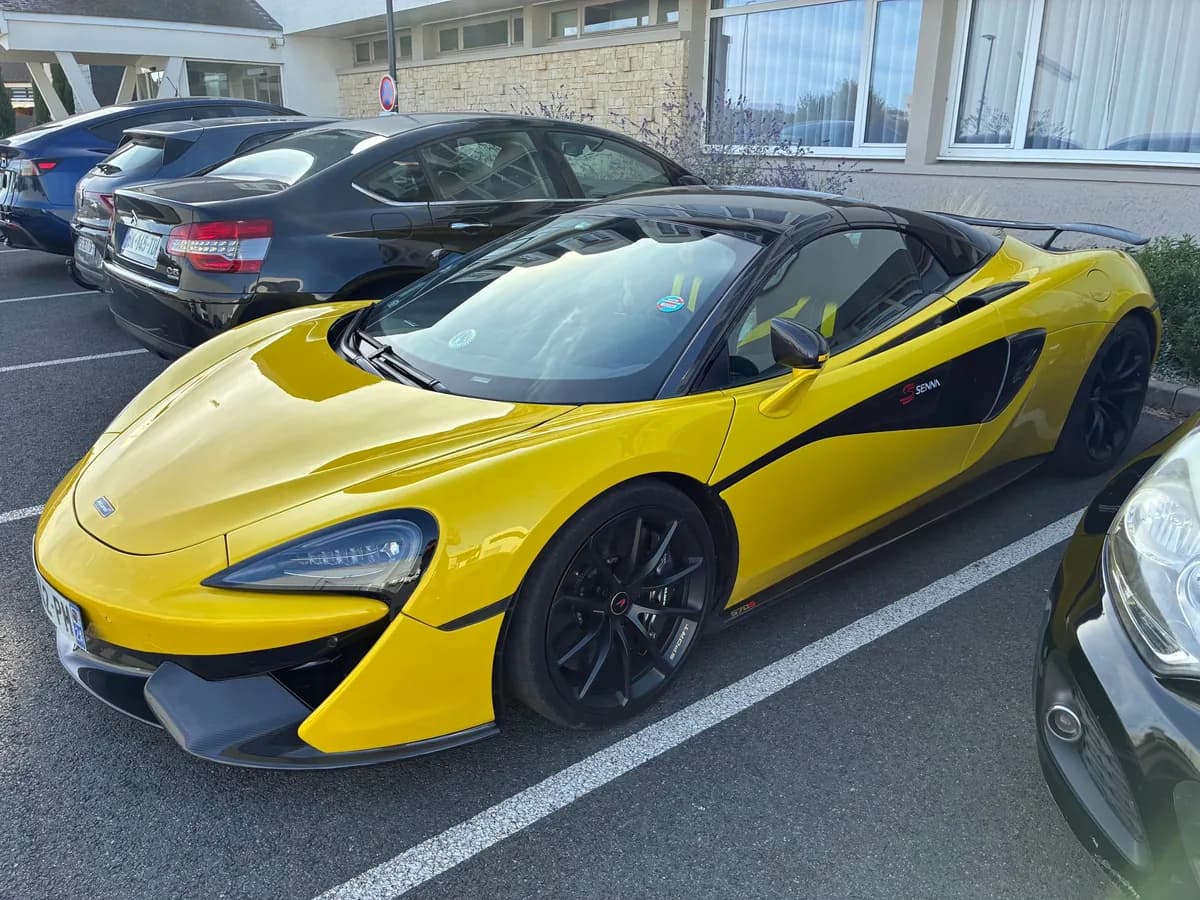
A McLaren 570 is first identified by its very low shape, dihedral doors, and large air intakes positioned behind the doors. The mid-mounted engine creates a forward-set cabin and a short front section, while slim pillars give the car unusually open visibility for a supercar. The family consists of two-seat, rear-wheel-drive cars with bodywork shaped around airflow management. To separate the versions, the 570S coupe has a fixed roof and a more compact rear profile. The 570GT uses a longer glass roof that extends toward the rear luggage compartment; that glass hatch and extra loading area are its most useful visual clues. The 570S Spider has a two-piece retractable hardtop. With the roof closed, it closely resembles the coupe, but the roof hardware and protective structures behind the seats help confirm the open-top model. Badges and exact equipment can vary by market and option specification, so trim lettering alone should not be treated as conclusive identification.
Important versions
Within the 2015-2017 scope, the 570S represents 2015 and serves as the family’s sporting foundation. The 570GT corresponds to 2016 and adds a stronger touring purpose through its glazed rear section, increased luggage capacity, and comfort-related changes. The 570S Spider appears in 2017 as the open-top derivative with a retractable hardtop. The shorter S, GT, and S Spider labels are associated with these three body styles in the reference set. They should not be mistaken for separate generations: the cars share a closely related architecture and powertrain family, while their main differences concern body design, calibration, and intended use.
References
- McLaren 570GT - Everyday Performance Sports CarMcLaren Automotive
- 570S Spider BrochureMcLaren Automotive
- 2018 McLaren 570S / 570GT Review, Pricing, and SpecsCar and Driver
- Svengali Supercar: 2018 McLaren 570S Spider Driven!Car and Driver
- 2017 McLaren 570S Spider First Drive ReviewMotorTrend
- https://cars-assets-production.mclaren.com/963/McLaren-570S-GT4---product-brochure.pdfcars-assets-production.mclaren.com
- https://www.caranddriver.com/reviews/a15894385/2017-mclaren-570gt-test-review/caranddriver.com
Frequently asked questions
- What years was the McLaren 570 produced?
- ScanRacer's referenced versions cover 2015 - 2017.
- How many McLaren 570 examples are documented on ScanRacer?
- 24 published scans from 23 members, with the latest photo added in September 2026.
What about the car you photographed?
Upload a photo to get a suggested make, model and likely year.
No account needed for the result · Publish only if you choose