
Stratos
Introduced as a prototype in 1970 and shown in definitive form in 1971, the Lancia Stratos was built around an unusual goal for its era: winning rallies with a car designed specifically for competition. Its wedge-shaped body, created by Marcello Gandini for Bertone, surrounds a mid-rear-mounted V6 derived from the Ferrari Dino 246 and a compact layout intended to improve agility. Production of the road-going version began in 1973, the same year recorded for ScanRacer’s Base variant. The Stratos went on to become one of rallying’s defining cars, helping Lancia secure the World Rally Championship manufacturers’ titles in 1974, 1975, and 1976. It remains immediately recognizable through its very low proportions, broad wheel arches, short wheelbase, and body panels designed to make servicing faster during competition.
Variants by year
1973
Model summary
Data from the ScanRacer library, organized to compare versions quickly.
Model introduction
Introduced as a prototype in 1970 and shown in definitive form in 1971, the Lancia Stratos was built around an unusual goal for its era: winning rallies with a car designed specifically for competition. Its wedge-shaped body, created by Marcello Gandini for Bertone, surrounds a mid-rear-mounted V6 derived from the Ferrari Dino 246 and a compact layout intended to improve agility. Production of the road-going version began in 1973, the same year recorded for ScanRacer’s Base variant. The Stratos went on to become one of rallying’s defining cars, helping Lancia secure the World Rally Championship manufacturers’ titles in 1974, 1975, and 1976. It remains immediately recognizable through its very low proportions, broad wheel arches, short wheelbase, and body panels designed to make servicing faster during competition.
History
The Stratos project began at Bertone with the Strato’s Zero concept, unveiled at the Turin Motor Show in 1970. That mid-engined show car used Lancia Fulvia mechanicals, but its radical proportions attracted the attention of Lancia and its competition department. The Stratos HF prototype appeared at the same show the following year. Under the direction of Cesare Fiorio, Lancia gradually focused the program on rallying and secured access to the 2,418 cc V6 associated with the Ferrari Dino 246. The final body was designed by Marcello Gandini, with development involving Lancia Corse, Bertone, Gianpaolo Dallara, and several specialist engineers. The Stratos began competing in 1972 and achieved major international victories in 1973, including the Firestone Rally and the Tour de France Automobile with Sandro Munari. The production version required for FIA Group 4 homologation was registered in October 1974. Lancia then won the World Rally Championship manufacturers’ title three years in succession, from 1974 through 1976. Factory involvement later declined as the Fiat group shifted attention toward the Fiat 131 Abarth, but the Stratos continued to score important results in European rallies and circuit events.
Generations
The Lancia Stratos does not divide into generations in the usual automotive sense. It was a short, consistent program whose main stages were the transition from concept to road car and the subsequent development of competition versions. Bertone’s 1970 Strato’s Zero was the original design study. The 1971 Stratos HF prototype adopted a shape much closer to the production car, but it should not be treated as a normal showroom generation. The road-going Stratos, often referred to as the Stradale, provided the basis for homologation. It retained the mid-rear-mounted V6, rear-wheel drive, and compact body, while offering equipment suitable for road use. Group 4 rally cars followed the same basic layout but received weight reduction, wider bodywork, engine preparation, and competition-specific equipment. Engine internals, cylinder heads, output, and body details could change with the season and regulations. These developments do not amount to separate commercial generations. In the ScanRacer context supplied here, only one variant is recorded: “Base,” dated 1973. Adding unlisted generations or trim levels would therefore go beyond the available evidence.
Key differences
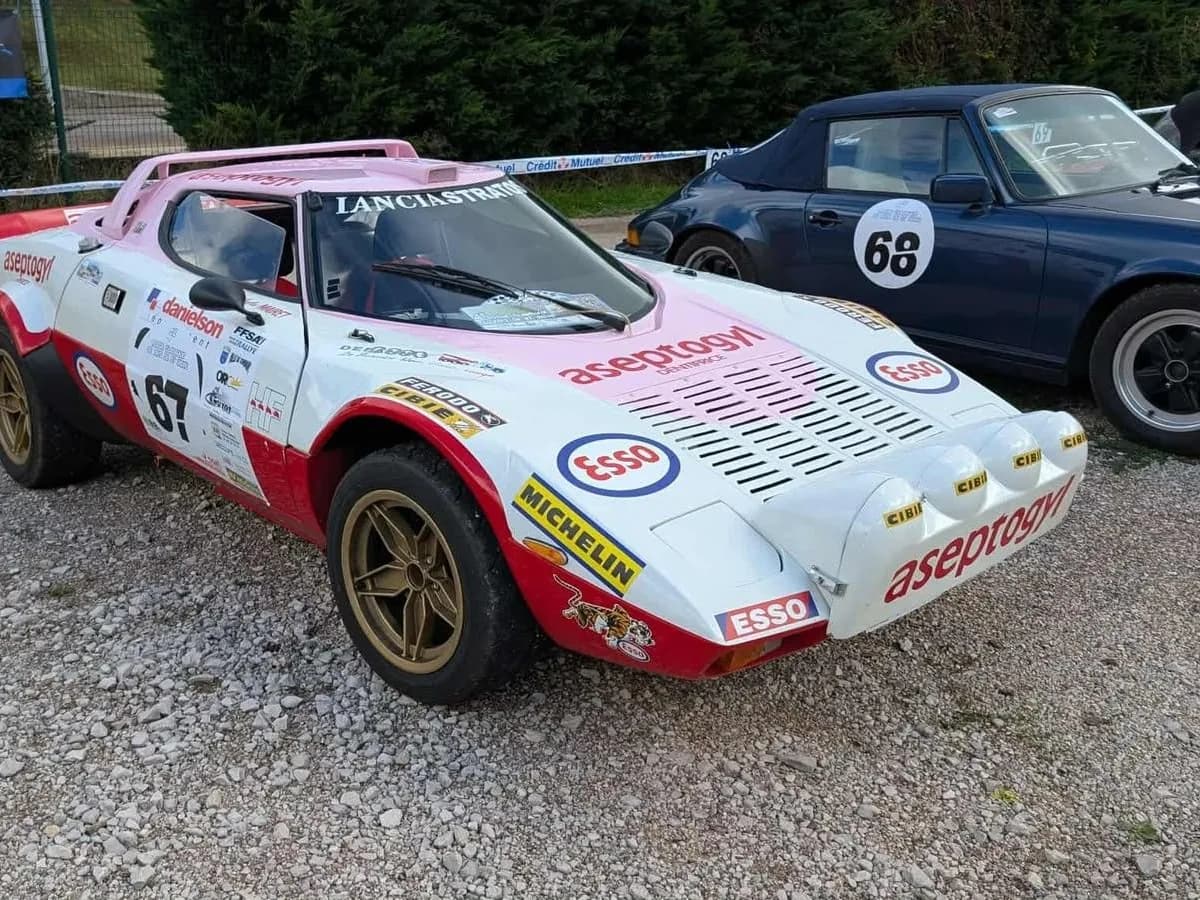
The most meaningful differences are between the road-going Stradale and the competition cars, rather than between separate production generations. The road version retained a relatively restrained body and equipment intended for normal use. Rally cars generally used wider arches, access panels for faster servicing, lighter glazing or body components, competition suspension, and a stripped-down interior. Their engines and transmissions were also prepared according to the regulations of the category and season. A famous racing livery can help identify a well-known competition car, but appearance alone does not prove an example’s authenticity or mechanical specification. Factory and customer cars evolved over time, while restored cars may combine parts from different periods. The ScanRacer entry supplied here records only a 1973 Base variant. No separate trim level, market-specific specification, or engine variation is confirmed for that entry.
Photo recognition
The Stratos is first recognized by its extremely low, short proportions, forward-set cabin, wedge-shaped Bertone body, and visually substantial rear section. Its steep windscreen flows into the side glazing, while the roof drops toward a small rear window framed by separate front and rear body shells. Competition cars are especially easy to distinguish by their broad rear arches. Other characteristic details include the round rear lights, rear wing, and opening panels designed to simplify servicing. The engine is mounted transversely in a mid-rear position and drives the rear wheels. A road car should retain the trim and equipment associated with the Stradale, while a rally car may show a roll cage, bonnet fasteners, competition wheels, protective panels, and a more functional cabin. The Alitalia colors are strongly associated with the model, but they have been reproduced on replicas and are not sufficient proof of originality. Reliable identification should therefore consider the chassis number, documented history, restoration details, and FIA homologation records.
Important versions
The Stratos HF Stradale was the road-going version produced to support competition homologation. It combined a 2,418 cc V6 derived from the Ferrari Dino 246 with a mid-rear layout and an extremely compact Bertone body. Group 4 rally cars are the model’s most famous form: extensively lightened and prepared, they helped Lancia win the manufacturers’ world titles from 1974 through 1976. Works cars in Alitalia colors became iconic, but that livery does not represent a separate road-car trim level. For the ScanRacer entry supplied here, only the 1973 Base variant is confirmed.
References
- Lancia Stratos, one of the most successful rally cars of all time, is celebrating today the 50th anniversary of its first international victoryLancia / Stellantis Media
- The story from birth to now – Lancia StratosLanciaStratos.com
- Lancia Stratos, one of the most successful cars in the history of rallyingFCA Archive / Stellantis Media
- https://www.caranddriver.com/reviews/a15125060/new-lancia-stratos-lancia-stratos-review/caranddriver.com
- https://www.caranddriver.com/reviews/a60243527/1975-lancia-stratos-archive-drive/caranddriver.com
- https://www.hemmings.com/stories/1973-75-lancia-stratos/hemmings.com
- https://www.carandclassic.com/buyer-guides/lancia-stratos-models-and-specscarandclassic.com
Frequently asked questions
- What years was the Lancia Stratos produced?
- ScanRacer's referenced versions cover 1973.
- How many Lancia Stratos examples are documented on ScanRacer?
- 3 published scans from 2 members, with the latest photo added in September 2026.