
Stinger
Introduced in 2017, the Kia Stinger is a large five-door fastback designed as a genuine grand tourer. It represented a major departure for Kia, using a longitudinal-engine layout, available rear-wheel drive, and a market position aimed at European four-door coupes and sporty executive cars. Its styling was developed in Frankfurt under Peter Schreyer and Gregory Guillaume, while dynamic development included testing at the Nürburgring. Depending on the market, the Stinger was offered with a 2.0-liter turbocharged four-cylinder, a 3.3-liter twin-turbo V6, or a 2.2-liter turbo-diesel four-cylinder. In North America, the launch version was sold as a 2018 model, with an eight-speed automatic transmission and rear- or all-wheel drive depending on specification. This combination of long-distance comfort, liftback practicality, and rear-drive balance defined the model’s identity. (press.kia.com)
Variants by year
2017
Model summary
Data from the ScanRacer library, organized to compare versions quickly.
Model introduction
Introduced in 2017, the Kia Stinger is a large five-door fastback designed as a genuine grand tourer. It represented a major departure for Kia, using a longitudinal-engine layout, available rear-wheel drive, and a market position aimed at European four-door coupes and sporty executive cars. Its styling was developed in Frankfurt under Peter Schreyer and Gregory Guillaume, while dynamic development included testing at the Nürburgring. Depending on the market, the Stinger was offered with a 2.0-liter turbocharged four-cylinder, a 3.3-liter twin-turbo V6, or a 2.2-liter turbo-diesel four-cylinder. In North America, the launch version was sold as a 2018 model, with an eight-speed automatic transmission and rear- or all-wheel drive depending on specification. This combination of long-distance comfort, liftback practicality, and rear-drive balance defined the model’s identity. (press.kia.com)
History
The Stinger grew out of the Kia GT concept shown in 2011 and the GT4 Stinger prototype unveiled in 2014. The production car was revealed in early 2017, with production planned for the second half of that year and European sales scheduled for the final quarter. Kia developed it as a halo-style vehicle intended to demonstrate capabilities beyond its mainstream range. Its European design team emphasized classic grand-touring proportions: a long hood, short front overhang, extended wheelbase, and a cabin set toward the rear. The five-door body provided seating for five while retaining a practical liftback and useful luggage space. (press.kia.com) European launch specifications included 2.0-liter and 3.3-liter gasoline engines alongside a 2.2-liter diesel. The North American range followed a different formula, concentrating on gasoline powertrains and trims named Stinger, Premium, GT, GT1, and GT2. The 3.3-liter twin-turbo V6 served as the performance flagship, while the 2.0-liter turbocharged four-cylinder was the entry engine in the United States. Kia later revised the Stinger’s styling, equipment, and market positioning, with a significant update appearing around 2020-2021. Automotive sources generally treat the model as one generation produced through 2022, rather than as a series of separate generations. (kiamedia.com)
Generations
The Kia Stinger is generally treated as a single first-generation model, launched in 2017 and produced through 2022. That generation can nevertheless be divided into two broad phases. Early cars use the original 2017 design, marked by Kia’s Tiger Nose grille, long hood, side air vents, sloping roof, and fastback liftgate. The structure makes extensive use of advanced high-strength steel, with MacPherson front suspension and a five-link rear arrangement. In North America, the 2.0-liter and 3.3-liter models could be configured with rear- or all-wheel drive, while European specifications varied by market and engine. (kiamedia.com) The second phase began with a facelift introduced progressively from 2020 depending on region and sold through later model years. The revisions focused on bumpers, lighting signatures, exterior detailing, equipment, and interior presentation. This was an update to the existing vehicle rather than a completely new technical generation. Engine choices, trim names, and equipment were not identical worldwide: a European diesel Stinger should not automatically be equated with a North American 2.0-liter car or GT. Correct identification therefore depends on the country of sale, model year, and trim level. Those distinctions are especially important when comparing specifications, because the same Stinger name could describe substantially different powertrains and equipment packages. (autoexpress.co.uk)
Key differences
The most important differences between Stingers concern the powertrain rather than the overall body design. The 2.0-liter turbocharged four-cylinder provides the entry point and a balance suited to everyday use, while the 3.3-liter twin-turbo V6 delivers substantially more performance and identifies GT versions in several markets. Europe also received a 2.2-liter diesel, an engine absent from the North American range described by Kia. Higher trims could add electronically controlled suspension, a limited-slip differential, Brembo brakes, 19-inch wheels, and extra comfort equipment. (press.kia.com) All-wheel drive was available on selected versions, but rear-wheel drive remains a defining technical feature of the Stinger. Equipment, advertised output, badges, and trim names vary between countries. The name “Stinger” or “GT” alone is therefore not enough to establish a car’s exact specification. Country of sale, model year, engine, drivetrain, and trim should be checked together before comparing vehicles or interpreting catalog data.
Photo recognition
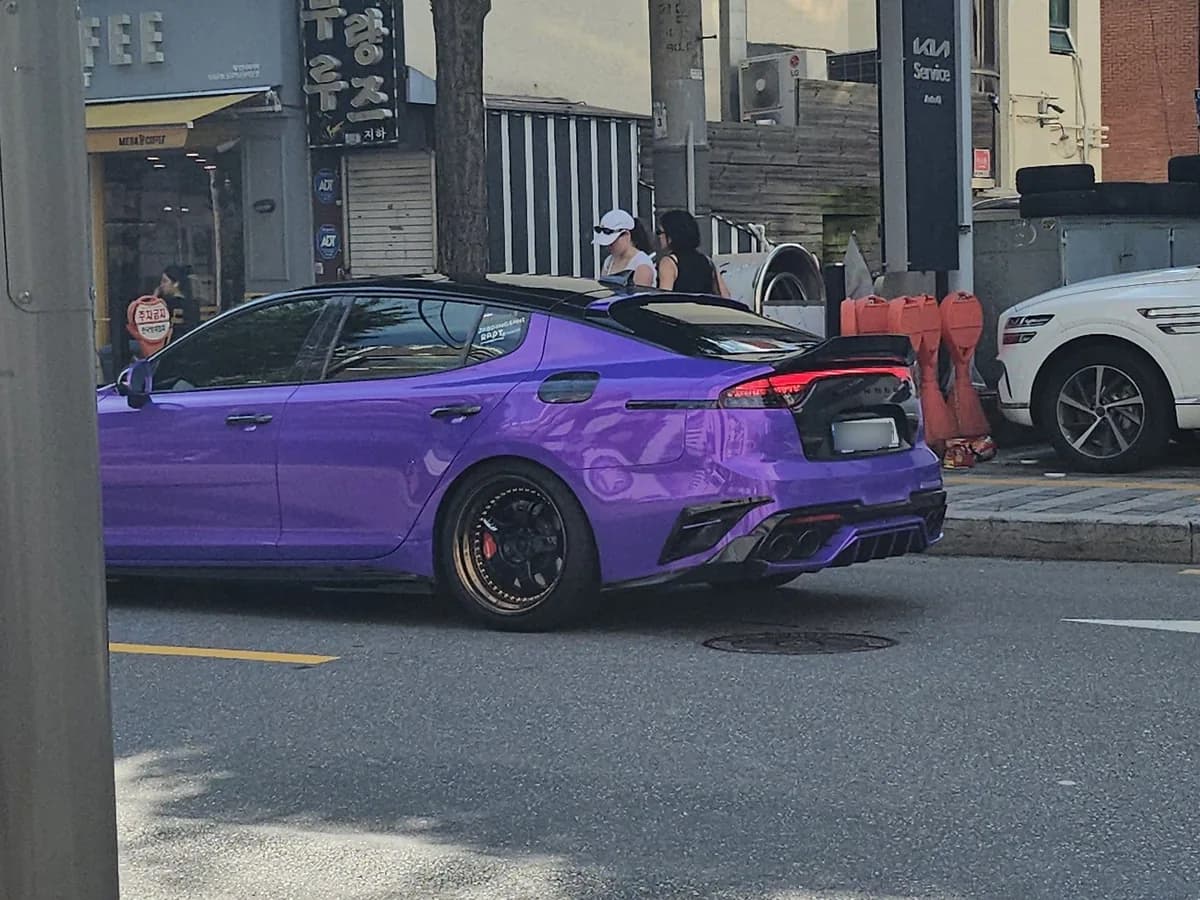
A Kia Stinger is first identified by its five-door fastback profile, long hood, rear-set cabin, sloping roof, and wide liftgate. The front end uses Kia’s Tiger Nose grille and swept lighting, while sportier versions add openings intended to support engine and brake cooling. Strong rear haunches and vents behind the front wheels are characteristic side details. European gasoline models generally use four oval exhaust outlets, while the European diesel launch specification was identified by a twin-outlet arrangement, according to Kia’s original documentation. (press.kia.com) Trim identification requires closer inspection of the wheels, brakes, badges, and cabin. V6 versions commonly use larger wheels and Brembo braking hardware, although exact combinations differ by market. A reliable identification should therefore be checked against the VIN, compliance plate, engine, and local sales literature. Model year alone may not clearly separate cars built before and after the facelift. The same exterior shape can represent different engines, drivetrains, equipment packages, or regional specifications, so visual recognition is useful for orientation but insufficient for a definitive catalog match.
Important versions
The key versions include the entry Stinger with its 2.0-liter turbocharged four-cylinder, the 2.2-liter diesel offered in Europe, and GT derivatives using the 3.3-liter twin-turbo V6. In the United States, Kia organized the range around Stinger, Premium, GT, GT1, and GT2 trims, with equipment increasing up the line. The GT is chiefly distinguished by its V6 engine, Brembo brakes, and, depending on trim, electronically controlled suspension or a limited-slip differential. These names are not universal across markets, so they should always be read alongside the country, model year, drivetrain, and engine. (kiamedia.com)
References
- Nouvelle Kia Stinger - Présentation de la version européenneKia France
- 2018 Kia Stinger OverviewKia Media
- 2018 Kia Stinger SpecificationsKia Media
- 2018 Kia Stinger Features & OptionsKia Media
- Kia Stinger (2017-2022) reviewAuto Express
- 2022 Stinger OverviewKia Media
- https://www.rac.co.uk/drive/car-reviews/kia/stinger/stinger/rac.co.uk
Frequently asked questions
- What years was the Kia Stinger produced?
- ScanRacer's referenced versions cover 2017.
- How many Kia Stinger examples are documented on ScanRacer?
- 5 published scans from 5 members, with the latest photo added in August 2026.