
S-Type
The Jaguar S-Type name refers to two distinct saloon cars separated by more than three decades. The first arrived in 1963, combining the compact proportions of the Mark II with an independent rear suspension related to the systems used by the Mark X and E-Type. Built until 1968, it used Jaguar’s 3.4- and 3.8-litre six-cylinder engines. Jaguar revived the name in 1999 for a modern front-engine, rear-wheel-drive saloon positioned between the XJ and XK in the company’s range. This second S-Type gradually gained more powerful V6 and V8 engines, a high-performance S-Type R derivative and, in selected markets, a 2.7-litre V6 diesel. Production years and variants should therefore be read carefully, because the name covers two separate design and engineering programmes rather than one continuous model line.
What about the car you photographed?
Upload a photo to get a suggested make, model and likely year.
No account needed for the result · Publish only if you choose
Variants by year
Make: Jaguar · Model: S-Type
2 / 2 versions shown
1999
1963
Jaguar S-Type photos
Model summary
Data from the ScanRacer library, organized to compare versions quickly.
Model introduction
The Jaguar S-Type name refers to two distinct saloon cars separated by more than three decades. The first arrived in 1963, combining the compact proportions of the Mark II with an independent rear suspension related to the systems used by the Mark X and E-Type. Built until 1968, it used Jaguar’s 3.4- and 3.8-litre six-cylinder engines. Jaguar revived the name in 1999 for a modern front-engine, rear-wheel-drive saloon positioned between the XJ and XK in the company’s range. This second S-Type gradually gained more powerful V6 and V8 engines, a high-performance S-Type R derivative and, in selected markets, a 2.7-litre V6 diesel. Production years and variants should therefore be read carefully, because the name covers two separate design and engineering programmes rather than one continuous model line.
History
The first Jaguar S-Type appeared in 1963 as a more sophisticated development of the Mark II. Jaguar retained part of the Mark II’s basic structure and passenger compartment, but introduced a Mark X-inspired rear treatment and independent rear suspension. This layout improved ride quality and road manners compared with the Mark II’s live rear axle, while keeping the car smaller than the large Mark X saloon. Power came from Jaguar’s XK straight-six in 3.4- and 3.8-litre forms; the Mark II’s 2.4-litre engine was not offered. The S-Type remained on sale alongside the Mark II because the two cars served different buyers. The Jaguar Daimler Heritage Trust records total production of 24,993 cars between 1963 and 1968. After a lengthy gap, Jaguar reused the S-TYPE name for a new saloon introduced in the late 1990s and launched in 1999. The new car used a modern rear-wheel-drive layout, with a 3.0-litre V6 and 4.0-litre V8 available at launch depending on market. The range later expanded to include 2.5- and 2.7-litre V6 engines, 4.2-litre V8s and the supercharged S-TYPE R. Exterior and interior revisions arrived during the mid-2000s. Production ended in 2008, when the XF became Jaguar’s replacement in this class.
Generations
It is more accurate to describe the S-Type as two production periods rather than one continuous sequence of generations. The classic S-Type, built from 1963 to 1968, used a four-door body derived from the Mark II, with a compact roofline and independent rear suspension. The 3.4- and 3.8-litre versions followed the same overall concept, with differences in engine capacity, transmission and equipment. This series belongs to Jaguar’s pre-XJ saloon era. The modern S-TYPE, launched in 1999, was a larger executive saloon developed in a very different engineering and industrial context. It retained rear-wheel drive and styling influenced by historic Jaguar models, but its platform, systems and engines were not mechanically related to the 1963 car. Early examples centred on the launch V6 and V8 engines. Later updates brought 2.5-, 4.2- and 2.7-litre engines, together with the supercharged S-TYPE R. Mid-2000s cars received revised styling and updated equipment combinations. Internal designations and model-year details can vary by market, so identification should be checked against the vehicle’s documentation rather than inferred from the name alone.
Key differences
The most important distinction concerns age and engineering. The 1963-1968 car is a compact classic saloon powered exclusively by Jaguar’s 3.4- or 3.8-litre XK straight-six. Its independent rear suspension is the major technical step beyond the Mark II. The 1999-2008 S-TYPE is considerably larger and more modern, using V6 and V8 engines, more extensive electronic equipment and a broader choice of transmissions depending on market. Its styling echoes themes from the Mark II without being a historical reproduction. The S-TYPE R adds a clearly sporting specification with a supercharged 4.2-litre V8, upgraded brakes and revised suspension. The later 2.7-litre diesel is another major difference from the original car. Engine badges, trim and exterior details should be considered together because individual equipment could vary by country and model year.
Photo recognition
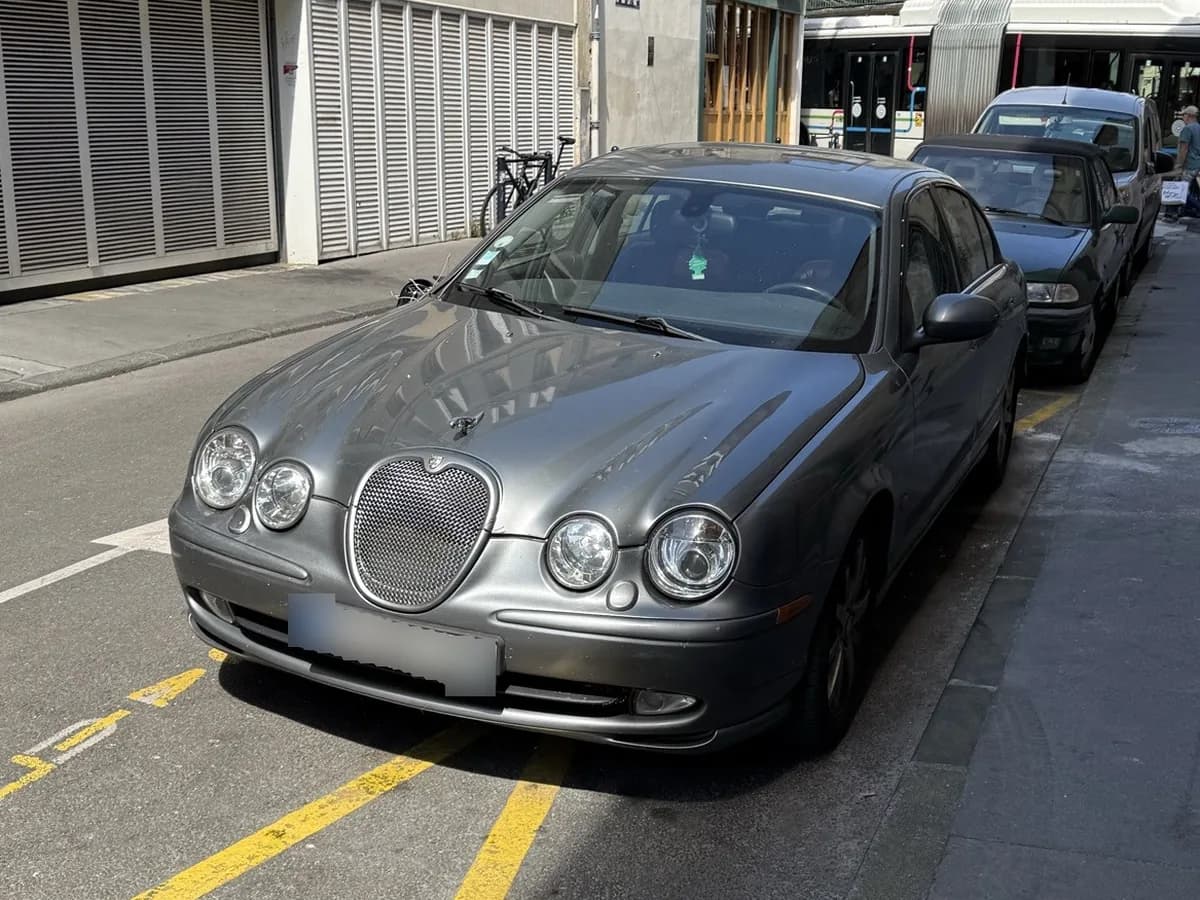
To identify the classic S-Type, look for a compact Jaguar saloon with rounded sides, a vertical grille, four round headlamps and a roofline close to that of the Mark II. Its rear section is longer and more smoothly shaped than the Mark II’s, while the whole car appears less substantial than a Mark X. 3.4 or 3.8 badges can be useful clues, but they do not always establish the exact year or specification. The modern S-TYPE is a larger contemporary saloon with a chrome grille, four round headlamps and a tail treatment that references earlier Jaguar designs. Early cars have a more overtly retro appearance and a strongly curved dashboard. Updated models look more restrained and use a revised interior. An S-TYPE R can often be recognised by its wheels, sportier exterior details and specific badging, although these parts may have been changed during the car’s life. The vehicle identification number, engine specification and original documentation remain the most dependable ways to confirm identity. Market-specific equipment means that visual clues alone should be treated cautiously.
Important versions
For the 1963-1968 S-Type, the main configurations are the 3.4- and 3.8-litre cars. The 3.8-litre version is generally the performance-focused choice, while the 3.4-litre offers a more moderate interpretation of the same saloon concept. Equipment such as automatic transmission, power steering and overdrive depended on specification and market. For the modern S-TYPE, the 3.0-litre V6 and 4.0-litre V8 represent the original 1999 launch range. The 2.5-litre V6 and 4.2-litre V8 followed later, while the S-TYPE R, introduced in 2002, became the most distinctive performance derivative. A 2.7-litre V6 diesel was added during the mid-2000s in selected markets, aimed more at long-distance usability than outright performance. Trim names such as SE and Sport should be checked against local brochures and the vehicle identification number because equipment varied by country.
References
- 1965 Jaguar S-Type 3.4-Litre SaloonJaguar Daimler Heritage Trust
- Jaguar S-Type: Genuine Parts, Service & MaintenanceJaguar
- Jaguar S-TYPE (1999-2007) Used Car ReviewRAC Drive
- Jaguar S-Type 3.0 V6 Road TestThe Automobile Association
- https://www.oldclassiccar.co.uk/car-brochures/jaguar-s-type.htmoldclassiccar.co.uk
- https://www.jaguarheritage.com/uploads/RG001H-Jaguar-S-type-420-and-Daimler-Sovereign-420-type-v.2-31-03-2020-.pdfjaguarheritage.com
- https://manualzz.com/doc/65246249/jaguar-s-type-1999-workshop-manualmanualzz.com
Frequently asked questions
- What years was the Jaguar S-Type produced?
- ScanRacer's referenced versions cover 1963 - 1999.
- How many Jaguar S-Type examples are documented on ScanRacer?
- 6 published scans from 6 members, with the latest photo added in September 2026.
What about the car you photographed?
Upload a photo to get a suggested make, model and likely year.
No account needed for the result · Publish only if you choose