
F-Pace
The Jaguar F-Pace is the British marque’s first production SUV. Revealed at the 2015 Frankfurt Motor Show, it reached markets in 2016 with five seats, an aluminium-intensive structure and a sportier design brief than many conventional SUVs. Its styling carries several F-Type influences, including pronounced rear haunches, distinctive tail-lamp graphics and a taut side profile. Launch specifications varied by market, with petrol and diesel engines, rear-wheel drive or all-wheel drive, and different power outputs available depending on location. The 2016 model year therefore represents the F-Pace’s formative launch phase, before later updates expanded and revised the range. Its defining combination is a raised driving position, a 650-litre luggage compartment and road manners developed to retain the responsive character associated with Jaguar saloons and sports cars.
What about the car you photographed?
Upload a photo to get a suggested make, model and likely year.
No account needed for the result · Publish only if you choose
Variants by year
Make: Jaguar · Model: F-Pace
1 / 1 versions shown
2016
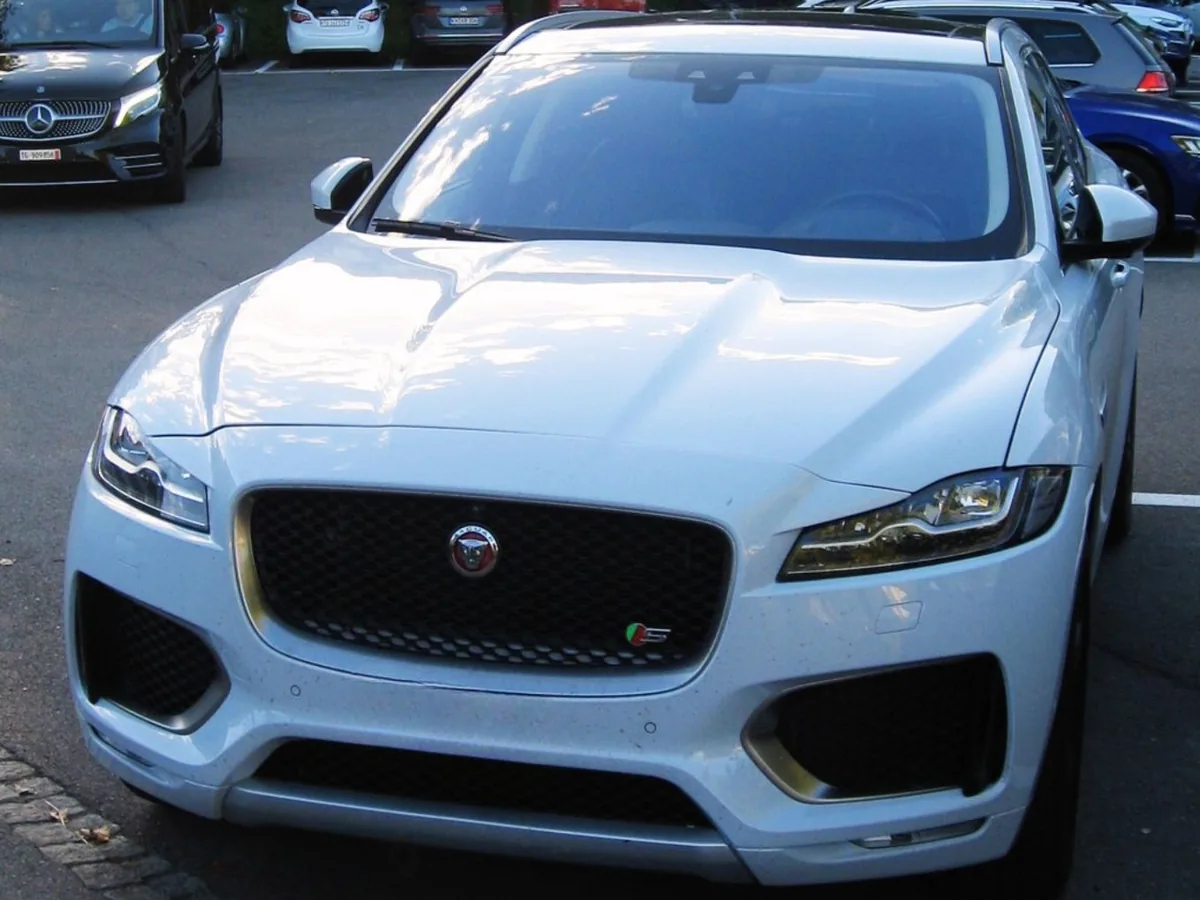
Jaguar F-Pace photos
Model summary
Data from the ScanRacer library, organized to compare versions quickly.
Model introduction
The Jaguar F-Pace is the British marque’s first production SUV. Revealed at the 2015 Frankfurt Motor Show, it reached markets in 2016 with five seats, an aluminium-intensive structure and a sportier design brief than many conventional SUVs. Its styling carries several F-Type influences, including pronounced rear haunches, distinctive tail-lamp graphics and a taut side profile. Launch specifications varied by market, with petrol and diesel engines, rear-wheel drive or all-wheel drive, and different power outputs available depending on location. The 2016 model year therefore represents the F-Pace’s formative launch phase, before later updates expanded and revised the range. Its defining combination is a raised driving position, a 650-litre luggage compartment and road manners developed to retain the responsive character associated with Jaguar saloons and sports cars.
History
The F-Pace project took shape with the C-X17 concept, presented by Jaguar at the 2013 Frankfurt Motor Show. The prototype introduced a new aluminium-intensive monocoque architecture and explored Jaguar’s entry into the premium crossover market. Two years later, the production F-Pace was revealed in Frankfurt in a form closely related to the earlier study. Jaguar described it as the brand’s first SUV, designed to combine road performance with passenger space and everyday usability. Production was associated with Jaguar Land Rover’s Solihull plant in the United Kingdom. Sales began in 2016, although the relationship between calendar year and model year varied by market. In North America, Jaguar announced a 2016 market arrival as a 2017 model. Early powertrain announcements for that region included a 180-hp four-cylinder diesel and supercharged 340-hp and 380-hp V6 petrol engines. Other markets also received more powerful diesel options and different drivetrain combinations. The F-Pace gained attention soon after launch. In 2017, it won both the World Car of the Year and World Car Design of the Year awards. Those results underlined the model’s importance as Jaguar expanded beyond saloons, sports cars and grand touring vehicles into the premium SUV sector.
Generations
Within the 2016 scope, the Jaguar F-Pace belongs to the model’s first generation. It was not a replacement for an earlier Jaguar SUV; instead, it introduced the marque directly to this vehicle category. Its development used the aluminium-intensive architecture previewed by the C-X17 concept, giving engineers freedom to establish the wheelbase, track and body proportions required for a spacious but dynamically focused SUV. This first generation uses a five-door, five-seat body with a quoted 650-litre luggage compartment. Its chassis combines double-wishbone front suspension with an Integral Link rear arrangement, reflecting Jaguar’s emphasis on controlled road handling. Depending on specification and market, the F-Pace was offered with rear-wheel drive or all-wheel drive. Jaguar’s Intelligent Driveline Dynamics system was used with all-wheel-drive versions to manage torque distribution according to available grip and driver inputs. Commercial names, engines, transmissions and equipment were not identical in every country. A trim list from one market should therefore not be treated as a universal description of every 2016 F-Pace. During the launch period, the main distinctions involved engine type, drivetrain, power output and equipment level rather than a separate body generation.
Key differences
The main challenge when comparing 2016 F-Pace models is market variation. European launch information highlights the 180-hp four-cylinder diesel alongside more powerful V6 diesel and petrol engines. In North America, Jaguar sold the vehicle as a 2017 model, using names such as 20d, 35t and S. Those labels do not necessarily represent the same engine-and-equipment combinations in every country. Rear-wheel-drive versions provide a simpler drivetrain and, depending on market, could be paired with the entry diesel engine. All-wheel-drive models offer additional traction and were commonly associated with the higher-output engines. The supercharged 380-hp petrol V6 was the most performance-oriented launch specification described by Jaguar, while the 180-hp diesel was aimed more directly at efficiency and everyday use. Trim levels also changed the wheels, driver-assistance features, infotainment and interior presentation. A reliable identification should therefore consider the vehicle’s original market and VIN rather than relying on the badge alone.
Photo recognition
A 2016 F-Pace is best identified by its relatively low, elongated SUV shape, long bonnet, sloping roofline and pronounced rear shoulders. The front end uses a broad Jaguar grille framed by slim headlamps. The sides feature a taut waistline and vents behind the front wheel arches, while the horizontal tail lamps provide one of the clearest visual links to the F-Type sports car. A short front overhang adds to the car’s purposeful, rear-driven visual stance. Inside, the driving position is higher than in a saloon, but the cabin remains recognisably Jaguar, with a driver-focused dashboard and, where fitted, a tablet-style InControl Touch Pro central display. Five seats and a large tailgate help distinguish it from Jaguar’s two-seat F-Type. Exact specification still requires caution: wheels, bumpers, badges, exhaust outlets and infotainment equipment changed with market and trim. For an authoritative identification, the VIN and original-market documentation are more reliable than exterior badges alone.
Important versions
Important launch versions include the 180-hp four-cylinder diesel, offered in some markets with rear-wheel drive, plus the supercharged 340-hp and 380-hp V6 petrol engines announced for North America. The 380-hp model, using an engine family also associated with the F-Type, represents the original performance flagship. Certain markets also received a 300-hp V6 diesel, aimed at combining strong torque with long-distance refinement. Commercial naming differed by region: North American cars used labels including 20d, 35t and S, while European markets followed different naming structures. Exact engine and drivetrain availability should always be checked against the vehicle’s original market and VIN.
References
- The All-New Jaguar F-PACE – the World’s Ultimate Practical Sportscar is RevealedJaguar Media Newsroom
- Jaguar F-PACE: An All-New Performance Crossover to Join Line-Up in 2016Jaguar Media Newsroom
- Jaguar F-PACE Receives 2017 World Car of the Year and World Car Design of the Year AwardsJaguar Media Newsroom
- 2016 Jaguar F-Pace ReviewMotoring Research
- https://media.jaguar.com/news/2016/05/world-first-jaguar-spectacular-burj-khalifa-show-dubai-launches-f-pacemedia.jaguar.com
- https://media.jaguar.com/news/2016/06/all-new-f-pace-helps-drive-jaguar-land-rover-best-ever-may-sales-resultsmedia.jaguar.com
- https://media.jaguar.com/zh-cn/news/2016/05/qibu-jizhishang-jiebaopaochexingsuv-f-pacezhengshiqishoumedia.jaguar.com
- https://www.autoexpress.co.uk/jaguar/f-pace/94071/new-jaguar-f-pace-suv-2016-reviewautoexpress.co.uk
Frequently asked questions
- What years was the Jaguar F-Pace produced?
- ScanRacer's referenced versions cover 2016.
- How many Jaguar F-Pace examples are documented on ScanRacer?
- 6 published scans from 6 members, with the latest photo added in September 2026.
What about the car you photographed?
Upload a photo to get a suggested make, model and likely year.
No account needed for the result · Publish only if you choose