
GT40
The Ford GT40 is a mid-engined racing car developed to give Ford a serious contender in international endurance racing, especially at the 24 Hours of Le Mans. Its name refers to an approximate 40-inch overall height, while its exceptionally low body was intended to support high-speed stability. The program began in Britain under Ford Advanced Vehicles before major development and race preparation moved to the United States under Carroll Shelby and Kar Kraft. The versions covered here represent the principal Mk I, Mk II, Mk III and Mk IV evolutions associated with the 1965 through 1967 model years. The GT40 finally achieved Ford’s Le Mans objective with a Mk II 1-2-3 finish in 1966, followed by an outright Mk IV victory in 1967. Those results turned the GT40 into one of the defining endurance racing cars of the 1960s. (corporate.ford.com)
Variants by year
1967
1966
 L
L1965
Model summary
Data from the ScanRacer library, organized to compare versions quickly.
Model introduction
The Ford GT40 is a mid-engined racing car developed to give Ford a serious contender in international endurance racing, especially at the 24 Hours of Le Mans. Its name refers to an approximate 40-inch overall height, while its exceptionally low body was intended to support high-speed stability. The program began in Britain under Ford Advanced Vehicles before major development and race preparation moved to the United States under Carroll Shelby and Kar Kraft. The versions covered here represent the principal Mk I, Mk II, Mk III and Mk IV evolutions associated with the 1965 through 1967 model years. The GT40 finally achieved Ford’s Le Mans objective with a Mk II 1-2-3 finish in 1966, followed by an outright Mk IV victory in 1967. Those results turned the GT40 into one of the defining endurance racing cars of the 1960s. (corporate.ford.com)
History
The GT40 project took shape after Ford’s unsuccessful negotiations with Ferrari in 1963. Ford then set out to develop a car capable of competing in major road races and assembled a team that included Roy Lunn, Eric Broadley and John Wyer. Ford Advanced Vehicles established the initial operation at Slough in England, and the first prototype was completed in April 1964. The car showed impressive speed, but early races exposed weaknesses in gearbox durability, suspension and high-speed aerodynamic stability. Further testing led to rear-end aerodynamic changes and a major shift of development and race preparation toward the United States. Carroll Shelby became a key figure in the program during 1965. The Mk I evolved around Ford’s 289-cubic-inch V8, while the Mk II introduced the larger 427-cubic-inch engine and a heavier-duty competition package. The Mk II delivered Ford’s breakthrough at Le Mans in 1966, finishing first, second and third. The Mk IV grew out of the J-Car development program and used a substantially revised body along with an aircraft-inspired aluminum honeycomb chassis. It won the 1967 24 Hours of Le Mans with Dan Gurney and A.J. Foyt, giving Ford a second consecutive victory over Ferrari. (corporate.ford.com)
Generations
The Mk I is the original GT40 concept. It retains the low, streamlined body developed for the initial program and is generally associated with Ford’s 289-cubic-inch V8 in competition trim. Early examples exposed the project’s reliability problems, but the developed Mk I became a successful endurance platform. It also formed the basis of Ford’s later Le Mans victories in 1968 and 1969, although those years fall outside the ScanRacer range supplied here. The Mk II is a more powerful and durable evolution. Its 427-cubic-inch V8 brought a major increase in engine capacity, while changes to the chassis, brakes, bodywork and transmission were intended to withstand long-distance racing. The Mk III was a small-series road-oriented derivative rather than a direct race specification. Its more civil interior and road-focused bodywork separate it from the competition Mk IIs. The Mk IV is the most extensively redesigned version in the listed family. Developed from the J-Car program, it used a wind-tunnel-refined body and an aluminum honeycomb chassis. Its 1967 Le Mans victory marked a significant technical step beyond the earlier GT40s. The four labels therefore describe related but distinct stages: original platform, big-engine race evolution, road derivative and extensively redesigned American-built racer. (thehenryford.org)
Key differences
The clearest distinction between the versions is their intended role. The Mk I is the foundational competition car, generally associated with Ford’s 289-cubic-inch V8 and the original low-slung body. The Mk II uses the 427-cubic-inch V8, requiring corresponding changes to cooling, braking and transmission systems to handle the higher loads. The Mk III should not be treated as simply another race-development step: it was a road-oriented, small-series derivative with a more civil interior and distinct body treatment. The Mk IV stands apart through its substantially redesigned body, more advanced aerodynamic development and aluminum honeycomb structure derived from the J-Car program. Exact equipment could differ between chassis and race preparations, and cars were often modified during their competitive lives. Visual identification should therefore be supported by chassis records, period photographs or technical documentation rather than styling alone. (thehenryford.org)
Photo recognition
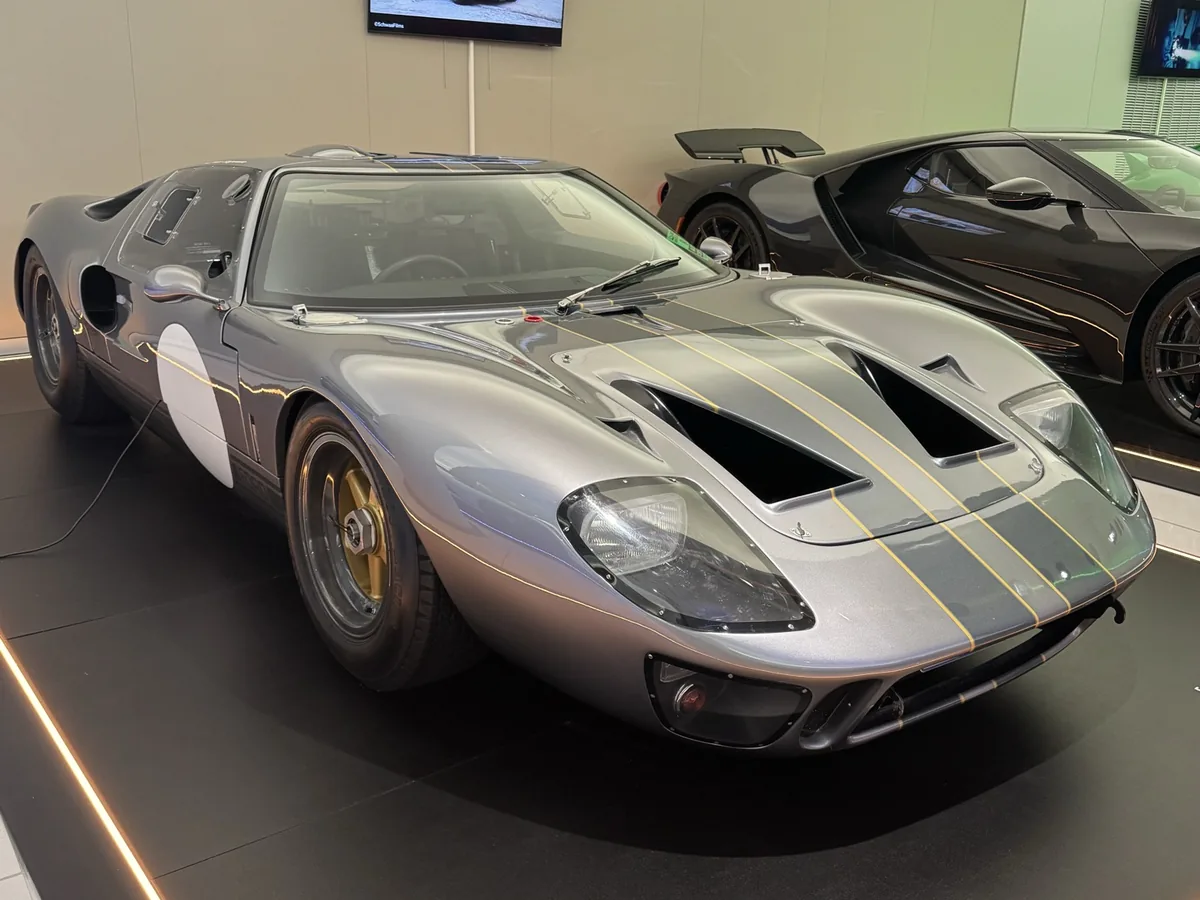
Start with the overall shape when identifying a GT40: an exceptionally low body, forward-set cockpit, long rear section and a prominent air intake behind the cabin. The Mk I usually displays the proportions closest to the original design. The Mk II is less dependent on one external feature and is better identified through its 427-cubic-inch engine association, period race configuration and links to Shelby American or Holman & Moody-prepared cars. The Mk III is easier to separate when its road equipment remains present, including a more usable cabin and less stripped-out presentation. The Mk IV has a broader, more modern appearance, with extensively revised aerodynamic surfaces and bodywork that wraps more completely around the cockpit. Famous Gulf colors, race stripes and competition numbers can help identify an individual historic car, but they do not always establish the Mk designation. Chassis documentation, period photographs and provenance remain the most dependable evidence. (corporate.ford.com)
Important versions
The Mk II is most directly associated with Ford’s breakthrough at Le Mans in 1966, when three cars finished first, second and third and Bruce McLaren and Chris Amon took the victory. The Mk IV is the other defining milestone, winning the 1967 race with Dan Gurney and A.J. Foyt in a car built in the United States. The Mk I remains historically important as the foundation of the program and as the platform behind Ford’s later 1968 and 1969 Le Mans victories. The Mk III occupies a different position: its road-oriented specification and limited production gave the GT40 family a more usable, civil derivative alongside the purpose-built endurance racers. (thehenryford.org)
References
- Ford vs. Ferrari: Entry and Failure - 1964Ford Motor Company
- Ford vs. Ferrari: The Le Mans Committee - Victory in 1966Ford Motor Company
- The American ChallengeFord Motor Company News Bureau
- 50 Years of GT40 Racing WinsThe Henry Ford
- Ford GT40 Mk II & Mk IVAutomobile Club de l'Ouest / 24 Hours of Le Mans Museum
- https://media.ford.com/content/dam/fordmedia/history/products/fordgt-gt40/1966-LeMans-Summary-Press-Release-noting-123-Finish-07-05-1966.pdfmedia.ford.com
- https://media.ford.com/content/fordmedia/feu/gb/en/news/2017/03/16/fifty-years-after-winning-at-sebring-in-a-ford-gt40-mk-iv--mario.htmlmedia.ford.com
Technical specifications
Structured data available for versions linked to this model.
| Version | Power | Torque | Top speed | Drivetrain | Fuel |
|---|---|---|---|---|---|
| — | Environ 335 chevaux | — | — | Propulsion / Boîte manuelle à 5 rapports | — |
Frequently asked questions
- What years was the Ford GT40 produced?
- ScanRacer's referenced versions cover 1965 - 1967.
- How many Ford GT40 examples are documented on ScanRacer?
- 18 published scans from 15 members, with the latest photo added in September 2026.
- What is the power output of the Ford GT40?
- The sourced technical data lists Environ 335 chevaux.