
California
Introduced in 2008, the Ferrari California brought a different interpretation of grand touring to Ferrari: a front-mounted V8, a retractable hardtop, and a layout intended to combine sports-car performance with greater everyday versatility. Ferrari’s European technical data lists a naturally aspirated 4.3-liter V8 producing 460 horsepower, paired with a seven-speed dual-clutch transmission. The California also stood out for its 2+2 configuration, aluminum construction, and roof system that allowed it to shift quickly between coupe and convertible roles. Ferrari updated the model in 2012 with the lighter, more powerful California 30. The California T followed with a major mechanical change, replacing the naturally aspirated engine with a 3.9-liter twin-turbocharged V8. The result was a faster and more extensively revised interpretation of the same grand-touring concept.
What about the car you photographed?
Upload a photo to get a suggested make, model and likely year.
No account needed for the result · Publish only if you choose
Variants by year
Make: Ferrari · Model: California
2 / 2 versions shown
2013
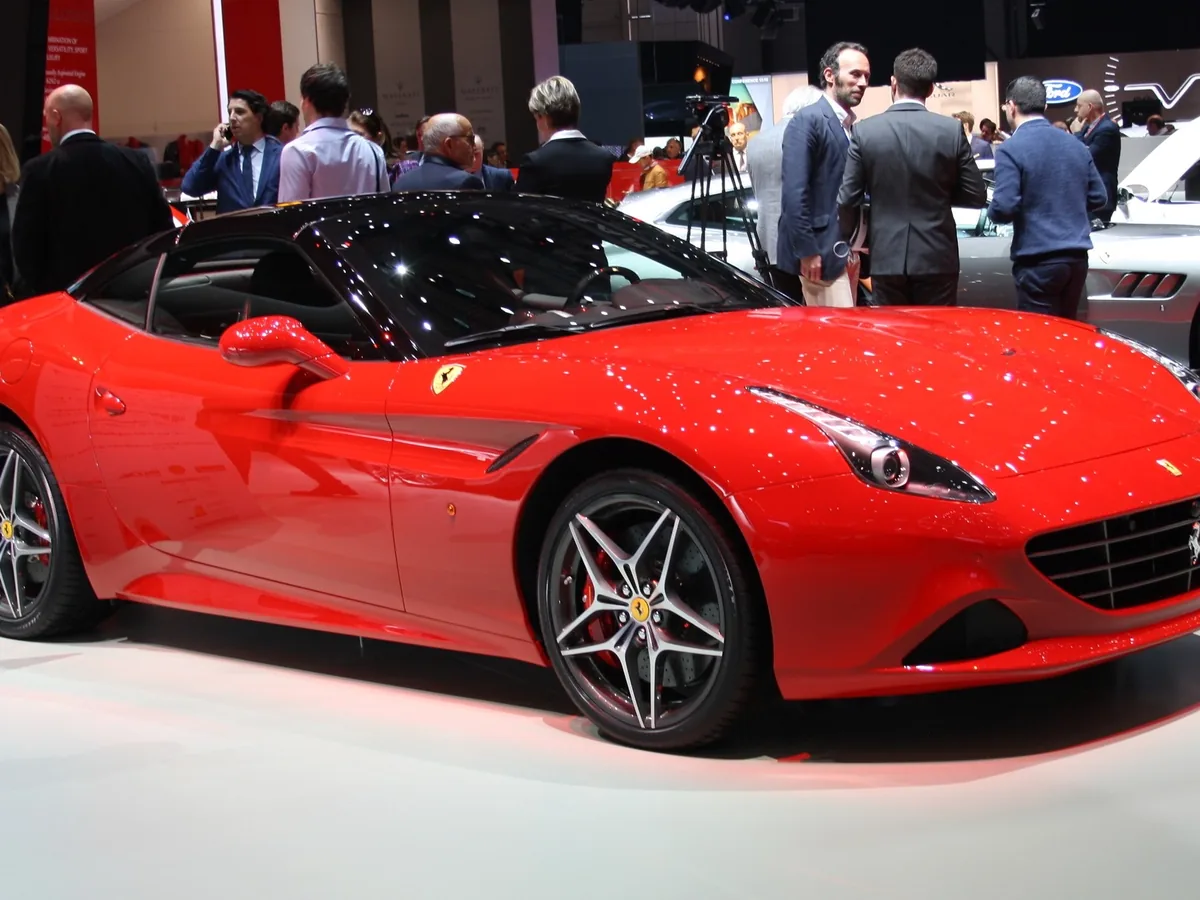
2008

Ferrari California photos
Model summary
Data from the ScanRacer library, organized to compare versions quickly.
Model introduction
Introduced in 2008, the Ferrari California brought a different interpretation of grand touring to Ferrari: a front-mounted V8, a retractable hardtop, and a layout intended to combine sports-car performance with greater everyday versatility. Ferrari’s European technical data lists a naturally aspirated 4.3-liter V8 producing 460 horsepower, paired with a seven-speed dual-clutch transmission. The California also stood out for its 2+2 configuration, aluminum construction, and roof system that allowed it to shift quickly between coupe and convertible roles. Ferrari updated the model in 2012 with the lighter, more powerful California 30. The California T followed with a major mechanical change, replacing the naturally aspirated engine with a 3.9-liter twin-turbocharged V8. The result was a faster and more extensively revised interpretation of the same grand-touring concept.
History
The California name has a long history within Ferrari. It first became associated with the 250 GT California Spyder, developed in the late 1950s for the American market’s interest in an open Ferrari. A much rarer 365 California followed in 1966; Ferrari states that only 14 examples were built. After several decades without a car carrying the name, the modern California was unveiled in 2008. It used an unusual architecture for Ferrari at the time, combining a front-mid-mounted V8, a dual-clutch gearbox, and a retractable hardtop. Ferrari positioned it as a grand tourer capable of covering long distances while retaining serious performance. In 2012, the California 30 introduced substantial weight savings and increased output to 490 horsepower. The California T, presented in 2014, represented a deeper technical change by adopting a twin-turbocharged V8. It continued the same open-top GT formula until the model line was replaced by the Ferrari Portofino.
Generations
The modern California can be understood as one model family developed through two major technical stages. The first, launched in 2008, used a naturally aspirated 4,297 cc direct-injection V8. Ferrari listed 460 horsepower, a 310 km/h top speed, and a 0-to-100 km/h time of four seconds for the European version. This generation retained the retractable hardtop, seven-speed dual-clutch transmission, and aluminum body structure. The 2012 California 30 remained closely related to that platform, but Ferrari claimed a 30 kg weight reduction and 30 additional horsepower, bringing output to 490 horsepower. The second stage was the California T, introduced in 2014. Although it preserved the basic 2+2 retractable-hardtop GT concept, it adopted a new 3,855 cc twin-turbocharged V8 producing 560 horsepower. Ferrari also stated that the engine sat 40 mm lower than in the previous California. It should therefore be regarded as a substantial mechanical and chassis revision, not merely a trim update.
Key differences
The main distinction is between the naturally aspirated California and the twin-turbocharged California T. Early versions use a 4.3-liter V8 rated by Ferrari at 460 horsepower, while the California 30 raises output to 490 horsepower and cuts 30 kg of weight. The California T moves to a 3.9-liter twin-turbocharged V8 producing 560 horsepower, with substantially more torque and an official 0-to-100 km/h time of 3.6 seconds. It also receives revised bodywork, a lower engine position, and chassis changes. Both families retain the model’s defining elements: a front-mid-mounted engine, rear-wheel drive, retractable hardtop, 2+2 seating, and seven-speed dual-clutch transmission. The 2013 year attached to the T entry in the supplied catalog should be treated cautiously, because Ferrari officially presented the California T in 2014. That discrepancy may reflect cataloging or model-year conventions rather than the formal launch date.
Photo recognition
The first clue when identifying a modern California is its retractable-hardtop coupe-convertible shape, long hood, and 2+2 cabin. The naturally aspirated California has a softer overall design and less sharply defined body surfacing than the California T. Its key mechanical characteristics include a non-turbocharged V8 and a dual-clutch transmission. The California 30 remains visually close to the earlier car, so reliable identification usually requires checking documentation, badging, or factory specifications rather than relying on exterior appearance alone. The California T is generally recognizable through its revised styling, more pronounced exterior details, and the “T” designation associated with its turbocharged engine. Exact identification should still be confirmed through the vehicle identification number and original build information. Factory options, transition-year cars, and later cosmetic changes can make visual comparisons inconclusive, especially when a California has received non-original wheels, trim, or bodywork.
Important versions
The Base entry corresponds to the naturally aspirated V8 version of the modern California, represented here by the 2008 year. It forms the starting point of this model family, with Ferrari quoting 460 horsepower and a retractable hardtop. The T entry is associated with 2013 in the supplied catalog, but it refers to the California T officially presented by Ferrari in 2014. This is the model’s most significant technical evolution, using a 3.9-liter twin-turbocharged V8 producing 560 horsepower alongside revised styling and chassis engineering. The California 30 is also an important intermediate version, introduced in 2012. It retained the naturally aspirated architecture while gaining 30 horsepower and losing 30 kg, although it does not appear as a separate entry in the supplied model data.
References
- Ferrari California (2008)Ferrari
- Ferrari California 30 (2012)Ferrari
- Ferrari California T (2014)Ferrari
- California DreamingFerrari Magazine
- Ferrari 250 CaliforniaFerrari
- Ferrari 365 CaliforniaFerrari
- https://www.jdpower.com/cars/history/ferrari/californiajdpower.com
- https://www.carandclassic.com/buyer-guides/ferrari-california-models-and-specscarandclassic.com
Technical specifications
Structured data available for versions linked to this model.
| Version | Power | Torque | Top speed | Drivetrain | Fuel |
|---|---|---|---|---|---|
| — | 560 horsepower at 7,500 rpm | — | — | Rear-wheel drive / 7-speed dual-clutch transmission | — |
Frequently asked questions
- What years was the Ferrari California produced?
- ScanRacer's referenced versions cover 2008 - 2013.
- How many Ferrari California examples are documented on ScanRacer?
- 28 published scans from 23 members, with the latest photo added in October 2026.
- What is the power output of the Ferrari California?
- The sourced technical data lists 560 horsepower at 7,500 rpm.
What about the car you photographed?
Upload a photo to get a suggested make, model and likely year.
No account needed for the result · Publish only if you choose