
430 Scuderia
Introduced in 2007, the Ferrari 430 Scuderia was the most focused road-going version of the F430 berlinetta. Its naturally aspirated 4.3-liter V8 produces 510 hp at 8,500 rpm, while the six-speed F1 gearbox, electronic differential and F1-Trac traction control give the car a distinctly competition-inspired operating character. Ferrari quoted a 0-to-62-mph time of less than 3.6 seconds and a top speed of 198 mph, or approximately 319 km/h. Weight reduction, sharper chassis responses and a more purposeful cabin were central to the concept, with Alcantara, carbon fiber and lightweight technical materials used throughout the interior. The 430 Scuderia therefore occupies an important place in Ferrari’s series of special V8 berlinettas, combining road legality with technology and development input drawn from the marque’s racing activities.
Variants by year
2007
Model summary
Data from the ScanRacer library, organized to compare versions quickly.
Model introduction
Introduced in 2007, the Ferrari 430 Scuderia was the most focused road-going version of the F430 berlinetta. Its naturally aspirated 4.3-liter V8 produces 510 hp at 8,500 rpm, while the six-speed F1 gearbox, electronic differential and F1-Trac traction control give the car a distinctly competition-inspired operating character. Ferrari quoted a 0-to-62-mph time of less than 3.6 seconds and a top speed of 198 mph, or approximately 319 km/h. Weight reduction, sharper chassis responses and a more purposeful cabin were central to the concept, with Alcantara, carbon fiber and lightweight technical materials used throughout the interior. The 430 Scuderia therefore occupies an important place in Ferrari’s series of special V8 berlinettas, combining road legality with technology and development input drawn from the marque’s racing activities.
History
The 430 Scuderia arrived in 2007 as a more competition-focused development of the F430. It followed the earlier 360 Challenge Stradale, but Ferrari applied a broader performance strategy: reducing weight while also refining the electronics, transmission and chassis response. Ferrari states that Michael Schumacher played a significant role in the car’s development, including testing on the Nürburgring Nordschleife. Output increased by 20 hp over the standard F430, reaching 510 hp. The F1 SuperFast 2 transmission was calibrated for quicker shifts, while the E-Diff and F1-Trac systems worked together to improve traction and control. The car retained a high-revving naturally aspirated V8, an increasingly characteristic formula for Ferrari’s mid-rear-engined berlinettas of the period. In 2008, the range gained a separate open-top derivative, the Scuderia Spider 16M, created to commemorate Ferrari’s sixteenth Formula 1 constructors’ championship. The 430 Scuderia itself remained the closed berlinetta and the clearest expression of the F430’s road-and-track engineering direction.
Generations
The 430 Scuderia does not form a conventional multi-generation model family. It is a special series derived directly from the F430, introduced for 2007 and built around a single mid-rear-engined berlinetta architecture. Its important distinctions are therefore related to specification, equipment and body derivatives rather than to successive generations. Compared with a standard F430, the 430 Scuderia combines greater engine output with lower weight, revised suspension settings, more performance-oriented electronic controls and a simplified interior. The automated F1 transmission is central to the car’s identity, meaning that the Scuderia is more than a cosmetic trim level. Its engineering changes were intended to improve circuit performance while retaining road-car usability and homologation. The 2008 Scuderia Spider 16M should be treated as a separate open-top derivative rather than as a new generation of the berlinetta. The next conceptual step came with the 458 Speciale, which followed the same broad formula of a lighter, sharper V8 special series but was based on a different Ferrari platform and powertrain. No evidence supports dividing the 430 Scuderia itself into several factory generations.
Key differences
The main difference between the 430 Scuderia and the standard F430 is its dynamic focus. The naturally aspirated V8 produces 510 hp, the F1 transmission is tuned for faster shifts, and the E-Diff and F1-Trac systems receive more performance-oriented calibration. Ferrari also quotes a dry weight of approximately 1,260 kg, although published weight figures can vary with market specification and equipment. Weight-saving measures are reflected in a more stripped-back cabin using carbon fiber, Alcantara and lightweight technical materials. The suspension, tires, braking system and electronic settings were developed around the same objective. As a result, the Scuderia is more specialized and less focused on conventional grand-touring comfort than a regular F430. Exact equipment can differ between cars because of market requirements and factory options, so a visible feature should not automatically be assumed to be standard on every example.
Photo recognition
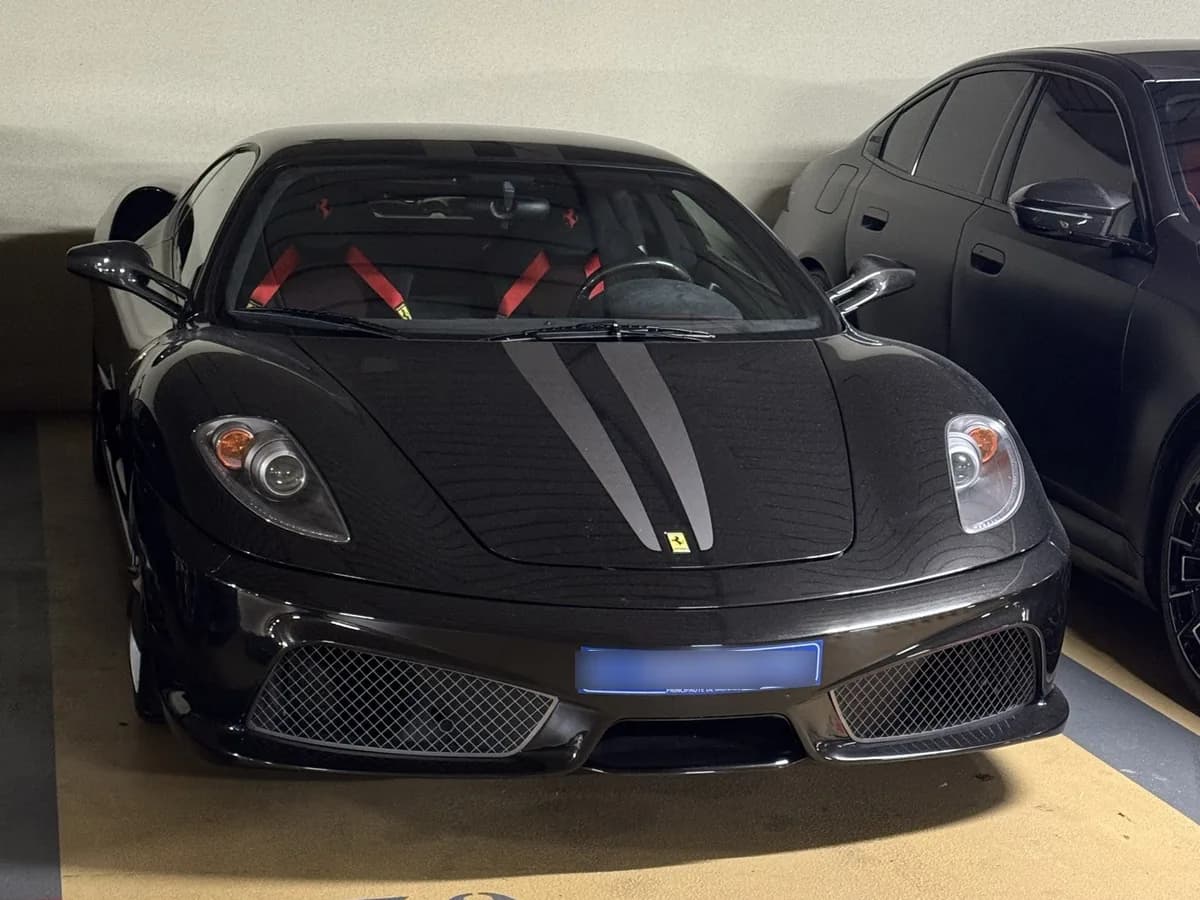
The 430 Scuderia is first identified by its more purposeful treatment compared with a regular F430. Longitudinal stripes are a common visual clue when fitted, but they are not proof of authenticity because decorative elements can be added later. The body has a more aggressive presentation, with dedicated aerodynamic details and a lower, more compact visual stance. Inside, Alcantara, carbon-fiber trim, strongly bolstered seats and a deliberately reduced level of luxury reflect the model’s track-oriented philosophy. The steering wheel uses Ferrari’s manettino control, while the F1 transmission is operated through paddles. Forged wheels, carbon-ceramic brakes and specific exterior details can also help identification, but their presence should be checked against the original specification. For separating a genuine 430 Scuderia from a modified F430, factory documentation, the chassis number, option records and service history are more dependable than appearance alone. The name should also be written as “430 Scuderia”; Ferrari’s official model references do not generally use “F430 Scuderia” as the model title.
Important versions
The main version is the 430 Scuderia, a two-seat berlinetta derived from the F430 and introduced in 2007. It uses the 4.3-liter V8 producing 510 hp, a six-speed F1 transmission and chassis electronics including the E-Diff and F1-Trac systems. Its cabin and body emphasize lower weight, sharper responses and circuit-oriented performance. The 2008 Scuderia Spider 16M is the open-top derivative of the same philosophy. Its name refers to Ferrari’s sixteen Formula 1 constructors’ championships. It should not be confused with an ordinary F430 Spider, since its positioning, setup and collectability are distinct. There is no reliable basis for dividing the closed 430 Scuderia into multiple internal factory generations. Equipment and appearance can vary with options, so individual cars should be checked against their original build documentation.
References
- Ferrari 430 ScuderiaFerrari
- Ferrari 430 Scuderia: Ferrari HistoryFerrari
- 2008 Ferrari 430 Scuderia First Drive ReviewCar and Driver
- https://motogallery.com/blogs/ferrari-database/ferrari-430-scuderiamotogallery.com
- https://www.edmunds.com/ferrari/430-scuderia/2008/features-specs/edmunds.com
- https://www.autolit.eu/en/ferrari-f430/35132-2007-ferrari-f430-scuderia-press-brochure-prospekt-3079-07.htmlautolit.eu
Technical specifications
Structured data available for versions linked to this model.
| Version | Power | Torque | Top speed | Drivetrain | Fuel |
|---|---|---|---|---|---|
| — | 510 chevaux à 8 500 tr/min | — | — | Propulsion arrière / Boîte semi-automatique à 6 rapports | — |
Frequently asked questions
- What years was the Ferrari 430 Scuderia produced?
- ScanRacer's referenced versions cover 2007.
- How many Ferrari 430 Scuderia examples are documented on ScanRacer?
- 6 published scans from 6 members, with the latest photo added in September 2026.
- What is the power output of the Ferrari 430 Scuderia?
- The sourced technical data lists 510 chevaux à 8 500 tr/min.