
348
Introduced in 1989 as the successor to the Ferrari 328, the 348 is a two-seat sports car with a mid-mounted rear V8 and Pininfarina bodywork. Its name combines an engine displacement of roughly 3.4 liters with an eight-cylinder layout, while the TB and TS suffixes identify the fixed-roof coupe and targa-roof versions. The 348 also introduced a distinctive Ferrari design language, with deep side air intakes and square rear lamps that echoed the larger Testarossa. In 1993, Ferrari revised the range as the 348 GTB and GTS, adding more power and detail changes, while also introducing the first full-convertible 348 Spider with a folding fabric roof. Across the 1989-1993 period, the principal body styles are the Berlinetta, Targa, and Spider.
What about the car you photographed?
Upload a photo to get a suggested make, model and likely year.
No account needed for the result · Publish only if you choose
Variants by year
Make: Ferrari · Model: 348
3 / 3 versions shown
1993

1989
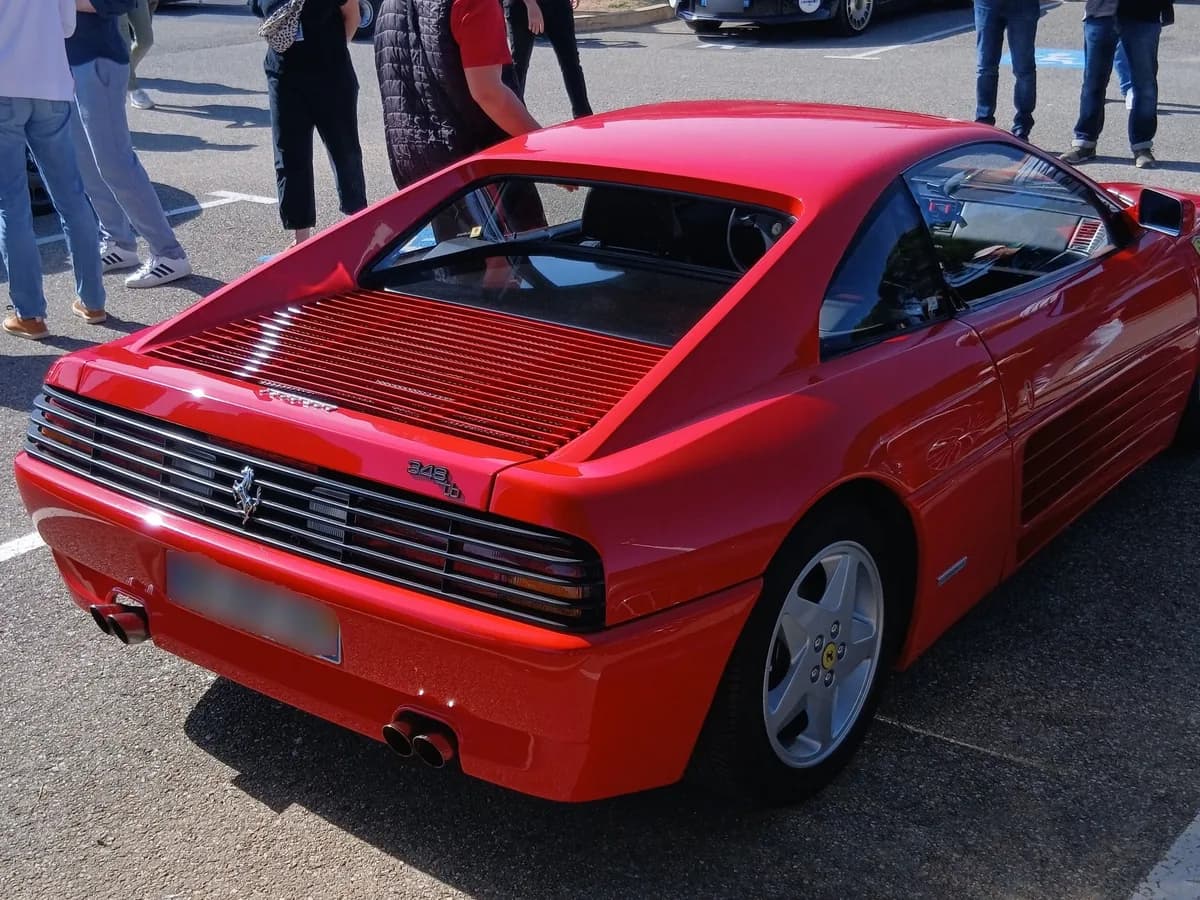

Ferrari 348 photos
Model summary
Data from the ScanRacer library, organized to compare versions quickly.
Model introduction
Introduced in 1989 as the successor to the Ferrari 328, the 348 is a two-seat sports car with a mid-mounted rear V8 and Pininfarina bodywork. Its name combines an engine displacement of roughly 3.4 liters with an eight-cylinder layout, while the TB and TS suffixes identify the fixed-roof coupe and targa-roof versions. The 348 also introduced a distinctive Ferrari design language, with deep side air intakes and square rear lamps that echoed the larger Testarossa. In 1993, Ferrari revised the range as the 348 GTB and GTS, adding more power and detail changes, while also introducing the first full-convertible 348 Spider with a folding fabric roof. Across the 1989-1993 period, the principal body styles are the Berlinetta, Targa, and Spider.
History
The Ferrari 348 made its public debut at the 1989 Frankfurt Motor Show, following the 308 and 328. It retained Ferrari’s mid-mounted rear-engine V8 concept but introduced a 3.4-liter unit with twin overhead camshafts per bank, four valves per cylinder, and dry-sump lubrication. Early cars produced approximately 300 hp and were sold as the 348 TB, a fixed-roof coupe, and the 348 TS, fitted with removable targa roof panels. The T referred to the transverse gearbox mounted behind the engine, while B meant Berlinetta and S meant Spider, although the TS was not a full convertible. Ferrari continued to refine the model during the early 1990s. A limited special series introduced upgrades to power, gearing, tires, and chassis tuning. In 1993, several of those developments reached the regular range: the TB became the GTB, the TS became the GTS, and Ferrari listed output at 320 hp. That year also brought the 348 Spider, the first version with a fully folding fabric roof. The 348 formed the basis of Ferrari’s new one-make Challenge series and later inspired competition-focused derivatives, including the GT Competizione homologation special.
Generations
The 348 was not divided into officially named generations; it remained one model line produced across the late 1980s and early 1990s, with a substantial update in 1993. The first phase consisted of the 348 TB and TS introduced in 1989. The TB was the fixed-roof Berlinetta, while the TS used two removable roof panels to create a targa configuration. These early cars used the original 3.4-liter V8 specification and are commonly identified by black exterior details, including the lower body sections and side sills. The second phase arrived in 1993. Mechanical and trim revisions produced the 348 GTB and GTS: the former retained the coupe body, while the latter continued the targa concept. Ferrari revised elements such as the bumpers, front grille, lower skirts, and engine-cover presentation, while quoted output rose to 320 hp. The 348 Spider was introduced alongside this update as a separate open-top body style, replacing removable roof panels with a fully folding fabric hood. The Challenge and GT Competizione were specialized derivatives rather than separate road-car generations. They demonstrate how Ferrari developed the 348 for customer racing and GT competition, while the main production structure remained the early TB/TS phase followed by the GTB/GTS and Spider update.
Key differences
The clearest distinction is the roof design. The Berlinetta, identified as TB at launch and GTB after 1993, has a fixed roof. The Targa, known as TS and later GTS, uses removable roof panels, preserving a coupe-like profile while allowing open-air driving. The 1993 Spider has a folding fabric hood and a genuinely convertible body, so it should not be mistaken for the targa-roof TS. Early TB and TS cars produced approximately 300 hp, while the revised GTB and GTS were listed at 320 hp. Later cars also received exterior, trim, and chassis-related revisions. The 348 Challenge was prepared for Ferrari’s one-make racing series and used dedicated equipment including a roll cage, harnesses, revised exhaust and brakes, and racing tires. The GT Competizione was rarer still and developed for GT homologation purposes. These competition derivatives should be treated separately from the three principal road-car body styles.
Photo recognition
A Ferrari 348 is primarily identified by its wedge-shaped profile, deep side air intakes, and square rear lamps positioned beneath a black grille. Early cars use a more contrasting exterior treatment, with dark lower body sections and sills, while later versions feature more body-colored trim. The mid-mounted V8 is visible behind the cabin beneath a vented engine cover. The roof provides the quickest way to separate the body styles. A TB or GTB has a fixed roof; a TS or GTS uses removable targa panels that can be stored behind the seats; and the Spider has a folding fabric hood with distinct rear structure. The rear badge can help, but badges are replaceable and should not be treated as conclusive evidence. Chassis records, production documentation, original equipment, and detailed photographs are more reliable when separating an early launch car from a revised 1993 model or a Challenge derivative.
Important versions
The 348 TB and 348 TS were the 1989 launch versions: the former was the fixed-roof Berlinetta, while the latter used a targa roof. In 1993, they evolved into the GTB and GTS, with quoted output rising to 320 hp and several exterior and engineering revisions. Also introduced in 1993, the 348 Spider used a full folding fabric roof and is the easiest open-top version to distinguish visually. Beyond the standard road cars, the 348 Challenge launched Ferrari’s one-make racing series with dedicated circuit equipment. The 348 GT Competizione was a much rarer homologation model, incorporating lightweight components and competition-oriented development for GT racing. These sporting derivatives are historically significant, but they should be kept distinct from the standard road-going body styles.
References
- Numbers Game: Ferrari 348Ferrari
- Ferrari 348 SpiderFerrari
- Ferrari 348 ChallengeFerrari
- Ferrari 348 GT Competizione: Ferrari HistoryFerrari
- The Ferrari 348: History, Models, SpecsMotorTrend
- Ferrari 348: Buying guide and review (1989-1994)Auto Express
- https://www.ferrari.com/it-IT/magazine/articles/numbers-game-ferrari-348ferrari.com
Frequently asked questions
- What years was the Ferrari 348 produced?
- ScanRacer's referenced versions cover 1989 - 1993.
- How many Ferrari 348 examples are documented on ScanRacer?
- 4 published scans from 4 members, with the latest photo added in September 2026.
What about the car you photographed?
Upload a photo to get a suggested make, model and likely year.
No account needed for the result · Publish only if you choose