
DMC-12
Introduced in 1981, the DeLorean DMC-12 is a two-seat sports coupe assembled at Dunmurry, near Belfast, Northern Ireland. Its Giorgetto Giugiaro styling, gull-wing doors and brushed stainless-steel exterior panels give it an instantly recognizable presence. Beneath the dramatic bodywork is a backbone-style chassis, a rear-mounted 2.8-liter PRV V6 and a choice of five-speed manual or three-speed automatic transmission. The original DeLorean was produced for the 1981, 1982 and 1983 model years, with changes introduced progressively during production rather than through major annual redesigns. The car later gained an extraordinary cultural profile after appearing as the time machine in the Back to the Future trilogy. Its visual identity remains stronger than its brief commercial life, making the DMC-12 one of the most distinctive automotive designs of the early 1980s.
Variants by year
1981
Model summary
Data from the ScanRacer library, organized to compare versions quickly.
Model introduction
Introduced in 1981, the DeLorean DMC-12 is a two-seat sports coupe assembled at Dunmurry, near Belfast, Northern Ireland. Its Giorgetto Giugiaro styling, gull-wing doors and brushed stainless-steel exterior panels give it an instantly recognizable presence. Beneath the dramatic bodywork is a backbone-style chassis, a rear-mounted 2.8-liter PRV V6 and a choice of five-speed manual or three-speed automatic transmission. The original DeLorean was produced for the 1981, 1982 and 1983 model years, with changes introduced progressively during production rather than through major annual redesigns. The car later gained an extraordinary cultural profile after appearing as the time machine in the Back to the Future trilogy. Its visual identity remains stronger than its brief commercial life, making the DMC-12 one of the most distinctive automotive designs of the early 1980s.
History
The DeLorean project grew from John Z. DeLorean’s ambition to create a sports car unlike conventional competitors. Giorgetto Giugiaro and Italdesign were responsible for the styling, while Lotus contributed to the car’s engineering development and production readiness. To build the vehicle, DeLorean Motor Company established a factory at Dunmurry near Belfast with support from the British government. Production began in early 1981 after repeated delays and substantial cost overruns. The DMC-12 combined unpainted stainless-steel outer panels with a fiberglass underbody and a steel backbone chassis. Its PRV V6, developed jointly by Peugeot, Renault and Volvo, was mounted behind the rear axle. Despite considerable attention at launch and a highly original design, the car faced a high price, early quality and development issues, and an unfavorable automotive market. DeLorean Motor Company entered receivership and ceased operations in 1982. Some unfinished cars were completed after the factory closed, which helps explain why vehicles carrying 1983 model-year identification can have late-1982 build dates. Total production is commonly estimated at slightly more than 9,000 cars, although exact figures vary because surviving records and VIN sequences are not completely consistent.
Generations
The DeLorean DMC-12 does not divide into successive generations in the usual automotive sense. It was a single model built over a short period, with running changes introduced throughout production. The 1981, 1982 and 1983 model years therefore represent production sequences and VIN designations more than three clearly separated generations. Early 1981 cars can differ from later examples in details such as hood design, fuel-cap arrangement, antenna position, wheels and interior equipment. Engineering corrections and production improvements were introduced continuously, sometimes without waiting for a new model year. Cars identified as 1983 models are especially unusual because several were completed or re-identified after the company entered receivership, and their physical build dates can fall in 1982. As a result, it is risky to infer every specification from the model year alone. The relevant entry here is the 1981 base version. It belongs to the first production phase and should be assessed using its VIN, build date and actual equipment rather than a generational label. Specialist DeLorean documentation identifies the VIN as the most dependable way to establish model year, while visual details are useful for judging production sequence and originality.
Key differences
Confirmed facts: the DMC-12 received running changes during production rather than sharply separated annual updates. Useful identification points include hood design, the presence or absence of a fuel-filler flap, fuel-cap type, antenna location, wheel design, radio equipment and selected trim details. Early wheels were generally dark gray, while silver wheels appeared later, with more than one casting style used during production. Cautious interpretation: one 1981 car is not automatically identical to another car carrying the same model year. Build date, VIN sequence and later owner modifications can produce unusual combinations of features. Factory documentation identifies transmission and interior color as the principal choices: a five-speed manual or three-speed automatic, with gray or black interior trim. Dealer-installed accessories and later restorations should not be treated as separate factory versions. Visual clues are valuable, but the VIN remains the stronger reference when model-year identification matters.
Photo recognition
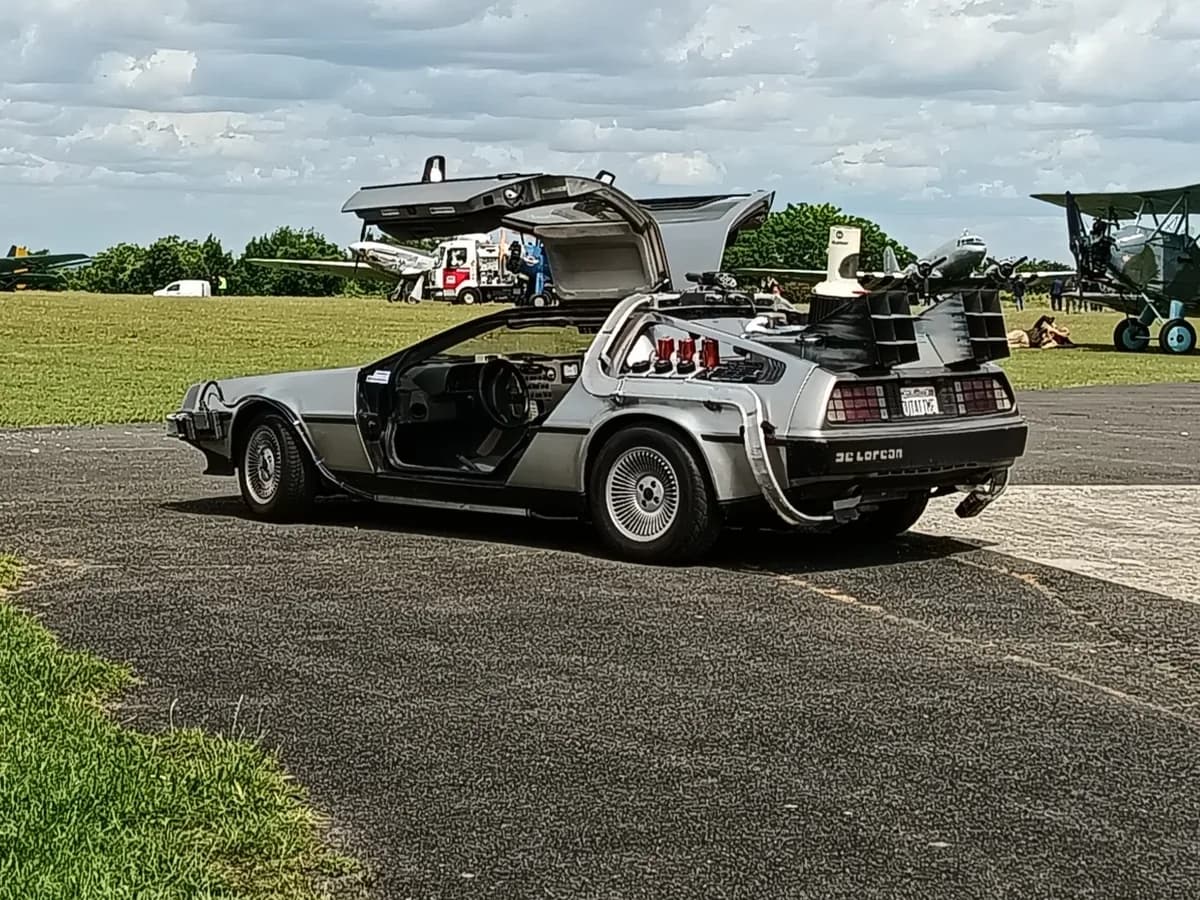
The DMC-12 is first identified by its wedge-shaped profile, gull-wing doors and brushed stainless-steel body panels left unpainted. The front hood has no conventional grille, and later configurations carry a DeLorean emblem on the hood. Broad black air intakes sit behind the doors, while the rear features black louvers and a sharply inclined rear window. Original wheels are staggered in nominal diameter, measuring 14 inches at the front and 15 inches at the rear. When examining a 1981 car, visual inspection should be supported by the build plate in the driver’s door jamb and by the VIN. The tenth VIN character identifies model year: B for 1981, C for 1982 and D for 1983. The build date may precede the model year, particularly because 1982 production began in December 1981. A Craig radio is characteristic of 1981 cars, while later examples often used an ASI unit with a DMC logo on the cassette door. Wheels, radios and antenna arrangements can be changed, so they should be treated as clues rather than final proof of identity.
Important versions
The 1981 base version represents the DMC-12’s first production phase. It uses the model’s common architecture: a two-seat coupe, rear-mounted 2.8-liter PRV V6, rear-wheel drive, stainless-steel bodywork and backbone chassis. Two factory transmissions were available: a five-speed manual or a three-speed automatic. Interior trim was offered in gray or black. The DMC-12 did not have a broad, traditionally structured range of luxury trims or performance derivatives. The most meaningful differences between cars usually reflect production sequence, original equipment and later modifications. For accurate identification, VIN information and build date are more dependable than the “Base” label or general appearance. Items such as wheels, radios, antennas and trim pieces can be replaced during restoration, so they should be used as supporting evidence rather than as definitive version markers.
References
- 1981 DeLorean DMC-12 Coupe “Gold”Petersen Automotive Museum
- The DeLorean DMC-12: A Short, Chaotic HistoryTIME
- https://www.carcollectorinternational.com/research/buyers-guides/delorean/dmc-12carcollectorinternational.com
- https://classics.honestjohn.co.uk/reviews/delorean/dmc-12/history/classics.honestjohn.co.uk
- https://www.hagerty.co.uk/articles/an-eighties-classic-the-delorean-dmc-12/hagerty.co.uk
- https://www.oldcarsweekly.com/features/car-of-the-week-1981-delorean-dmc-12oldcarsweekly.com
- https://www.autoexpress.co.uk/features/354919/delorean-motor-company-and-dmc-12-full-storyautoexpress.co.uk
- https://motor-car.net/historic-cars/856-delorean/10133-dmc-12-history-1981-82motor-car.net
Frequently asked questions
- What years was the DeLorean DMC-12 produced?
- ScanRacer's referenced versions cover 1981.
- How many DeLorean DMC-12 examples are documented on ScanRacer?
- 7 published scans from 5 members, with the latest photo added in September 2026.