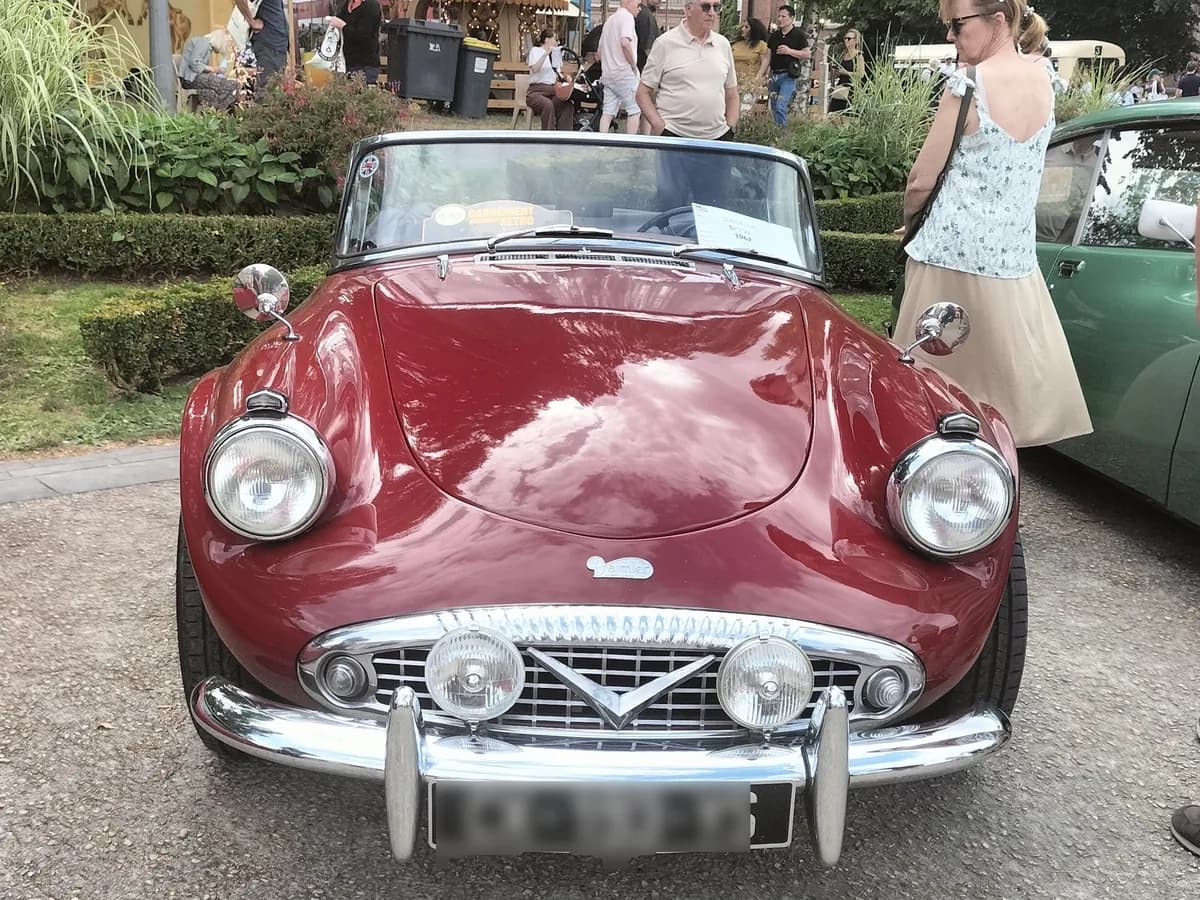
Daimler SP250 1959
Introduced in 1959, the Daimler SP250 is a two-seat British roadster with a fibreglass body and a 2.5-litre V8. Developed under Edward Turner, it represented a sharp departure from the saloons and limousines traditionally associated with Daimler. The car was unveiled at the New York Motor Show in April 1959 as the Daimler Dart, but Chrysler objected because Dodge already used the Dart name. Daimler therefore adopted the SP250 designation, derived from the project’s internal type number. A 1959 example belongs to the earliest production period and is generally identified with the A-Spec configuration. These first cars used the original, less heavily braced chassis and carried the distinctive styling that made the SP250 one of the most individual British sports cars of its era.
Curious about this car?
Explore SP250, then try your own photo.
No account needed for the result · Publish only if you choose
History
The SP250 emerged while Daimler was facing financial and commercial difficulties. By the late 1950s, the company had too many models and limited funds for a complete renewal of its range. Edward Turner’s engineering programme nevertheless produced new V8 engines, including a 2.5-litre unit that could power a lighter sports car. Daimler had initially considered using the engine in a saloon, but the two-seat roadster became the most developed and commercially promising proposal, particularly for the United States. A steel chassis influenced by the Triumph TR3A was combined with a fibreglass body to reduce tooling costs and speed production. The car’s April 1959 New York debut reflected Daimler’s export ambitions. Those plans were weakened by an American recession, early body-quality problems and criticism of the chassis’s flexibility. Jaguar acquired Daimler in 1960 and introduced structural revisions, but the model remained a low-volume product until production ended in 1964.
Latest scans
Photos added by the community for this page.
Anecdotes
The Daimler Dart name was used only briefly. Chrysler objected because Dodge already marketed a Dart, so Daimler adopted the SP250 designation instead. A 1959 prototype, chassis 100002, survives in the Jaguar Daimler Heritage Trust collection. It served as a factory press car, was tested by Autocar and Motor, and later appeared on the cover of Vogue’s November 1959 issue. The car’s early publicity history reflects Daimler’s attempt to give its unconventional sports car a strong international profile.
Production
The Daimler SP250 was produced from 1959 to 1964, with a total commonly recorded as 2,654 chassis or cars, depending on the counting method used. This result fell well short of Daimler’s original expectations of 1,500 cars in the first year and 3,000 annually thereafter. Production included both right-hand-drive and left-hand-drive examples for the British, North American and other export markets. Specialists generally divide the model’s development into A-Spec, B-Spec and C-Spec phases, while noting that the changes were introduced progressively and that some earlier cars were later upgraded. Its modest production volume, combined with a comparatively high survival rate, makes the SP250 an uncommon sight today and gives the earliest 1959 examples particular historical interest.
Press reception
Press reaction to the SP250 was mixed. Its highly distinctive styling ensured immediate attention, but it also divided opinion among journalists and potential buyers. Early road tests identified insufficient chassis rigidity as a significant weakness, helping to shape the mixed reputation of the first cars. The later B-Spec benefited from a more favourable assessment because its structural revisions improved steering accuracy and road behaviour. At the same time, reviewers recognised the V8’s flexibility and the performance available from a relatively light sports car. Road tests listed by the Daimler Lanchester Owners’ Club show that the model received sustained coverage in British and international motoring publications. Its engineering interest was clear, even though the commercial response never matched Daimler’s original ambitions.
Evolution
Variants
References
- 1959 Daimler SP 250 (Dart) XHP 438Jaguar Daimler Heritage Trust
Supports the 1959 launch context, prototype history, press-car use, name change and total production figure.
- 1961 Daimler SP 250 SportsJaguar Daimler Heritage Trust
Supports the two-seat fibreglass body, 2.5-litre V8, American-market intent, New York launch and Chrysler naming dispute.
- Daimler SP250 buyer’s guideClassics World
Supports the production period, A/B/C-Spec evolution, 140 bhp output, transmission options and contemporary assessment of the car.
- Daimler Dart: Buying guide and review (1959-1964)Auto Express
Supports the rarity, early chassis revisions and later enthusiast evaluation.
- SP250Daimler Lanchester Owners’ Club
Supports the list of period road tests and historical context for the model’s development.
- SP250Daimler Lanchester Owners Car Club of Australia
Supports the 2,654-unit production total, right-hand-drive and left-hand-drive split, and the progressive A/B/C-Spec classification.
- Daimler SP250 – Cult Classic, Not Best SellerCar & Classic Magazine
Supports the original market ambitions, engine output, transmission description, chassis criticisms and later B/C-Spec changes.
- https://en.wikipedia.org/wiki/Daimler_SP250en.wikipedia.org
Source found by OpenAI web search for this vehicle page.