
SP250
Introduced at the New York Motor Show in April 1959, the Daimler SP250 was a British roadster with a fibreglass body and a 2.5-litre V8 engine. It was initially announced as the Daimler Dart, but Daimler adopted the SP250 designation after Chrysler objected to the use of Dart, already associated with a Dodge model. Developed partly with the American market in mind, the SP250 represented a sharp departure from Daimler’s established practice. It used a separate chassis influenced by the Triumph TR3, Girling disc brakes on all four wheels and a manual gearbox alongside an available automatic transmission. Its unusual styling and compact Edward Turner V8 give it a distinctive place in Daimler history. Production eventually totalled 2,654 cars between 1959 and 1964, making the SP250 an uncommon survivor of the British sports-car boom of the late 1950s and early 1960s.
What about the car you photographed?
Upload a photo to get a suggested make, model and likely year.
No account needed for the result · Publish only if you choose
Variants by year
Make: Daimler · Model: SP250
1 / 1 versions shown
1959
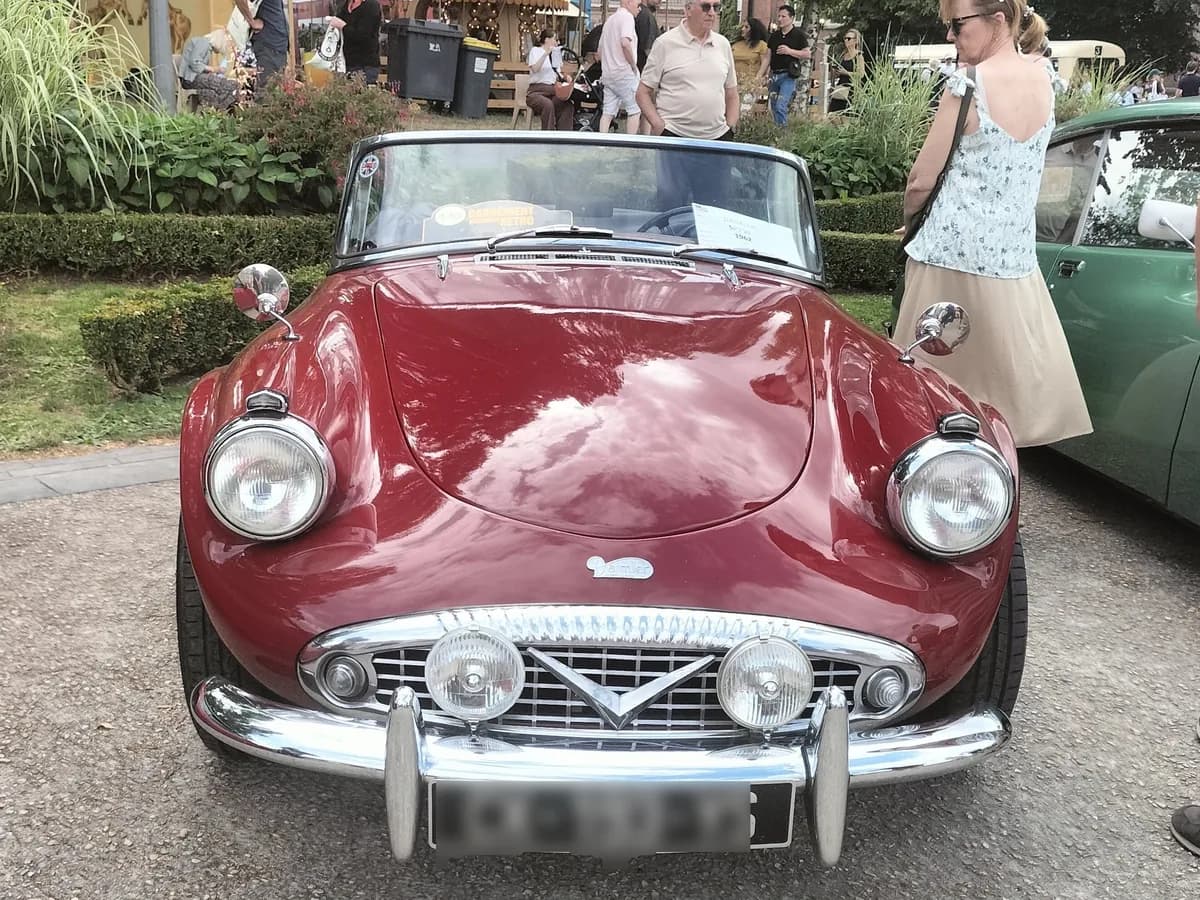
Daimler SP250 photos
Model summary
Data from the ScanRacer library, organized to compare versions quickly.
Model introduction
Introduced at the New York Motor Show in April 1959, the Daimler SP250 was a British roadster with a fibreglass body and a 2.5-litre V8 engine. It was initially announced as the Daimler Dart, but Daimler adopted the SP250 designation after Chrysler objected to the use of Dart, already associated with a Dodge model. Developed partly with the American market in mind, the SP250 represented a sharp departure from Daimler’s established practice. It used a separate chassis influenced by the Triumph TR3, Girling disc brakes on all four wheels and a manual gearbox alongside an available automatic transmission. Its unusual styling and compact Edward Turner V8 give it a distinctive place in Daimler history. Production eventually totalled 2,654 cars between 1959 and 1964, making the SP250 an uncommon survivor of the British sports-car boom of the late 1950s and early 1960s.
History
In the late 1950s, Daimler needed a new model that could attract customers beyond its traditional saloon range and provide an application for Edward Turner’s new V8 engine. The company chose a compact sports car aimed in part at North America. A fibreglass body reduced tooling costs and helped shorten the development process, while the separate chassis drew on ideas associated with the Triumph TR3. The result appeared at the New York Motor Show in April 1959 as the Daimler Dart. Chrysler objected because Dart was already registered for a Dodge model, so Daimler quickly changed the car’s official designation to SP250, based on the project number. Early cars developed an unfortunate reputation for limited structural rigidity and inconsistent body quality. Jaguar acquired Daimler in 1960, and the subsequent B-specification cars received additional chassis and scuttle reinforcement to reduce flexing. A later C specification made several previously optional items standard. The SP250 nevertheless remained a low-volume product. Its compact V8, four-wheel disc brakes and lively performance gave it genuine technical interest, but the anticipated American sales did not materialise. Production ended in 1964, with 2,654 cars built in total.
Generations
The SP250 is not normally divided into completely separate generations. Its main production changes are identified as A, B and C specifications, which describe successive development stages rather than wholly different models. The A specification covers the earliest cars, produced from 1959. These cars used the lightest structural arrangement and depended more heavily on customer-selected options. Their lower weight makes them attractive to some enthusiasts, although early examples are also associated with criticism of chassis and body flex. The B specification appeared late in 1960, after Jaguar had acquired Daimler. It introduced additional longitudinal chassis members and further reinforcement around the cockpit and front bulkhead. The aim was to improve structural stiffness and reduce body shake, with a corresponding increase in weight. Some cars originally exported to the United States were returned to Britain for conversion to the improved specification. The C specification followed in the early 1960s, commonly dated to 1963 in specialist references. It retained the reinforced B-specification structure while making a range of previously optional equipment more widely fitted or standard. The changes therefore concern structure and equipment rather than a new body or engine. The SP252 prototype represented a possible redesign, but it never entered series production and should not be treated as a production generation of the SP250.
Key differences
Within the ScanRacer library context, the Daimler SP250 is represented by a single “Base” variant dated 1959. That entry should not be read as evidence that the model was produced only in that year: historical sources place production from 1959 to 1964 and describe successive A, B and C specifications. For a 1959 car, the most relevant distinction is its likely association with the early A specification. It may retain the original lightweight structure, a more option-dependent equipment level and exterior details associated with the first production period, before the reinforcement changes introduced around 1960. The year alone is not enough to establish every detail, however, because cars were sometimes upgraded later, including with B-specification structural modifications. Individual cars may also differ through the choice of manual or automatic transmission, bumpers, wire wheels, hard-top and other accessories. Those items should be treated as equipment variations rather than automatically interpreted as separate body styles or generations. A surviving car’s chassis number and factory records remain the safest way to confirm its original specification.
Photo recognition
The SP250 is easiest to identify by its compact roadster shape, rounded front wings, low wide grille and small rear fins. The nose has a particularly distinctive opening, often described as a mouth-like grille, which separates the car visually from contemporary Triumph, MG and Austin-Healey sports cars. Its body is made from fibreglass and mounted on a separate chassis. Early examples may show small chrome pieces on either side of the grille when full-width bumpers were not fitted. Cars could be equipped with a soft top, a hard-top or both, and wire wheels were available. The cabin has two main front seats and a small rear bench, explaining the commonly used 2+2 description even though rear accommodation is restricted. Specification identification requires more than exterior styling. Structural reinforcement, equipment levels and chassis documentation are more reliable indicators of A-, B- or C-specification status. Surviving cars have often been modified, restored or upgraded, so details such as a later gearbox, added bumpers or converted chassis should not automatically be treated as factory-original features.
Important versions
The most important production distinction is the early A specification, corresponding to the cars launched in 1959 with the lightest structure and a more option-based equipment level. The B specification appeared late in 1960 and added chassis and bulkhead reinforcement to improve rigidity. The C specification, generally dated to the early part of 1963, retained the strengthened structure while making more equipment standard. The Daimler Dart name is also significant: it was the car’s original launch name before Chrysler’s objection led to the adoption of SP250. The SP252 should be recorded as a proposed successor rather than a production version. It used related engineering ideas but never reached series manufacture. Police cars and competition examples are specialised applications or adaptations, not separate production generations.
References
- 1959 Daimler SP250 Prototype Chassis 100002Jaguar Daimler Heritage Trust
- The Tip & Tail Of The DartJaguar Daimler Heritage Trust / Classic & Sports Car
- SP250 HistoryDaimler Lanchester Owners’ Club
- HistoryDaimler SP250 Owners’ Club
- https://www.classic.com/m/daimler/sp250/classic.com
- https://daimlersp250dartownersclub.com/numbers/daimlersp250dartownersclub.com
- https://classicsworld.co.uk/cars/test-drive-1960-daimler-sp250/classicsworld.co.uk
Frequently asked questions
- What years was the Daimler SP250 produced?
- ScanRacer's referenced versions cover 1959.
- How many Daimler SP250 examples are documented on ScanRacer?
- 2 published scans from 1 member, with the latest photo added in July 2026.
What about the car you photographed?
Upload a photo to get a suggested make, model and likely year.
No account needed for the result · Publish only if you choose