
Méhari
Introduced in France in May 1968, the Citroën Méhari was a lightweight leisure vehicle with an ABS plastic body developed around the mechanical base of the Dyane 6. Its straightforward layout combined a 602 cc flat-twin engine, front-wheel drive and an open body that could be fitted with a fabric top, hardtop or removable side sections. Designed for practical transport as well as outdoor recreation, it stood out through its low weight, simple construction and suitability for use in sunny or coastal environments. A four-wheel-drive version appeared at the end of the 1970s, adding genuine off-road capability to the range. In 2015, Citroën introduced the E-Méhari, a fully electric four-seat convertible that revived the name and several visual ideas of the original. It is best understood as a modern successor in spirit, rather than as a direct technical continuation of the 1968 vehicle.
Variants by year
2016
1968
Model summary
Data from the ScanRacer library, organized to compare versions quickly.
Model introduction
Introduced in France in May 1968, the Citroën Méhari was a lightweight leisure vehicle with an ABS plastic body developed around the mechanical base of the Dyane 6. Its straightforward layout combined a 602 cc flat-twin engine, front-wheel drive and an open body that could be fitted with a fabric top, hardtop or removable side sections. Designed for practical transport as well as outdoor recreation, it stood out through its low weight, simple construction and suitability for use in sunny or coastal environments. A four-wheel-drive version appeared at the end of the 1970s, adding genuine off-road capability to the range. In 2015, Citroën introduced the E-Méhari, a fully electric four-seat convertible that revived the name and several visual ideas of the original. It is best understood as a modern successor in spirit, rather than as a direct technical continuation of the 1968 vehicle.
History
The Méhari was unveiled to the press at the Deauville golf course on May 11, 1968, before appearing publicly at the Paris Motor Show later that year. Its concept was unusual for the period: a lightweight and versatile vehicle that could carry people or equipment while also serving as an open-air leisure car. The ABS body, produced in body-coloured plastic, became one of its defining features. Citroën based the car on the company’s A-Series mechanical family, giving it a close technical relationship with the Dyane 6 and 2CV6. During its career, the Méhari received a series of revisions affecting exterior details, dashboard design, braking equipment and safety provisions. A two-seat configuration broadened its practical role, while military, police and professional versions demonstrated that the model was more than a beach car. The Méhari 4x4, introduced in 1979, added four-wheel drive and gained visibility through its involvement in support operations for the 1980 Paris-Dakar. French production ended in 1987 after approximately 145,000 vehicles. The E-Méhari, revealed in December 2015 and available in 2016, revived the name with an electric powertrain, four seats and a much more contemporary body design.
Generations
The original Méhari represents a long production run of one basic model rather than a sequence of clearly separated generations. The earliest cars from 1968 and 1969 have several distinctive body and lighting details. From 1970 onward, exterior revisions modernised the design, while a two-seat layout and additional equipment expanded the vehicle’s practical uses. The most visible later changes arrived in the late 1970s, including a revised front end, a new dashboard and braking upgrades. The Méhari 4x4 appeared in 1979. Because it used a substantially different drivetrain layout from the front-wheel-drive car, it is best treated as a major technical variant rather than a separate generation. The E-Méhari marks a second chapter for the name. Shown at the end of 2015 and offered in 2016, it adopted a modern four-seat convertible body and an all-electric powertrain. Its connection with the historic Méhari is primarily conceptual and visual: open-air use, a relaxed character and a deliberately colourful identity. The two cars do not share the same platform, powertrain or mechanical design. Within the ScanRacer context, the available entries therefore represent the original 1968 model and the 2016 E-Méhari rather than a complete catalogue of every historical Méhari configuration.
Key differences
The key distinction is between the historic Méhari and the E-Méhari. The original uses a simple combustion-powered layout: a 602 cc flat-twin engine, manual transmission and front-wheel drive in the mainstream version. Its ABS body, removable equipment and limited cabin specification prioritise simplicity and versatility. The Méhari 4x4 adds four-wheel drive and represents a more specialised mechanical configuration. The E-Méhari belongs to a completely different technical category. It is a four-seat electric convertible with a modern body, contemporary safety equipment and a more developed cabin. It retains the idea of a colourful open-air car, but its dimensions, structure, electronics and energy-storage system are unrelated to those of the 1968 model. Correct identification should therefore begin with the vehicle’s shape and powertrain, not simply with the Méhari name. A modern electric drivetrain or a contemporary two-tier lighting design points toward the E-Méhari, while exposed, minimalist body panels and A-Series mechanical proportions indicate the original car.
Photo recognition
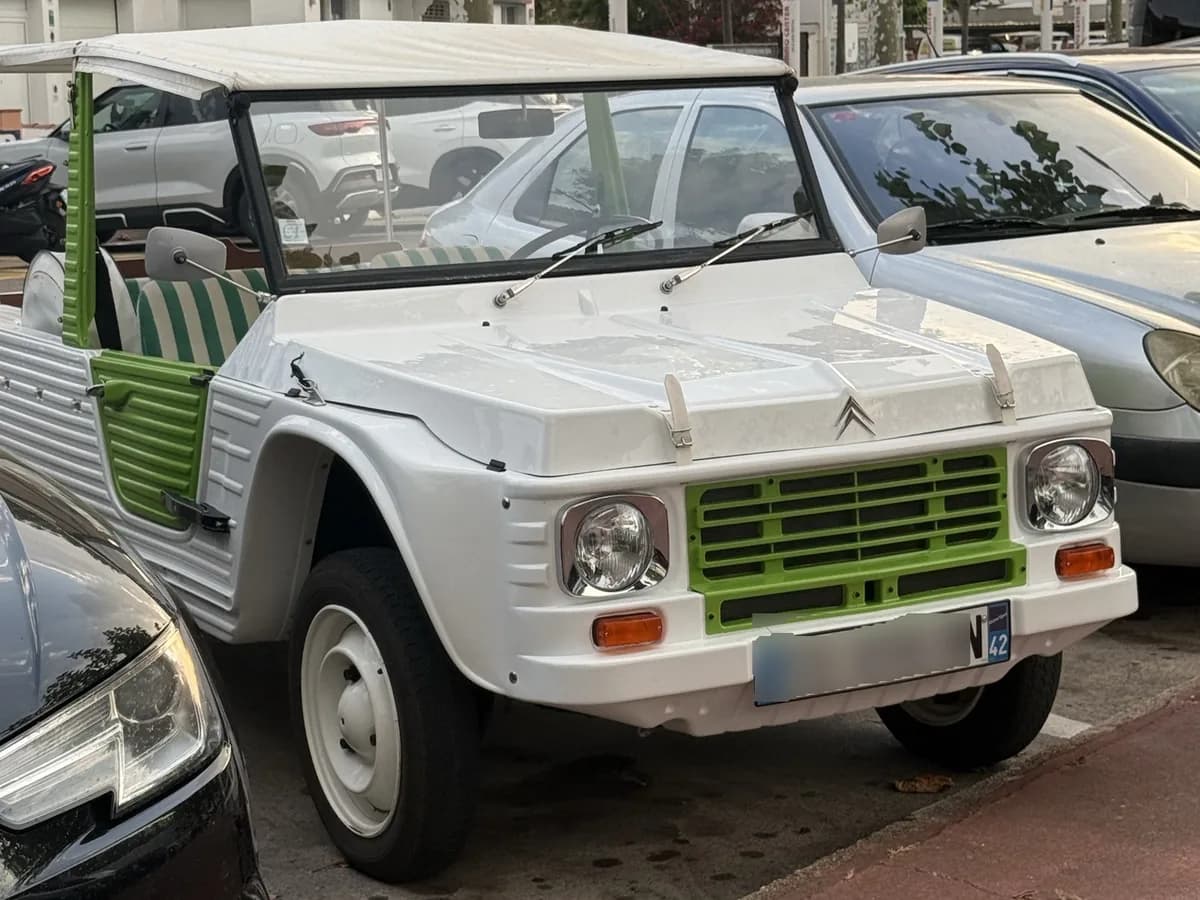
The classic Méhari is first identified by its extremely simple body made from smooth ABS plastic panels. It has a short, upright profile, an open cabin, separate front wings and a fabric top that can cover the occupants. Depending on the specification, the side doors may be simple removable panels rather than conventional framed doors. The two-cylinder mechanical layout and proportions related to the 2CV and Dyane family provide further clues. Dating an individual car requires more care. Early examples may have rectangular front indicators and different windscreen details from later cars. Vehicles from the late 1970s received a revised front end and dashboard. A spare wheel mounted on the bonnet, distinctive ground clearance and four-wheel-drive hardware suggest a 4x4, although restorations can alter external details. The E-Méhari is visibly more modern, with smoother bodywork, four seats, split-level lighting and no exposed A-Series mechanical character. Colour alone is not a reliable identifier because both original and electric cars were offered in bright, expressive finishes.
Important versions
Among the historic configurations, the two-seat Méhari served a more utilitarian purpose, while the four-seat layout embodied its leisure-car role. The Méhari 4x4, introduced in 1979 and built in small numbers into the early 1980s, is the most technically distinctive variant because of its four-wheel-drive system. The Azur limited edition, launched in 1983, combined white bodywork with blue trim and was aimed at a strongly coastal, recreational image. The Plage version was another special-market interpretation offered in parts of the Iberian market. In 2015, the E-Méhari reworked the concept around four seats and electric power. Limited editions such as Styled by Courrèges further emphasised the modern model’s design-led character rather than extending the mechanics of the original Méhari.
The name “Méhari” follows Citroën naming, with its rules and its exceptions. Decode a Citroën name
References
- Citroën célèbre les 50 ans de Méhari avec une Art Car E-MEHARICitroën / Stellantis Media
- New Citroën E-MEHARI: the all-electric cabriolet becomes a versatile carCitroën / Stellantis Media
- Citroën E-MEHARI disponible à partir de 299 euros/moisCitroën / Stellantis Media
- Citroën Méhari: 55 years and still inspiringCitroën / Stellantis Media
- https://www.media.stellantis.com/fr-fr/citroen/press/karl-zero-plus-branche-que-jamais-dans-une-vraie-fausse-pub-pour-e-meharimedia.stellantis.com
- https://www.media.stellantis.com/em-en/citroen/press/citroen-presents-the-limited-edition-new-e-mehari-styled-by-courregesmedia.stellantis.com
- https://www.media.stellantis.com/em-en/citroen/press/exploring-paris-with-4-roues-sous-1-parapluie-in-a-citroen-e-meharimedia.stellantis.com
Frequently asked questions
- What years was the Citroën Méhari produced?
- ScanRacer's referenced versions cover 1968 - 2016.
- How many Citroën Méhari examples are documented on ScanRacer?
- 6 published scans from 6 members, with the latest photo added in September 2026.