Citroën ID Sedan 1968
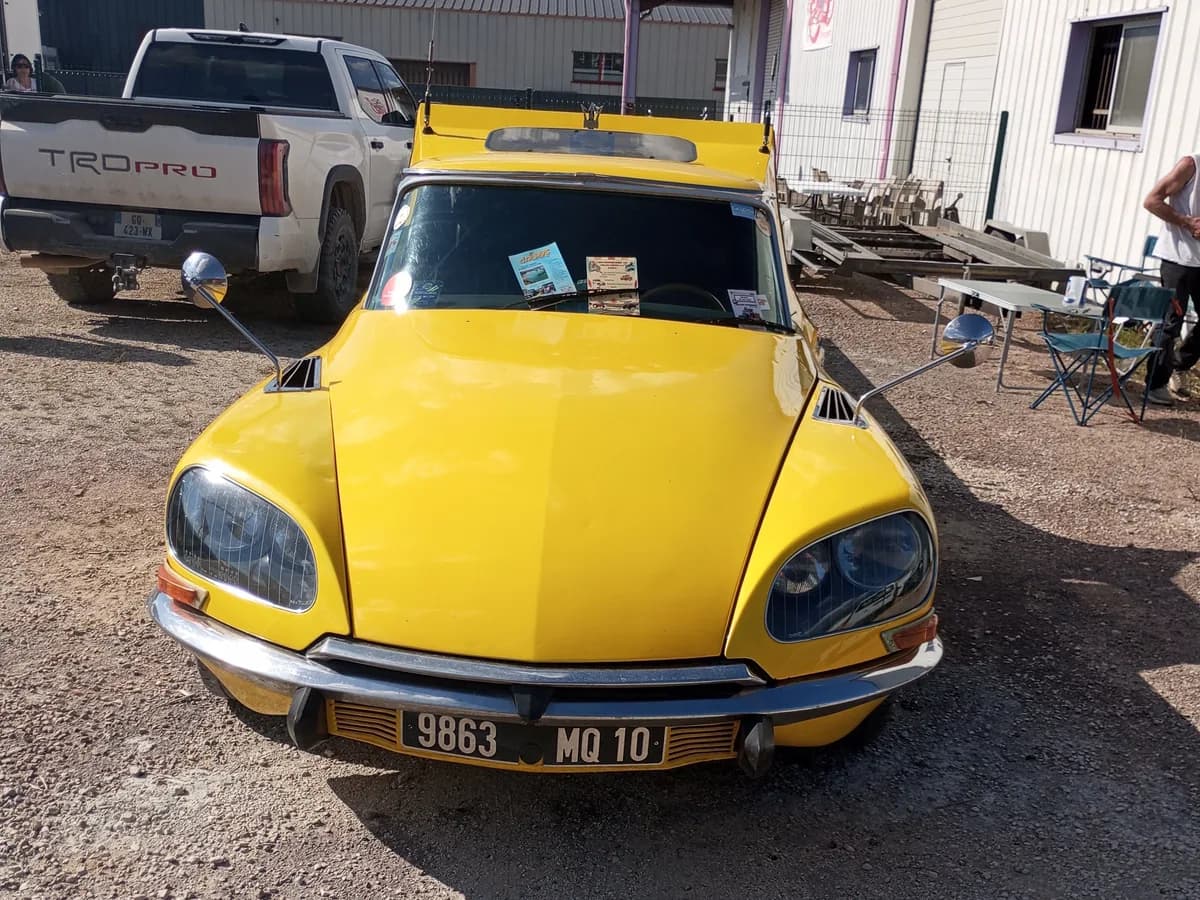
For the 1968 model year, the Citroën ID received a new front end with four headlamps arranged beneath a smooth glass cover. This sedan belonged to the D-series family created around the DS, but retained a simpler presentation and a conventional manual gearshift. Its significance therefore goes beyond its futuristic appearance: the car combined an aerodynamic body, self-levelling hydropneumatic suspension and a front-wheel-drive layout. The 1968 ID Sedan represents an important transition in Citroën’s large-car range, following the 1967 facelift and preceding the restructuring that would establish the ID 19 and ID 20 names more clearly. It offered a less expensive and less lavish interpretation of the flagship Citroën formula while preserving the engineering features that made the DS family distinctive.
History
The ID appeared in 1956 as a simpler derivative of the DS, sharing its body shell and hydropneumatic suspension. Citroën used it to make its large sedan more accessible by removing some of the DS’s complex equipment. The ID retained a manual gearbox and a driver-operated clutch, whereas the DS commonly used a hydraulically controlled semi-automatic transmission. The range developed gradually through mechanical improvements, revised trim and changing equipment levels. For the 1968 model year, a facelift developed under the direction of designer Robert Opron transformed the front of the car. The four headlamps were enclosed beneath a streamlined cover, while ID versions generally used fixed lamps; swivelling headlamps were associated with selected DS equipment levels or offered as an option on certain ID models. The redesign brought the ID visually closer to the DS without removing the distinction in specification and mechanical controls.
Latest scans
Photos added by the community for this page.
Anecdotes
The name “ID” is pronounced in French like “idée”, meaning “idea”, continuing Citroën’s wordplay around the DS name, pronounced like “déesse”, or “goddess”. The 1968 sedan also belongs to the first D-series generation fitted with the dramatic four-lamp front end beneath a glass cover. On ID models, swivelling headlamps were not universally standard as they were on some high-specification DS versions; their availability depended on the model and selected equipment.
Production
The exact production total for the 1968 Citroën ID Sedan is difficult to separate from the wider D-series figures. Published totals often combine ID and DS models, several body styles or multiple markets, without identifying the sedan built during one specific model year. It is therefore safer not to assign a precise number of cars to this version without a factory record covering the same scope. The sedan was nevertheless part of the ID family’s long commercial career, which began in the mid-1950s and continued until the range was reorganised in the early 1970s. Break models, export specifications and production outside France make surviving production statistics even harder to interpret consistently.
Press reception
Period tests and specialist publications generally identified the ID with suspension comfort, stability and strong road holding, while noting its less lavish specification compared with the DS. A Motor Sport road test of an ID 19 praised the car’s ability to absorb poor surfaces and its accurate handling, but also pointed to the substantial size and heavy steering during slow manoeuvres. That assessment captures the sedan’s character: it was better suited to long-distance travel and relaxed cruising than to quick urban responses. Contemporary commentary therefore treated the ID as more than a budget derivative. It remained a technically distinctive automobile, although its comfort-focused design brought compromises in weight, packaging and low-speed ease of use.
Evolution
Variants
References
- 70 years of DS historyStellantis Media
Supports the 1967 facelift, the 1968 model-year context and the later DS range developments.
- DS Automobiles: crisis and revival of the DS rangeStellantis Media
Supports the distinction between ID and DS, the role of the ID Super, and the later restructuring of the range.
- Citroën D Series 1958-1969Citroënët
Supports the 1968 front-end changes, fixed ID headlights and the 1969 ID 19 and ID 20 developments.
- Motor Racing review of the Slough-built ID19Citroënët, reproducing Motor Racing
Supports the period assessment of ride comfort, road holding, steering and long-distance character.
- 1968 Citroën ID19 brochureCitroënët
Provides access to period brochure material for the 1968 ID19 range.
- 1968 model development timelineIDDS.dk
Supports the 1968 front-end redesign, the distinction between fixed and swivelling headlights, and the subsequent ID19 and ID20 changes.
- https://www.autoencyclopedie.com/citroen-ds---id-1955-1975autoencyclopedie.com
Source found by OpenAI web search for this vehicle page.
- https://citroenclassics.wordpress.com/2012/06/13/factory-model-designations-for-all-citroen-ds-and-id-models-from-91965/citroenclassics.wordpress.com
Source found by OpenAI web search for this vehicle page.