
W16 Mistral
Unveiled in August 2022, the Bugatti W16 Mistral is a two-seat, mid-engined roadster that represents the road-going culmination of the marque’s W16 era. Bugatti developed it around the 1,600 PS version of its 8.0-litre quad-turbo engine, previously used in the Chiron Super Sport 300+. Although it shares engineering foundations with the Chiron family, the Mistral is not simply a Chiron with its roof removed: its open structure and bodywork were substantially redesigned. Key visual features include a wider horseshoe grille, air intakes behind the occupants and styling references to the historic Type 57 Roadster Grand Raid. Production was announced at 99 cars, with deliveries scheduled to begin in 2024. Bugatti completed the series in 2026, making the Mistral the final road-going model of the W16 generation. (newsroom.bugatti.com)
Variants by year
2024
Model summary
Data from the ScanRacer library, organized to compare versions quickly.
Model introduction
Unveiled in August 2022, the Bugatti W16 Mistral is a two-seat, mid-engined roadster that represents the road-going culmination of the marque’s W16 era. Bugatti developed it around the 1,600 PS version of its 8.0-litre quad-turbo engine, previously used in the Chiron Super Sport 300+. Although it shares engineering foundations with the Chiron family, the Mistral is not simply a Chiron with its roof removed: its open structure and bodywork were substantially redesigned. Key visual features include a wider horseshoe grille, air intakes behind the occupants and styling references to the historic Type 57 Roadster Grand Raid. Production was announced at 99 cars, with deliveries scheduled to begin in 2024. Bugatti completed the series in 2026, making the Mistral the final road-going model of the W16 generation. (newsroom.bugatti.com)
History
The W16 Mistral belongs to a story that began with the Veyron 16.4, launched in the mid-2000s with an 8.0-litre W16 engine and four turbochargers. Across the Veyron, Chiron and their derivatives, that architecture became one of the defining technical features of modern Bugatti. The Mistral is its final road-going expression. (newsroom.bugatti.com) Bugatti revealed the roadster during Monterey Car Week in 2022. Its name refers to the mistral, a powerful wind that travels through the Rhône Valley towards the Mediterranean. The designation was intended to suggest speed, elegance and the freedom associated with open-top driving. Bugatti also connected the car with its historic roadster tradition, particularly the Type 57 Roadster Grand Raid. (newsroom.bugatti.com) The manufacturer announced a run of 99 cars, all allocated before customer deliveries began, with a launch price of €5 million before taxes. First deliveries were scheduled for 2024. In July 2026, Bugatti confirmed that Mistral production had ended and that 99 cars had been built. This closed the road-going W16 chapter after two decades of development spanning the Veyron, Chiron and Mistral. (newsroom.bugatti.com)
Generations
The W16 Mistral is not a multi-generation model family. It is a limited-production model created to close the road-going chapter of Bugatti’s W16 engine. Within the announced production run, Bugatti did not present a separate generation, a series facelift or an internal successor carrying the Mistral name. Its model period is associated with deliveries beginning in 2024, while production ended in 2026. (newsroom.bugatti.com) The comparison with the Chiron requires some precision. The Mistral uses engineering foundations from the Chiron family and the 1,600 PS version of the W16, but Bugatti states that the monocoque and body were reworked for an open-top configuration. It has a distinct rear silhouette, air intakes positioned behind the occupants and aerodynamic development suited to the absence of a roof. It should therefore not be described simply as a convertible Chiron produced by removing the roof. (newsroom.bugatti.com) The clearest range distinction concerns individually specified cars rather than separate mechanical versions. Each example could receive a highly tailored combination of exterior colours, interior materials and trim through Bugatti’s personalisation process, but those choices did not create an official new generation. Differences between cars are therefore primarily related to specification, finish and customer commissioning rather than to a revised powertrain or chassis generation.
Key differences
The W16 Mistral is first distinguished by its roadster body and by its dedicated development work. Bugatti states that the structure was not simply opened by removing the roof: the monocoque was reworked to preserve stiffness and the vehicle’s proportions. The design features a more enveloping windscreen, prominent air intakes behind the seats and a rear section created specifically for the model. (newsroom.bugatti.com) Compared with the Chiron, the most significant difference is therefore the open-air driving experience rather than a different powertrain concept. The Mistral uses the 1,600 PS version of the quad-turbo W16, while its bodywork, cooling arrangements and aerodynamic components are adapted to the roadster format. Bugatti presents it as a distinct model, even though it shares engineering foundations with the Chiron. (newsroom.bugatti.com) It should also be separated from the Veyron Grand Sport Vitesse. The Mistral continues Bugatti’s roadster tradition, but belongs to a later technical and design generation and serves as the final road-going chapter of the W16.
Photo recognition
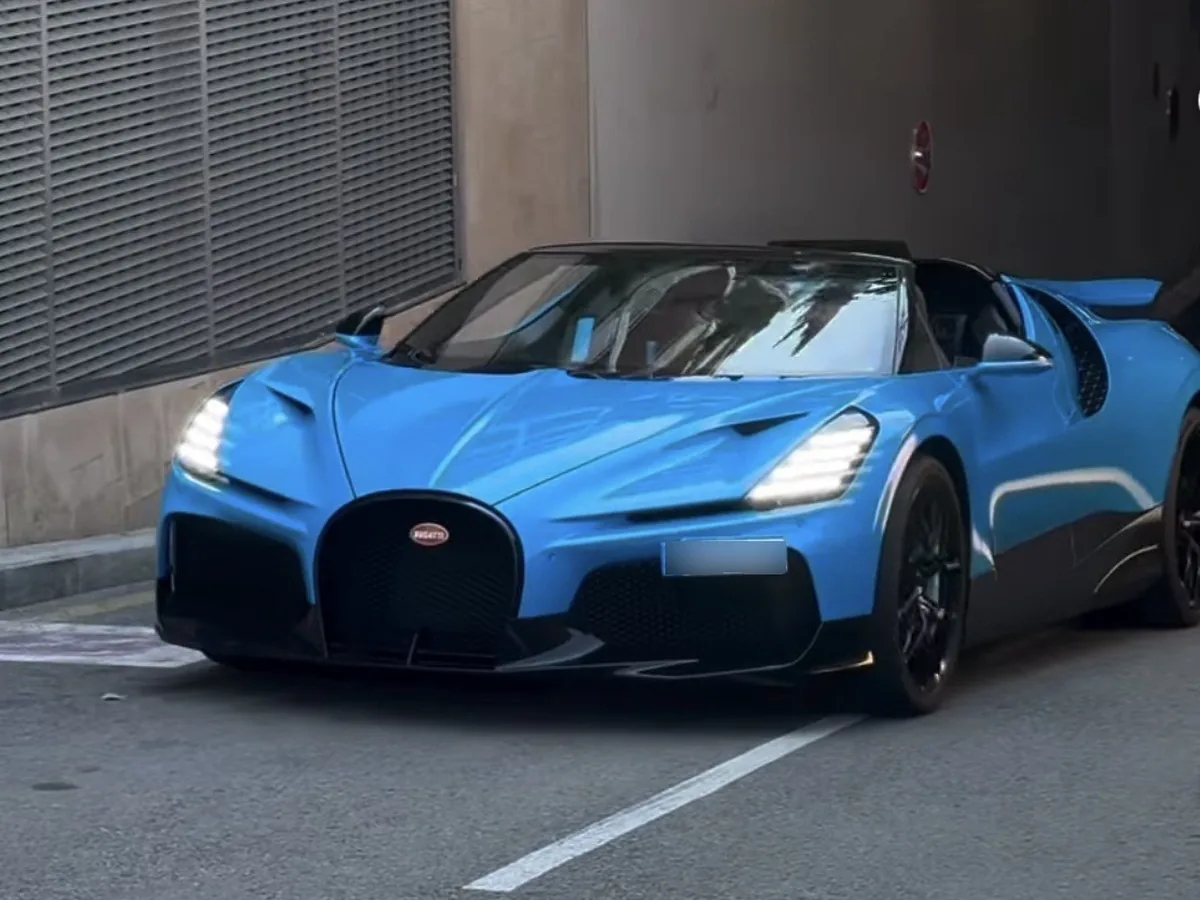
The most obvious identifier is the absence of a fixed roof combined with an extremely low and wide body. At the front, the Mistral uses a wider and deeper horseshoe grille than several earlier Bugatti models. The headlamps sit within slim outer elements, while the main air openings give the front end much of its visual structure. Bugatti says the central grille feeds the high-temperature radiator, while the side intakes focus on the intercoolers. (newsroom.bugatti.com) From the side, the two large air intakes behind the seats are especially useful recognition points. They feed the engine and emphasise the car’s open-top layout. The cabin is designed for two occupants, with a pronounced central division and the highly finished treatment associated with modern cars built in Molsheim. At the rear, thin horizontal lamps create a wide light signature beneath a tail that avoids a conventional fixed rear wing. To distinguish the Mistral from a modified Chiron, look for the complete combination of its dedicated windscreen, rear cockpit intakes, open body and roadster proportions. Exterior colours and interior trim can vary significantly from one car to another because all 99 examples were individually specified. (newsroom.bugatti.com)
Important versions
Bugatti presented the W16 Mistral as a single 99-car series rather than a range with several power levels or generations. Every car uses the 1,600 PS version of the 8.0-litre quad-turbo W16. Differences between individual cars are primarily the result of personalisation, including paint, interior materials, upholstery, trim and other finishing details. (newsroom.bugatti.com) The “Base” designation corresponds to the only variant represented in the library context, with a 2024 model period. It should be understood as a catalogue label rather than an official entry-level specification positioned against a more powerful Mistral. Bugatti’s public information focuses on a common mechanical specification and a high degree of individual commissioning across all 99 examples.
References
- Bugatti W16 Mistral: The ultimate roadsterBugatti Newsroom
- The last of its kind: Bugatti marks the end of production of the W16 MistralBugatti Newsroom
- Elegance at the extremes: Bugatti W16 MistralBugatti Newsroom
- https://newsroom.bugatti.com/api/en/press-releases/pdf/bugatti-w16-mistral-the-ultimate-roadsternewsroom.bugatti.com
- https://newsroom.bugatti.com/api/en/press-releases/pdf/bugatti-w16-mistral-elegance-at-extremesnewsroom.bugatti.com
- https://newsroom.bugatti.com/api/en/press-releases/pdf/w16-mistral-the-art-of-bringing-bugattis-ultimate-roadster-to-lifenewsroom.bugatti.com
- https://newsroom.bugatti.com/de/pressemeldungen/the-last-of-its-kind-bugatti-beendet-die-produktion-des-w16-mistralnewsroom.bugatti.com
Frequently asked questions
- What years was the Bugatti W16 Mistral produced?
- ScanRacer's referenced versions cover 2024.
- How many Bugatti W16 Mistral examples are documented on ScanRacer?
- 4 published scans from 4 members, with the latest photo added in August 2026.