
TT
The Audi TT entered series production in 1998, following its presentation as a concept at the 1995 Frankfurt Motor Show. Its deliberately minimalist design, defined by circular forms, rounded fenders, and a production body remarkably close to the show car, quickly made it one of Audi’s most recognizable models. The Coupé was followed by the Roadster in 1999. Across three generations, the TT retained its visual identity while gaining new engineering features, including turbocharged engines, quattro all-wheel drive, lightweight construction, Audi magnetic ride adaptive damping, and, from 2014, the Audi virtual cockpit digital instrument display. The ScanRacer model range covers the 1998–2014 period and includes both Coupé and Roadster body styles.
Variants by year
2014
 R
R2007

2006

1999
1998

Model summary
Data from the ScanRacer library, organized to compare versions quickly.
Model introduction
The Audi TT entered series production in 1998, following its presentation as a concept at the 1995 Frankfurt Motor Show. Its deliberately minimalist design, defined by circular forms, rounded fenders, and a production body remarkably close to the show car, quickly made it one of Audi’s most recognizable models. The Coupé was followed by the Roadster in 1999. Across three generations, the TT retained its visual identity while gaining new engineering features, including turbocharged engines, quattro all-wheel drive, lightweight construction, Audi magnetic ride adaptive damping, and, from 2014, the Audi virtual cockpit digital instrument display. The ScanRacer model range covers the 1998–2014 period and includes both Coupé and Roadster body styles.
History
The Audi TT project first appeared publicly in 1995, with a Coupé concept shown in Frankfurt and a Roadster study presented in Tokyo later that year. Audi retained much of the concept’s visual language for the production car. The TT Coupé reached the market in autumn 1998 and was built at Audi’s Győr plant in Hungary. The Roadster followed in 1999, using a two-seat open body with a fabric roof rather than the Coupé’s 2+2 layout. The first generation, identified internally as the 8N, combined an unconventional appearance with hardware related to other Volkswagen Group models. The 1.8-liter turbo engines were later joined by a 3.2-liter V6, while quattro all-wheel drive was available on selected versions. Audi also introduced its S tronic dual-clutch transmission during this generation. The second-generation 8J arrived in 2006 with styling more closely integrated into Audi’s broader design language and greater use of aluminum in its construction. It expanded the range with the TTS, TT RS, and TT 2.0 TDI quattro. Launched in 2014, the third generation revisited the original TT’s visual themes with sharper surfacing, a more driver-focused cabin, and a stronger emphasis on digital instrumentation.
Generations
The first generation, known as the 8N, spans 1998 to 2006. Its defining traits are the rounded bodywork, clean uninterrupted surfaces, and circular details such as the aluminum fuel-filler cap, round air vents, three-spoke steering wheel, and closely grouped exhaust outlets. The Coupé has a small rear bench, while the Roadster is strictly a two-seater. The engine range is centered on turbocharged four-cylinder units, with selected all-wheel-drive versions and a 3.2-liter V6 at the top of the line. The second generation, or 8J, arrived in 2006 for the Coupé and in 2007 for the Roadster. It remained visually related to the original TT but gained more sculpted flanks and a front end that aligned more closely with Audi’s design language of the period. This generation introduced Audi magnetic ride adaptive damping and broadened the performance range with the TTS and TT RS. The third generation, designated 8S, launched in 2014. It retained the compact silhouette, circular fuel cap, and distinctive roof profile, while adding a more angular Singleframe grille and an interior centered on the Audi virtual cockpit. For vehicles catalogued through 2014, the year can represent a transition between the outgoing 8J and the newly introduced 8S, depending on market and body style.
Key differences
The differences between generations are primarily visual, then technical. The 8N emphasizes rounded volumes and aluminum details, with a production design that remained close to the 1995 concept. The 8J looks wider and more sculpted, with more defined side surfaces and a more mature cabin; lightweight construction and Audi magnetic ride became important parts of its specification. The 8S adopts sharper surfacing, a more geometric grille, and a fully digital driver display. Performance badges also help distinguish versions. The TTS is the sportier step above the regular TT. The TT RS is more extreme, identified by its turbocharged five-cylinder engine and stronger performance focus. Introduced during the second generation, the TT 2.0 TDI quattro is a notable departure from the model’s usual identity, combining the compact sports-car body with diesel power and all-wheel drive. Equipment, engines, and transmissions varied between markets, so reliable identification should combine the model year, body-generation code, exterior details, and vehicle documentation rather than relying on a single badge.
Photo recognition
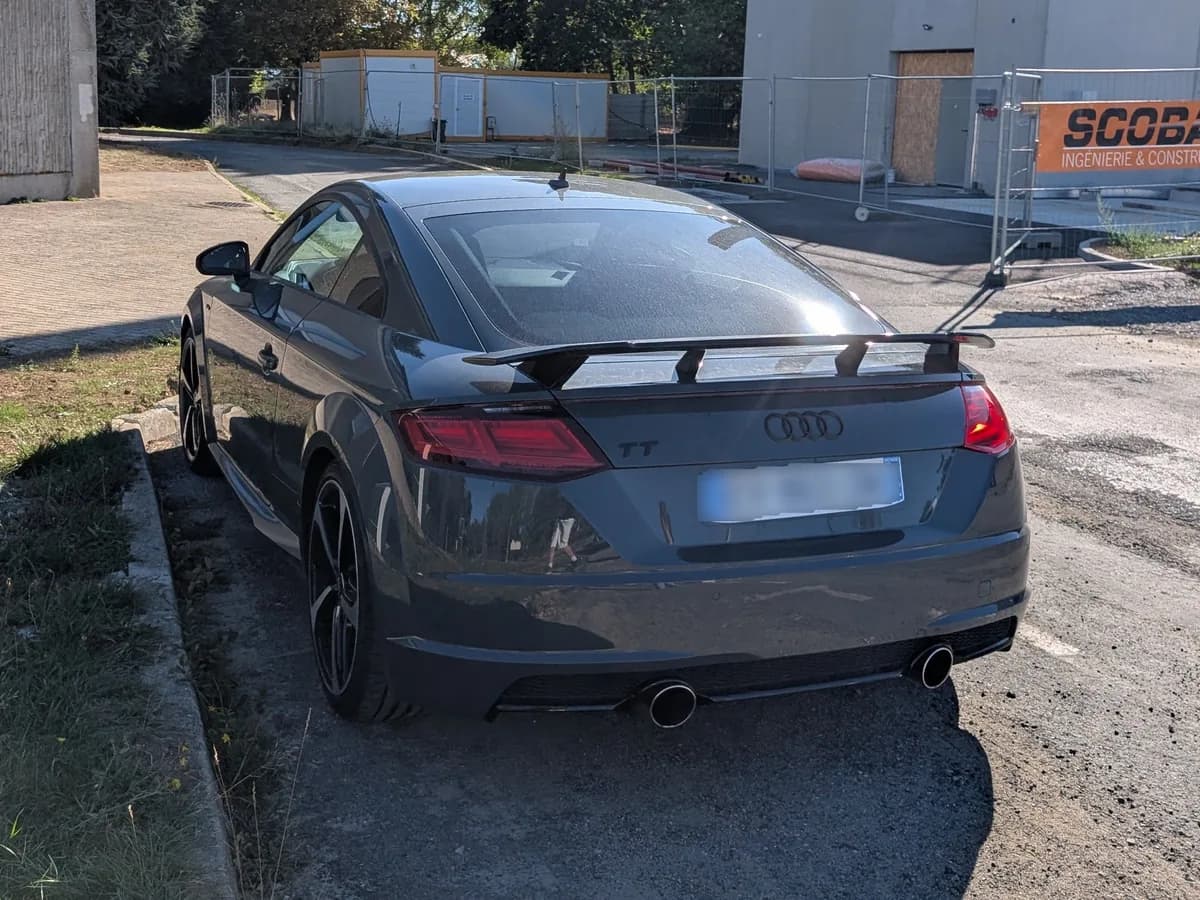
A first-generation TT is identified by its compact rounded body, arched roofline, and circular aluminum fuel-filler cap. Round air vents, integrated door handles, and closely spaced exhaust outlets are additional clues. The Coupé has a small glazed rear section and rear seats, while the Roadster uses a soft top and has two seats. The 8J retains the circular fuel cap and the overall TT profile but adds more sculpted side panels, longer-looking lamps, and a wider front grille. TTS and TT RS models generally have dedicated performance details, although the exact bumpers, wheels, and trim depend on year and market. The 8S can be recognized by its lower, more angular Singleframe grille, tighter body lines, and a cabin in which the main display is incorporated into the instrument cluster rather than placed in the center of the dashboard. Badges, wheels, and bumpers may be changed during a car’s life, so identification is more reliable when several design features are checked together.
Important versions
Several TT versions have particular historical importance. The first-generation TT 1.8 T represents the model’s core formula, combining compact dimensions with turbocharged power. The TT 3.2 quattro added a naturally aspirated six-cylinder engine and all-wheel drive to the 8N range. On the 8J generation, the TTS increased performance while remaining below the more focused TT RS, whose turbocharged five-cylinder engine became its defining mechanical feature. The TT RS plus took that approach further in selected configurations. The TT 2.0 TDI quattro deserves separate mention because Audi described it as the first production sports car with diesel power. Availability and specification varied by country and model year, so these names should be treated as version identifiers rather than universal equipment descriptions.
The name “TT” follows Audi naming, with its rules and its exceptions. Decode a Audi name
References
- The Audi TT: an icon of brand historyAudi
- History: The Audi TT and Audi TTS until 2023Audi
- Audi TT 1998–2006Audi Tradition
- Audi TT: Modelle, Technische Daten, PreiseADAC
- New Audi TT meets its ancestorsAutocar
- https://www.audi-mediacenter.com/en/the-audi-tt-and-audi-tts-until-2023-11105/downloadaudi-mediacenter.com
Technical specifications
Structured data available for versions linked to this model.
| Version | Power | Torque | Top speed | Drivetrain | Fuel |
|---|---|---|---|---|---|
| — | 200 chevaux pour la version 2.0 TFSI et 250 chevaux pour la version V6 3.2 | — | — | Traction avant pour la version 2.0 TFSI et transmission intégrale quattro pour la version V6 3.2 / Boîte manuelle à six rapports ou boîte S tronic à double embrayage | — |
Frequently asked questions
- What years was the Audi TT produced?
- ScanRacer's referenced versions cover 1998 - 2014.
- How many Audi TT examples are documented on ScanRacer?
- 15 published scans from 14 members, with the latest photo added in September 2026.
- What is the power output of the Audi TT?
- The sourced technical data lists 200 chevaux pour la version 2.0 TFSI et 250 chevaux pour la version V6 3.2.