
RS e-tron GT
The Audi RS e-tron GT is a four-door electric grand tourer with two permanent-magnet synchronous motors and quattro all-wheel drive. For 2024, the RS version is rated at up to 475 kW in temporary boost mode, equivalent to approximately 646 horsepower in Audi’s technical documentation, with maximum torque of 830 Nm. Its lithium-ion battery stores 93.4 kWh gross and 83.7 kWh net, while the 800-volt electrical system supports DC fast charging at up to 270 kW. Audi quotes a 0–100 km/h time of 3.3 seconds with boost and an electronically limited top speed of 250 km/h. The car combines a low coupé-like profile with advanced suspension hardware and a driver-focused cabin. In the ScanRacer library, the 2024 coverage contains Base and Performance variants.
Variants by year
2024

Model summary
Data from the ScanRacer library, organized to compare versions quickly.
Model introduction
The Audi RS e-tron GT is a four-door electric grand tourer with two permanent-magnet synchronous motors and quattro all-wheel drive. For 2024, the RS version is rated at up to 475 kW in temporary boost mode, equivalent to approximately 646 horsepower in Audi’s technical documentation, with maximum torque of 830 Nm. Its lithium-ion battery stores 93.4 kWh gross and 83.7 kWh net, while the 800-volt electrical system supports DC fast charging at up to 270 kW. Audi quotes a 0–100 km/h time of 3.3 seconds with boost and an electronically limited top speed of 250 km/h. The car combines a low coupé-like profile with advanced suspension hardware and a driver-focused cabin. In the ScanRacer library, the 2024 coverage contains Base and Performance variants.
History
The RS e-tron GT was introduced as Audi Sport’s first fully electric model carrying the RS designation. It was developed as a grand tourer rather than simply as an electric sedan, with an emphasis on rapid acceleration, high-speed stability and long-distance comfort. Audi launched it in February 2021 alongside the e-tron GT quattro. The car uses an 800-volt electrical architecture and places one electric motor on each axle. A two-speed automatic transmission is fitted to the rear motor, helping the car combine strong launch performance with efficiency at higher speeds. The RS e-tron GT subsequently evolved without changing its basic role in Audi’s range. Audi’s May 2024 technical sheet lists the familiar 93.4-kWh gross battery, 270-kW DC charging capability and temporary peak output of 475 kW. In June 2024, Audi announced a revised e-tron GT family for the following model year, including the RS e-tron GT performance. That derivative introduced a larger battery, higher output and dedicated functions such as RS performance mode and push-to-pass. It should therefore not automatically be treated as the same vehicle as the standard 2024 RS e-tron GT.
Generations
The RS e-tron GT is not divided into several officially named generations in the Audi sources reviewed. It belongs to the first generation of the e-tron GT family, launched in 2021 and closely related to the electric platform used by the Porsche Taycan. This first generation is defined by its four-door grand-touring body, dual electric motors, 800-volt battery system and all-wheel drive. For 2024, the RS e-tron GT retains the launch-era technical layout in Audi’s documentation: a 93.4-kWh gross battery, 83.7 kWh net capacity, DC charging up to 270 kW and a two-speed rear transmission. Quoted performance includes 3.3 seconds from 0 to 100 km/h using boost power and an electronically limited top speed of 250 km/h. Audi revealed a major range update during 2024 for the following model year. It added the S e-tron GT and RS e-tron GT performance, with a 105-kWh gross battery and charging capability of up to 320 kW. These changes represent a significant development of the model family, but the available evidence does not establish a completely new generation.
Key differences
Within the ScanRacer context, the two 2024 entries are named Base and Performance. These should be treated as library variant labels because Audi did not market the U.S. 2024 RS e-tron GT simply as two trims called Base and Performance. The standard 2024 RS e-tron GT is documented with 440 kW nominal peak output, up to 475 kW in boost, a 93.4-kWh gross battery and 270-kW DC charging capability. Audi also announced the RS e-tron GT performance in 2024 as part of the family’s next technical evolution. It uses a 105-kWh gross battery, can reach up to 680 kW in launch-control output and supports DC charging at up to 320 kW. Market availability and model-year terminology can vary by country, so the safest interpretation is to regard Base as the conventional 2024 RS e-tron GT and Performance as the more extreme derivative represented in the library. Exact equipment differences should not be inferred where the available variant data does not specify them.
Photo recognition
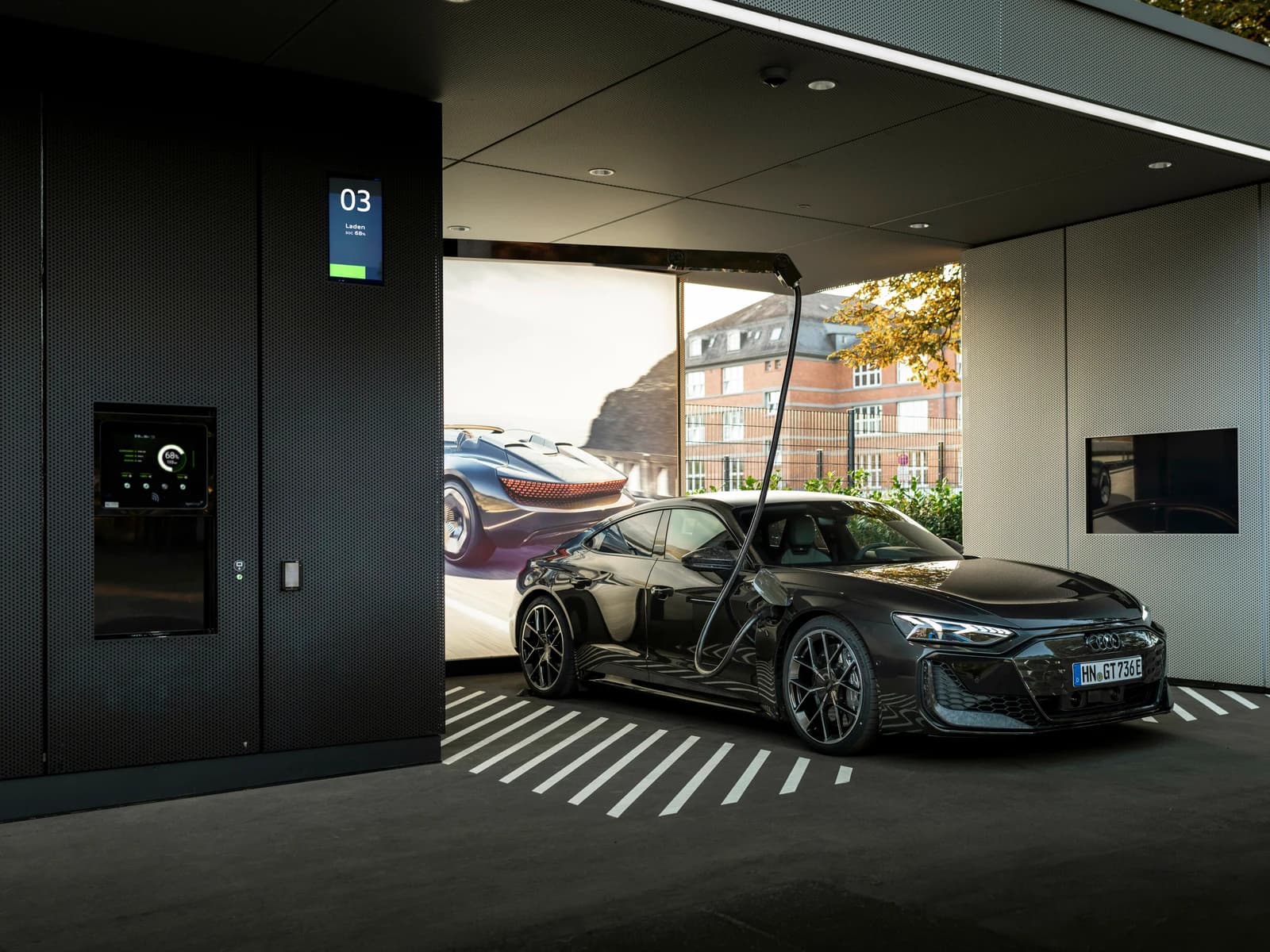
The RS e-tron GT is first identified by its very low grand-touring shape, with a sloping roofline, a long visual hood and a four-door body. Its front end is largely closed, reflecting the electric powertrain, while retaining Audi’s broad Singleframe grille in a mostly graphic form. Side air inlets and dark exterior surfaces give the nose a more focused appearance. RS-specific details are the most useful clues: RS badges, more assertive bumpers, large-diameter wheels, upgraded brakes and exterior trim that may be finished in black or carbon depending on specification. The side profile has steeply angled pillars and pronounced wheel arches, while the rear uses a full-width light signature and a diffuser-like lower section. Inside, a sport steering wheel, low seating position and driver-oriented digital displays support the RS identity. Equipment and trim combinations differ between markets, so no single visual detail can reliably separate the Base and Performance entries without documentation or a complete vehicle specification.
Important versions
The 2024 RS e-tron GT is the performance model in the first e-tron GT family. Audi documents it with two electric motors, all-wheel drive, 830 Nm of torque, a 93.4-kWh gross battery and temporary peak output of 475 kW. It is positioned above the e-tron GT quattro through its higher output and sport-oriented calibration. The RS e-tron GT performance announced during 2024 represents the next step in the range. It uses a 105-kWh gross battery, faster charging hardware and dedicated functions including RS performance mode and push-to-pass. In the supplied library, these two directions are represented by the Base and Performance entries, both associated with the 2024 year.
The name “RS e-tron GT” follows Audi naming, with its rules and its exceptions. Decode a Audi name
References
- Audi RS e-tron GT technical data sheet, 440 kWAudi MediaCenter
- Audi’s most powerful production vehicle: the new RS e-tron GT performanceAudi MediaCenter
- S e-tron GT / RS e-tron GT performance modelsAudi USA Media
- Electric performance halo 2022 Audi RS e-tron GTAudi USA Media
- Emotive design and revolutionary technology: the Audi e-tron GT quattro and RS e-tron GTAudi MediaCenter
- https://www.audi-mediacenter.com/en/press-releases/spearheading-the-electric-offensive-rs-e-tron-gt-prototype-proves-its-mettle-in-initial-tests-13337audi-mediacenter.com
- https://uploads.audi-mediacenter.com/system/production/car_motorizations/1392/file_en/91bfc69ec55530e277b5023245b77c1c82772920/eTD-Audi-RS-e-tron-GT-performance-550kW_240618.pdf?1718688537=&disposition=attachmentuploads.audi-mediacenter.com
- https://www.audi-mediacenter.com/de/emotionales-design-und-revolutionaere-technikder-audi-e-tron-gt-quattro-und-der-audi-rs-e-tron-gt-2021-13655/positionierung-13658audi-mediacenter.com
Frequently asked questions
- What years was the Audi RS e-tron GT produced?
- ScanRacer's referenced versions cover 2024.
- How many Audi RS e-tron GT examples are documented on ScanRacer?
- 16 published scans from 1 member, with the latest photo added in July 2026.